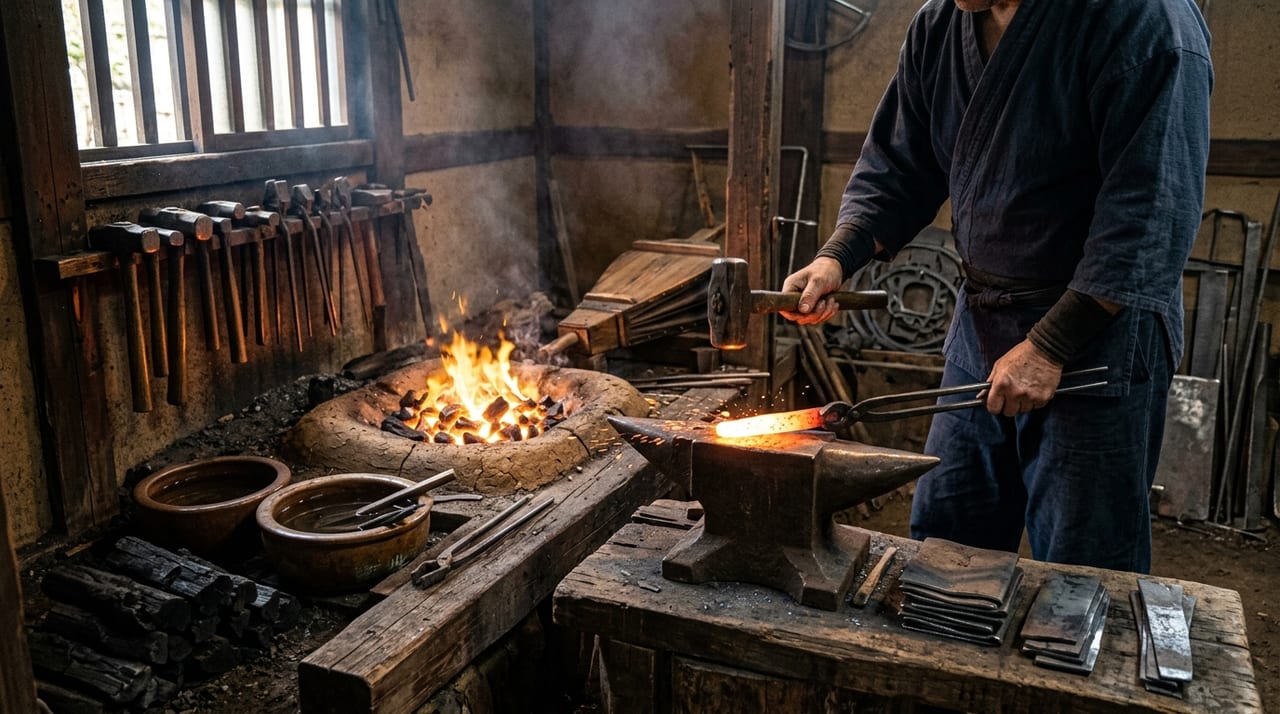
 * Image is for illustrative purposes only.
Chikuzen Samonji
筑前左文字
Description
Samonji was a swordsmith who was active in Hakata, Chikuzen Province (present-day Fukuoka Prefecture), in the early Nanboku-chō period. His birth and death years are unknown. He is said to have been the son of the Chikuzen smith Jitsua. His common name was Saemon Saburō, his secular name Yasuyoshi, and his Buddhist name Genkei. Because he cut only the single character “Sa” as his signature, he came to be called Samonji in later ages. The first generation, who was especially skilled, is called “Ō-Sa” to distinguish him from other smiths of the same name in the school. He is said to have studied under the famous Kamakura smith Masamune of Sagami Province, and he is counted among the Masamune Juttetsu, the ten great disciples of Masamune. As the person who brought the new Sōshū-den into the Kyūshū tradition, which had mainly consisted of archaic tachi-making, he is placed as the founder of the Kyūshū Sōshū-den.
His style shows the Sōshū-den, with a bright, clear jigane, well-developed nie, and deep nioiguchi. The jigane shows thick ji-nie and abundant chikei. The hamon is based on notare and gunome, and the activity of the nie has vigor. Whereas the old Kyūshū blades, which mainly had suguha, had an archaic character, the works of Samonji stand in contrast to them, bright and splendid, with the refined appearance of the Nanboku-chō period. Above all he is renowned for his tantō, whose well-balanced form was taken as a model in later ages.
Many of the signed representative works are designated National Treasures or Important Cultural Properties. The tachi “Kōsetsu Samonji” (blade length 78.2 cm) is the only National Treasure among the signed tachi by Samonji, and it is now held by the Fukuyama Museum of Art (Fukuyama, Hiroshima Prefecture). The tantō “Sa Chikushū-jū” was named “Taikō Samonji” after its cherished ownership by Toyotomi Hideyoshi. It is likewise a famous tantō designated as a National Treasure, and it is also transmitted at the Fukuyama Museum of Art. It is an excellent piece that clearly shows the Samonji style, with “Sa” cut on the front of the nakago and “Chikushū-jū” on the reverse.
His disciples included the second Yasuyoshi, as well as Yoshisada, Sadayoshi, and Yukihiro. As the Samonji school, they firmly established the Sōshū-den throughout Chikuzen in the Nanboku-chō period. Many works of the school have come down to the present, among them blades valued by warlords, such as the “Sōsan Samonji” (Yoshimoto Samonji) (Important Cultural Property), which passed through the hands of the masters of the realm, Oda Nobunaga, Toyotomi Hideyoshi, and Tokugawa Ieyasu. Samonji himself is rated as saijō-saku (the highest rank of master smith) even in the sword appraisal of the shintō period, and he holds a firm place in the history of swords, both as a master representing Kyūshū and as a great master who inherited the orthodox line of the Sōshū-den.
Famous Works
- Kōsetsu Samonji (named)
- Sōzō Samonji (named)