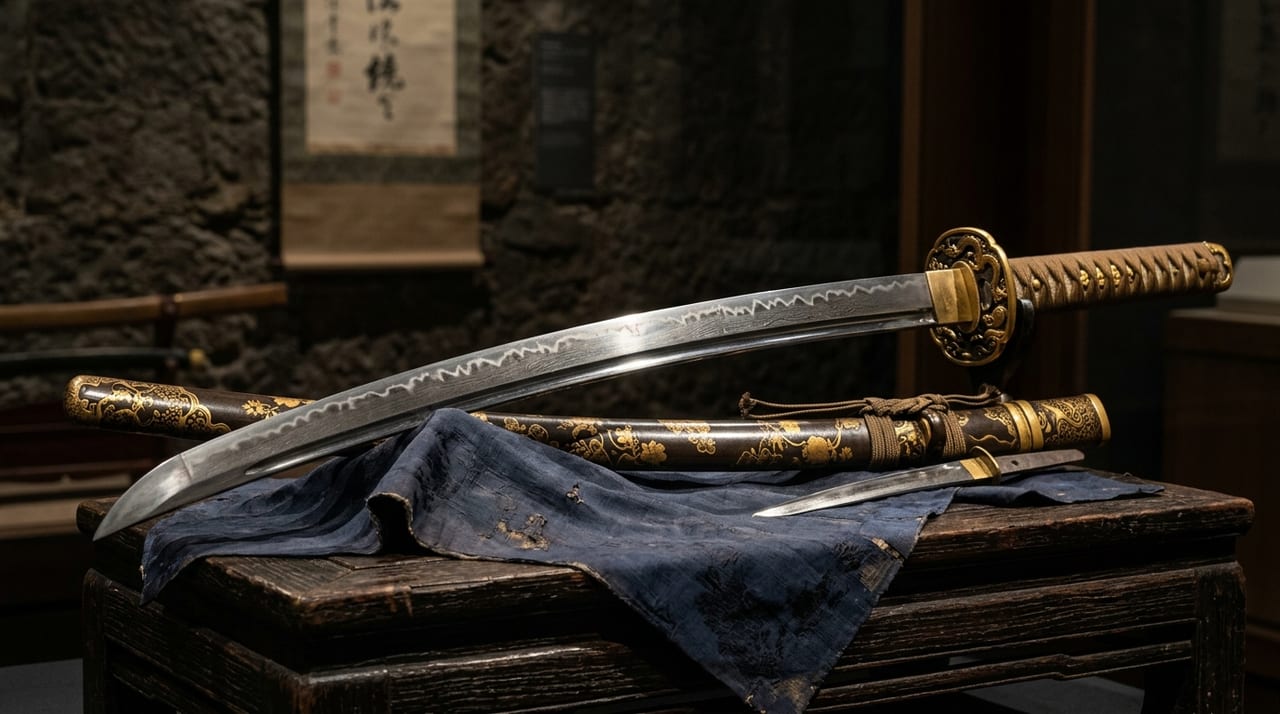
 * Image is for illustrative purposes only.
Osafune Nagamitsu
長船長光
Also known as: Nagamitsu
Description
Overview of the Sword
Bizen Osafune Nagamitsu (備前長船長光) was a master craftsman who flourished in the late Kamakura period (latter half of the 13th century to early 14th century) in Osafune, Bizen Province (present-day Setouchi City, Okayama Prefecture). As the son and successor of Mitsutada (光忠), the founder of the Osafune school, he inherited his father's great achievements while pioneering his own distinctive path, becoming one of the supreme master swordsmiths in Japanese sword history. Nagamitsu's father, Mitsutada, was a pioneering figure who elevated the Osafune school to the pinnacle of Bizen swords alongside the Ichimonji school. Nagamitsu inherited this technique while responding to the social demands of the late Kamakura era—military tensions following the Mongol invasions and the expansion of samurai society—producing an enormous number of works. He possesses multiple National Treasures and stands foremost among the Osafune school in the number of extant works.
Nagamitsu's Technique and Style
The jigane of Nagamitsu's tachi is a finely packed ko-itame with midare-utsuri, typical of the Bizen tradition. The hamon displays a richly varied landscape combining ko-midare, gunome, and chōji. His style evolved from his father Mitsutada's "neat large chōji" toward "more complex and varied irregular hamon." Nagamitsu's hamon, collectively called "Osafune-mono" (長船物), stands out among Bizen swords for its particular diversity, and even among blades bearing the same signature "Nagamitsu," one is struck by the breadth of his working styles. His bōshi is characteristic, turning slightly in notare from the yokote, a form known as the "sansaku bōshi." Besides tachi he made ko-dachi, naginata and ken, but tantō by him are extremely rare.
The Mongol Invasions and Nagamitsu's Era
The latter half of the 13th century when Nagamitsu flourished was an age of historical upheaval marked by two Mongol invasions—the Bunei Campaign (1274) and the Kōan Campaign (1281). This war against foreign forces brought major changes to Japanese samurai society, transforming warfare from individual duels to group tactics and infantry combat. In the tense political situation following the Mongol invasions, Nagamitsu sent out many tachi together with his son Kagemitsu and pupils such as Sanenaga and Nagamoto, and it has been pointed out that some of the later works signed Nagamitsu include pieces made by his pupils on his behalf.
Representative Transmitted Works
The most celebrated representative work of Nagamitsu is the National Treasure tachi "Daihannya Nagamitsu" (大般若長光) housed in the Tokyo National Museum. This tachi was valued at 600 kanmon in the Muromachi period, and was named "Daihannya Nagamitsu" after the Daihannya Sutra, which consists of 600 scrolls. The blade length is approximately 73.6 cm, and the magnificent chōji-midare hamon exemplifies Nagamitsu as a master craftsman. Among Nagamitsu's dated signed works, the Important Cultural Property "Tachi, signed: Made by Sakon-shōgen Nagamitsu of Osafune, Bizen Province / 10th month of Shōō 2" in the Hayashibara Museum of Art is well known.
Establishment of the Osafune School and Its Influence on Posterity
Through Nagamitsu's activities, the place name "Osafune" became synonymous throughout the nation with "Japan's finest swordsmithing center." The term "Osafune-mono" continued to serve as the expression of the highest evaluation of Bizen swords. The lineage of the Osafune school continuing through Nagamitsu's son Kagemitsu (景光) and grandson Kanemitsu (兼光) remained at the center of Japanese sword culture through the period of the Northern and Southern Courts. The "beauty that does not lose dignity amid rich variation" established by Nagamitsu became the standard for all subsequent Osafune smiths, and even after seven hundred years, in the modern era, the name Bizen Osafune Nagamitsu remains unshakeable as one of the supreme swordsmiths in Japanese sword history.
Modern Evaluation
In modern sword appraisal, the authenticity of Nagamitsu's signature is deemed paramount. Because the name Nagamitsu was so celebrated, many swords bearing falsely inscribed "Bizen Osafune Nagamitsu" signatures circulated in later periods. The existing confirmed signed works by Nagamitsu are very highly regarded; National Treasure and Important Cultural Property designated works hold the highest rank in Japanese sword collections. Regular exhibitions at the Tokyo National Museum provide the finest opportunity for conveying Nagamitsu's artistic excellence to the contemporary world.
Comprehensive Evaluation and Legacy of Nagamitsu
Bizen Osafune Nagamitsu inherited the tradition established by his father Mitsutada and the Osafune school, and elevated it to even greater heights. Against Mitsutada's majestic beauty, Nagamitsu succeeded in adding a new dimension of elegance and precision. So profound was Nagamitsu's influence on the formation of subsequent Bizen sword culture that one might say all post-Nagamitsu Bizen smiths were unable to forge without conscious awareness of Nagamitsu's aesthetic principles. Nagamitsu's fine signed works, beginning with the tachi dated Shōō 2 (1289), serve as crucial evidence demonstrating the pinnacle of Kamakura-period Japanese sword technique, and continue to be referenced at the forefront of modern sword research. Maintaining first-rank evaluation even after seven hundred years, Nagamitsu's blades preserve their position at the apex of Japanese sword history through their universal beauty transcending time. The designation of Nagamitsu's works as National Treasures—the highest level of protection under the Cultural Properties Protection Law—represents both official recognition of their historical and artistic value and an expression of the pride and responsibility Japan as a nation holds toward its sword culture. Nagamitsu's blades are neither mere weapons nor craft objects, but cultural indicators demonstrating the spiritual heights of Japanese civilization, and will continue to shine before humanity for generations to come.
Legends & Stories
Impact of the Mongol Invasions and the Role of Osafune Blades
The Mongol invasions of 1274 and 1281 dealt severe shock to Japanese samurai society. Traditional one-on-one mounted combat proved ineffective against organized Yuan tactics, poisoned arrows, and tetsuhatsu (exploding shells), forcing fundamental reconsideration of Japan's weapons systems. Osafune Nagamitsu's workshop stood at the vanguard of this transformation. In this era Nagamitsu continued to produce high-quality work without compromising the beauty of the Bizen tradition. His pursuit of both "practical effectiveness" and "beauty" embodied the strength and flexibility of Japanese samurai culture overcoming national crisis.
Legacy to Kagemitsu and Kanemitsu
Nagamitsu's son Kagemitsu inherited the most refined aspects of his father's broad output, becoming a master smith at the peak of late Kamakura and early Nanbokuchō periods. Kagemitsu's technical inheritance—"the frog's child is a frog"—demonstrates the strength of the Osafune foundation Nagamitsu established. Kanemitsu, Kagemitsu's son, flourished during Nanbokuchō as the "peak of the bold age" of Osafune blades. The lineage Nagamitsu—Kagemitsu—Kanemitsu ranks among the finest in all Japanese sword history. Through three generations, the seeds Nagamitsu sowed bore fruit; his name was permanently inscribed in sword history alongside his descendants' achievements.
Cultural Significance of the Term "Osafune-mono"
"Osafune-mono" is known as the term for works by the swordsmiths of Bizen Osafune, and the smith who best represents that renown is Nagamitsu at the school's peak. Today "Bizen Osafune" remains nationally known as a sword center. Osafune Town in Setouchi City, Okayama Prefecture, hosts the Bizen Osafune Sword Museum and Heritage Center, welcoming many visitors. This place-name recognition testifies to the deep imprint Nagamitsu and the Osafune smiths left on Japanese culture.
Significance of the Shōō 2 (1289) Signed Tachi
Nagamitsu's masterworks include the Daihannya Nagamitsu (Tokyo National Museum, National Treasure) and the Tsuda Tōtōmi Nagamitsu (Tokugawa Art Museum, National Treasure). Unusually for Kamakura smiths, Nagamitsu left many dated signed works spanning Shōō 2 (1289) to the Kagen era (1303–1306). The oldest dated signed work bears the Shōō 2 (1289) signature, concentrating his pursuit of beauty amid post-invasion tension. Encountering this tachi, we touch not merely beauty but the very atmosphere of that historical turning point and the resolve of Japanese samurai culture confronting it.
Nagamitsu and Masamune—Dialogue Across Generations
Nagamitsu's later years were close in time to the active period of Masamune, the Kamakura smith and giant of the Sōshū tradition. Bizen tradition's "reflection and clove beauty" and Soshu tradition's "ground-boil turbulence and gold-line flash" construct contrasting aesthetics. That contrast hints at two contemporary masterworks aware of each other, born from mutual tension. In the golden age—late Kamakura through Nanbokuchō—Nagamitsu's Osafune blade and Masamune's Soshu blade stood as opposing peaks, illuminating each other. Without Nagamitsu, Masamune's value halves; without Masamune, Nagamitsu's halves. The two geniuses, historically inseparable, expanded Japanese blade aesthetics to fullest extent.
Osafune Nagamitsu in the Modern Era
Modern sword enthusiasts position Osafune Nagamitsu as "the orthodox ideal of Bizen tradition." His reputation remains unchanged seven centuries later. When confirmed signed works display, sword lovers gather in multitudes, offering silent praise before his reflections and clove-temper patterns. Facing a Nagamitsu blade, the viewer touches a miraculous crystal of beauty born from Bizen iron sand, water, and flame, experiencing direct connection to Japanese culture's depths. Osafune Nagamitsu remains an eternal standard marking Bizen's peak for all who love the Japanese blade. His blades crystallize Kamakura's spirit—robust and refined, practical and artistic—in perfect form. Its radiance strikes fresh across seven centuries. As one of Japanese sword culture's greatest artistic achievements, Osafune Nagamitsu's name and works endure eternally.