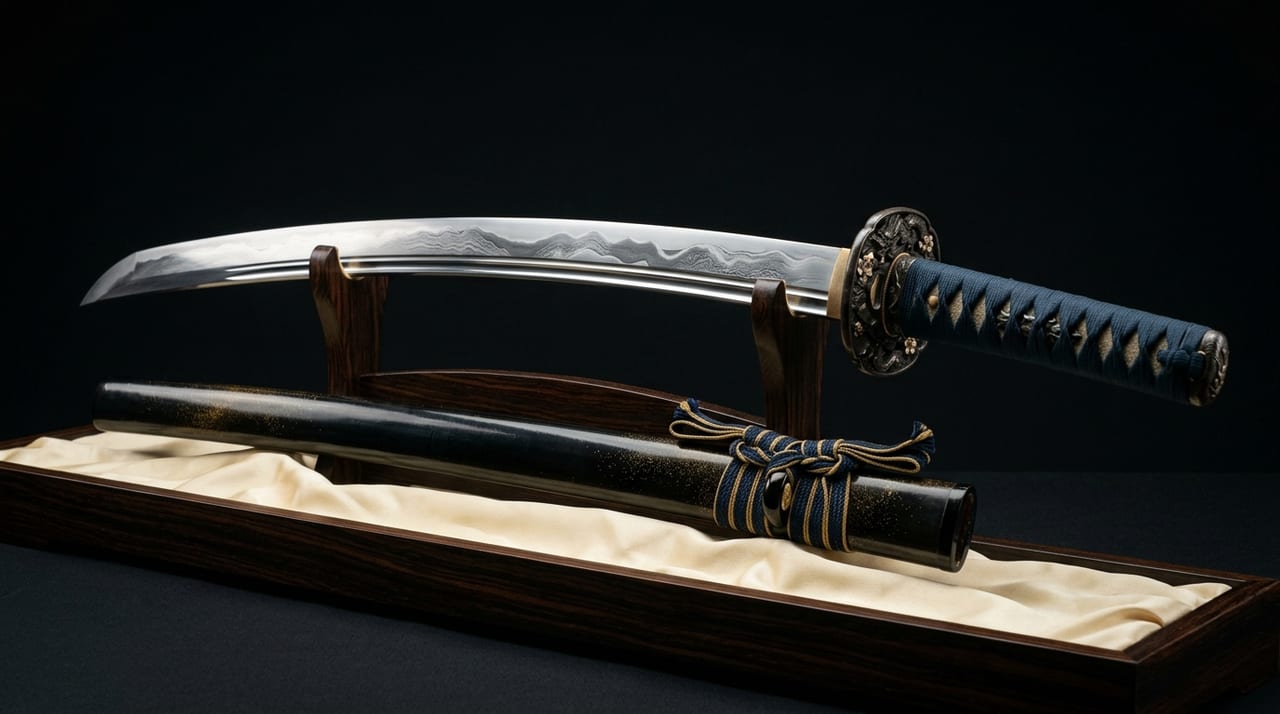
 * Image is for illustrative purposes only.
Nankaitarō Tomotaka (Chōson)
南海太郎朝尊
Also known as: Nankaitarō — Bakumatsu-era swordsmith and sword scholar of Tosa
Description
Nankaitarō Tomotaka (Chōson) — a Late-Edo Swordsmith of Tosa
Nankaitarō Tomotaka (Chōson) was a swordsmith from Tosa Province (present-day Kōchi Prefecture) who was active in the late Edo period (the bakumatsu era). He is said to have been born around Bunka 2 (1805), and his real name is recorded as Morioka Tomonosuke. “Nankaitarō” was one of the names he used, and he left works including large ōdachi (nodachi).
Tomotaka's Training and Style
Tomotaka is said to have gone up to Kyoto during the Bunsei era and entered under Iga no kami Kanemichi. He also forged blades in Edo and sympathized with the fukkotō theory (the theory of reviving ancient-style swords) advocated by Suishinshi Masahide of Edo. Around the latter half of the Tenpō era he based himself in Kyoto, also made swords in Tosa and Ōsaka, and in his later years lived in Iwakura (Hatae), Kyoto. He used several signatures, including “Yamashiro no kuni Nishijin jū Chōson,” “Tosa no kuni jūnin Gonnokami Chōson,” and “Yamashiro no kuni Hatae gū Chōson.”
Tomotaka as a Sword Scholar
Tomotaka was known not only as a swordsmith but also for his research and writing on swords. His works include Tōken Gyōron, Shintō Meishūroku, and Hōken Kidan, and as a scholarly swordsmith he contributed to sword learning in the late Edo period. His command of both practical forging and theory is what makes him a distinctive figure even among the swordsmiths of his time.
Large Ōdachi and Other Works
Tomotaka's surviving works include an ōdachi inscribed “Nankaitarō Tomotaka forged (this), Kōka 3, hinoe-uma year, 2nd month” and a sword inscribed “Nankaitarō Tomotaka, Tenpō 5, 8th month.” Works by Tomotaka are held at the Kōchi Castle Museum of History and elsewhere, and they carry the sword culture of late-Tosa into the present day.
Tosa's Sword Culture and Tomotaka
Tosa Province (present-day Kōchi Prefecture) lies at the southern tip of Shikoku and developed its own martial culture. In the turbulent bakumatsu period, Tomotaka refined his craft in Kyoto and Ōsaka, and while still connected to his home province of Tosa, he pursued both sword-making and sword research. As a provincial swordsmith with a nationwide outlook, his activities are an example of the diversity of late-bakumatsu Japanese sword history.
Legends & Stories
Takechi Hanpeita and Tomotaka's Swords
Starting in Man'en 1 (1860), Takechi Hanpeita, who led the Tosa Kinnōtō (Tosa Loyalist Party), undertook warrior training in Kyushu with Okada Izō and others. On the return journey, he is said to have stopped at Sukumo and bought a sword by Nankaitarō Tomotaka. Andō Hayatarō, a fukuchō jokin (assistant to the deputy commander) of the Shinsengumi, also owned a 2-shaku 5-sun sword by Tomotaka, and a record survives that it broke near the monouchi during the fighting of the Ikedaya Incident.
Tomotaka's Claim to Descent from Prince Takayoshi
In his work Shintō Meishūroku, Tomotaka claimed to be the 17th-generation descendant of Prince Takayoshi, the first son of Emperor Go-Daigo. However, some of his early works are signed with the Fujiwara surname, and this lineage is considered doubtful.