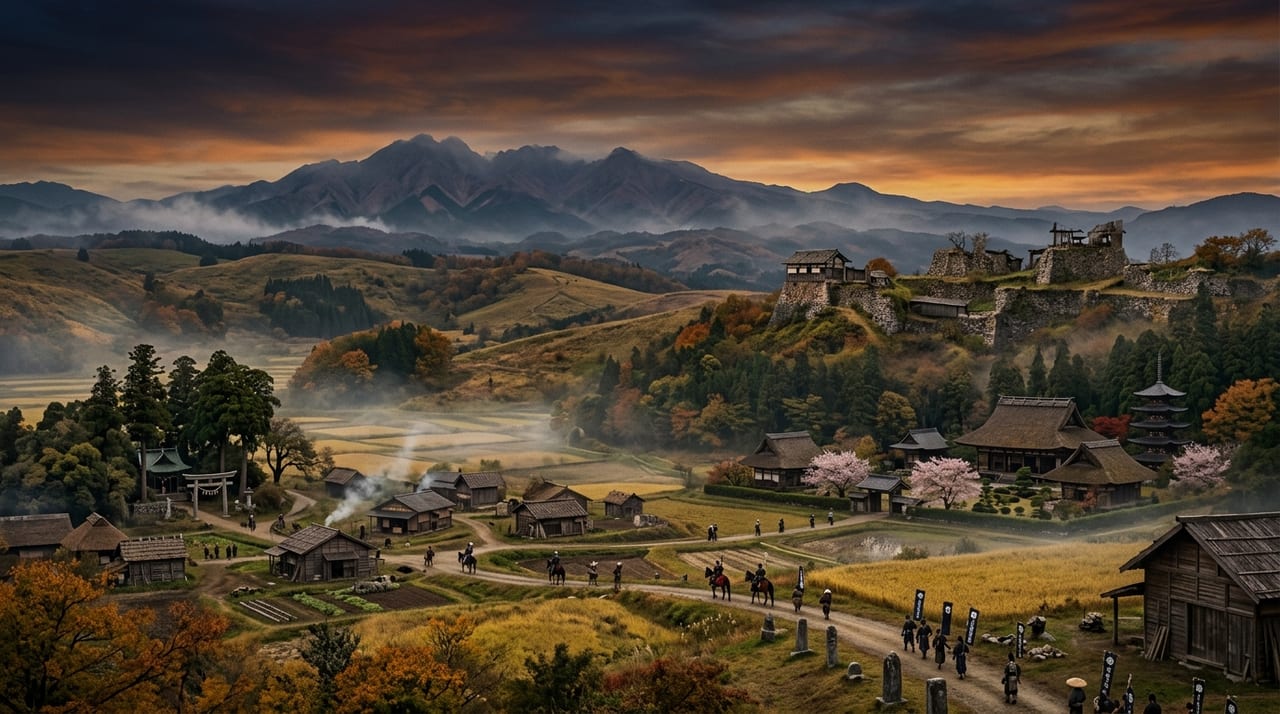
 * Image is for illustrative purposes only.
Eikyō-Kyōtoku Disturbances Period
永享・享徳の乱期
This was a half-century of warfare in which the Kantō kanrei, the Koga kubō, the Yamanouchi Uesugi and the Ōgigayatsu Uesugi were locked in conflict. It was a regional struggle that arose just before the chaos of the Ōnin War spread nationwide, and it later led on to the Chōkyō War.
Description
Structure of the Kantō Turmoil and Demand for Swords
The Eikyō Rebellion (1438–1439) began when the sixth shogun, Ashikaga Yoshinori, destroyed Kantō Kubō Ashikaga Mochiuji. It was the starting point of a half-century of great turmoil in the Kantō, which continued with the Battle of Yūki (1440–1441), fought in support of Mochiuji's heir, and the Kyōtoku Rebellion (1455–1483), led by Mochiuji's son Shigeuji. During this period, the Kantō lords centered on the Koga kubō (Shigeuji) remained opposed to the Uesugi clan, Kantō Kanrei, who allied with the shogunate, with both the Yamanouchi and Ōgigayatsu branches involved. As a result, the entire Kantō region fell into chronic warfare. This environment is thought to have sustained demand for swords over a long period.
Local Smiths of the Kantō
In the Kantō, where fighting continued, local smiths who supported the everyday arming of provincial warriors are also thought to have been active in various places.
Lineage of the Sōshū Tradition and Sue-Sōshū
The Sōshū tradition was brought to completion by Masamune in the late Kamakura period. In the Nanbokuchō period, following Sadamune, Hiromitsu and Akihiro produced the showy hamon known as hitatsura. The renowned smiths of various provinces later transmitted as Masamune's Ten Great Disciples (Masamune Juttetsu) were all influenced by Masamune's style. Sōshū works of the Muromachi period are called Sue-Sōshū, and in the late Muromachi period the center moved to Odawara, so they were also called Odawara Sōshū.
Divergence of Mass-Produced Swords and Superior-Work Swords
Another phenomenon to note in this period is the progressing qualitative polarization of swords. Chronic warfare created demand for large quantities of inexpensive practical swords (kazuuchi), while powerful warlords sought superior-work swords (jōsaku-tō: high-quality tachi and katana by famous smiths) to display their authority. Because demand for kazuuchi and superior-work swords existed side by side, specialization and stratification advanced among smiths, and the prototype of the sword production system of the later Sengoku period was formed.
Continuity with the Ōnin War
As the Kyōtoku Rebellion was prolonged and eventually developed into the Chōkyō Rebellion (1487–1505) between the Yamanouchi and Ōgigayatsu Uesugi clans, the Kantō Turmoil overlapped in time with the Ōnin War (1467–1477).
Characteristics of This Era
- In Sagami, Sōshū blades of the Muromachi period were called “Sue-Sōshū,” and in the late Muromachi period the center of production moved to Odawara (Odawara Sōshū).
- Polarization progressed between kazu-uchi (inexpensive mass-produced swords) and jōsakutō (high-quality swords by renowned smiths). Chronic warfare simultaneously created sword markets across different quality tiers.
- This was a transitional period from tachi to uchigatana. Reflecting the shift from mounted combat to fighting on foot, demand gradually grew for the more portable uchigatana (swords worn at the waist).
- Simplification of sword fittings (tōsōgu, koshirae). Reflecting the priority on practicality in wartime, functional field koshirae became the mainstream rather than ornate kazari-tachi.