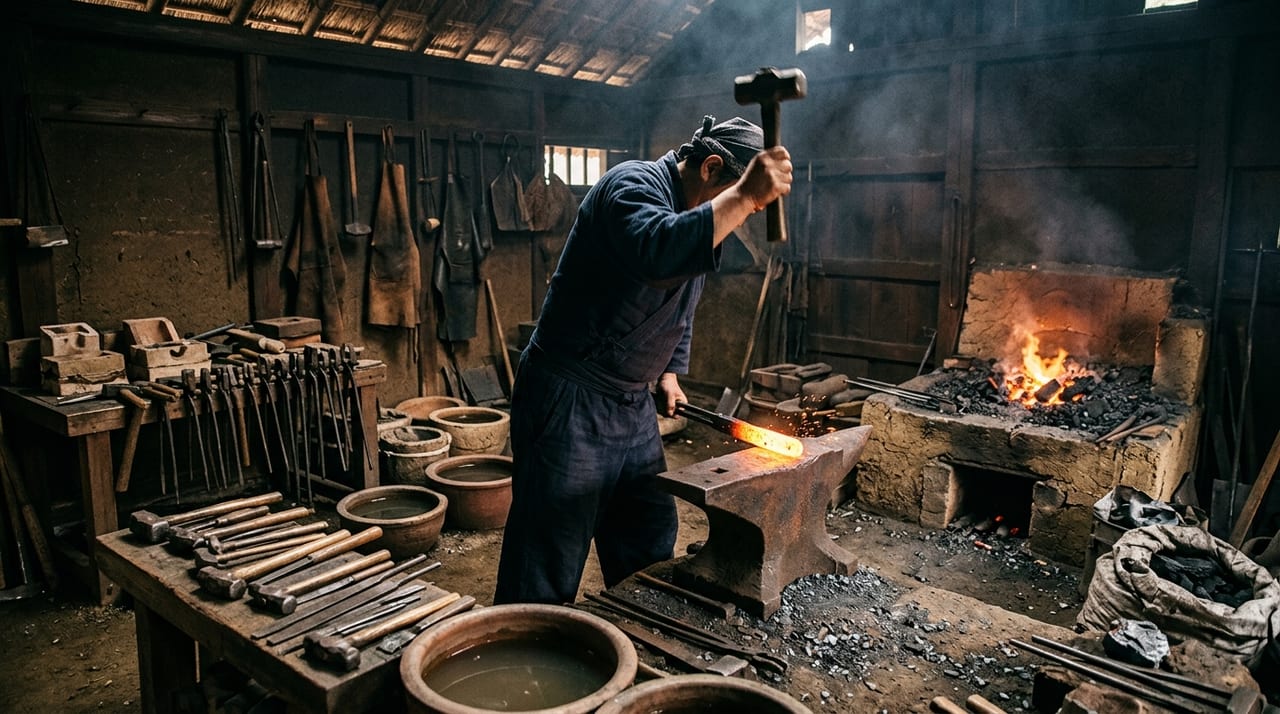
 * Image is for illustrative purposes only.
Osafune Chōgi
長船長義
Description
Osafune Chōgi was a swordsmith active during the Nanboku-chō period in Osafune in Bizen Province (present-day Osafune-chō, Setouchi, Okayama Prefecture). His signature is cut as 長義 (Chōgi), which may also be read as Nagayoshi. His sword-making period falls in the latter half of the fourteenth century, roughly centered on the Jōji and Ōan eras, corresponding to the middle of the Nanboku-chō period. Within the Osafune school, which forms the mainstream of Bizen swords, he stood apart from the main line running through Mitsutada, Nagamitsu, Kagemitsu, and Kanemitsu, and established a distinctive style strongly infused with the Sōshū tradition. In later ages he was counted among the Masamune Juttetsu (Ten Great Disciples of Masamune). As a representative figure of Sōden-Bizen, he is mentioned alongside his contemporary Kanemitsu, and the two form the twin pillars of Bizen in the Nanboku-chō period. He led a school of his own and is regarded as the founder of the Chōgi school.
His characteristic style lies in the bold tachi form of the Nanboku-chō period, broad in blade body and ending in an ō-kissaki. A feature of his work is that his jigane is itame-hada with strong ji-nie, and many examples show inconspicuous utsuri. His hamon is based on notare with gunome mixed in, and it is rich in variety, including broad-based ō-gunome and mimigata-midare in which two gunome sit side by side. The nie is thickly distributed, kinsuji and sunagashi appear conspicuously within the blade, and ashi and yō appear frequently. The bōshi runs into disorder and returns with a pointed tendency, and many have deep returns. Chōgi's true worth lies in fusing the nie-action of the Sōshū tradition with the jigane of the Bizen tradition, and he is described as "the style least Bizen-like among Bizen swords."
As a representative extant example, first there is the Important Cultural Property "Katana, signed Honsaku Chōgi (remainder omitted)," held at the Tokugawa Art Museum in Nagoya. This is an unsigned work by Chōgi that lost its original signature in suriage. In later ages, Horikawa Kunihiro cut a lengthy added signature on it in Tenshō 18 (1590) at the request of the Shimotsuke warrior Nagao Akinaga. It is known as a typical example of the bold form with a broad blade body. Also, the Important Cultural Property "Tachi, signed Bizen no kuni Osafune jū Chōgi" was transmitted to the public interest incorporated foundation Kaisendō (Yamagata Prefecture), but it is a single sword that was stolen in 1991. Its jigane is ko-itame, finely covered with nie. Its hamon is gunome-midare mixed with notare, with ashi and yō entering, nioi deep, and ko-nie mixed in. Its bōshi runs into disorder and returns with a pointed tendency. Signed tachi by Chōgi are few among extant examples, which makes this piece valuable as a benchmark.
Chōgi, together with Kanemitsu, is cited as a master representing Bizen of the Nanboku-chō period, and the two are often paired as "Kanemitsu, Chōgi." With his brilliant technique and splendid tempered edge, his style is described as full of fighting spirit, in contrast to the gentle Kanemitsu, and he is highly valued for an originality that fully digested the Sōshū tradition. With disciples, he formed the Chōgi school, and in later ages many copies imitating his style were made. He is also ranked high in cutting performance and is esteemed in later ages as a swordsmith of jōsaku rank.
Famous Works
- Tachi (Important Cultural Property)