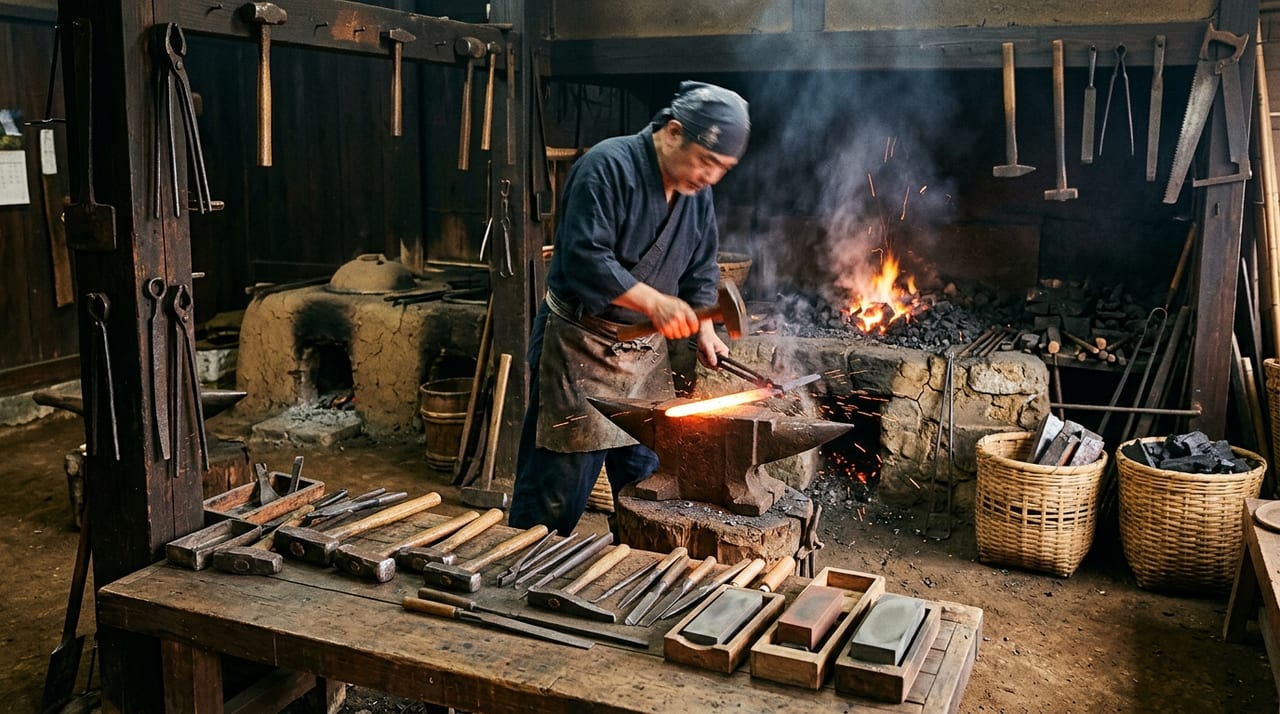
 * Image is for illustrative purposes only.
Uda Kunimune
宇多国宗
Description
Uda Kunimune was a swordsmith active in Etchū Province (present-day Toyama Prefecture) from the late Nanbokuchō period through the Muromachi period, and is known as one of the representative swordsmiths of the Etchū Uda school. The Uda school was a group of swordsmiths that developed independently in Etchū; while influenced by the Yamato tradition, it established a regionally distinctive style of its own.
One of the distinguishing features of the Uda school lies in its unique jigane. Itame and masame intermingle intricately, forming a flowing hada with undulation. Ji-nie is thickly present and chikei frequently appears in abundance, giving an overall impression of rustic vigor and power. The hamon is mainly ko-gunome and gunome, while incorporating features such as uchinoke and nijūba, displaying varied expression. The bōshi tends to be round and small in form.
The signature is known to read 'Uda Kunimune.' Much of the tang remains in its original ubu state, and the tang tip is mostly ha-agari kurijiri or hira-kurijiri. The name Kunimune was passed down through generations; the first generation is said to have been active around the Eitoku era (1381–84), and is traditionally considered the son of Kunimitsu, founder of the Uda school, and the younger brother of Kunifusa.
The Uda school was a group of swordsmiths that moved from Yamato to present-day Fukuoka-machi, Takaoka, in Etchū at the end of the Kamakura period. Apart from the major schools of the Kinai region, it achieved its own development, and the name was passed down into the shintō period.
Among signed works are a tanto in the collection of the Tokyo National Museum (signed Uda Kunimune) and a tachi in the collection of the Takaoka City Museum (signed Uda Kunimune), which is considered a work of the third generation. Overall, recognition of the Uda school among sword enthusiasts is limited compared with the major schools of the Kinai region, yet its distinctiveness and its historical significance as a bearer of regional swordsmith culture are highly regarded.
Famous Works
- tachi, signed Uda Kunimune (third generation; held by Takaoka City Museum)
- tantō, signed Uda Kunimune (held by Tokyo National Museum)