Traveling Swordsmiths (Tabi-kaji)—The History of how Itinerant Swordmakers Dispersed Japanese Sword Technology Across the Nation
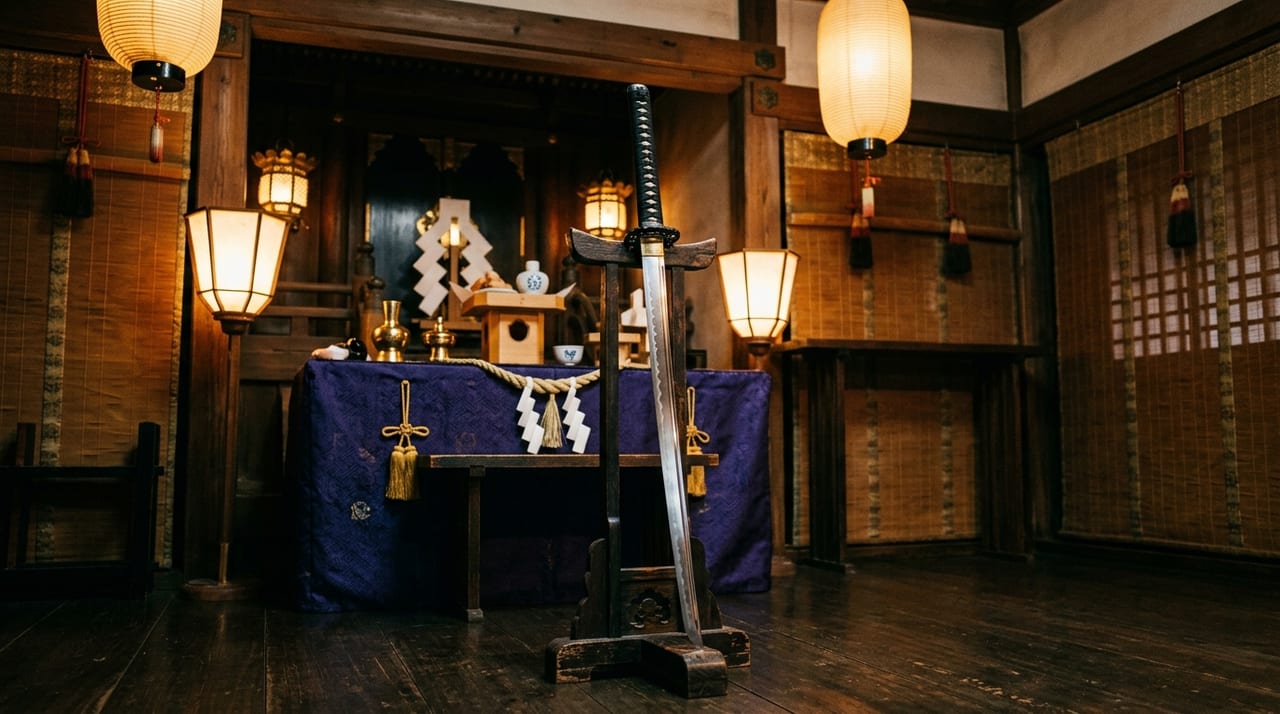 * Image is for illustrative purposes only.
Table of Contents
Who Were the Traveling Smiths?—Sword Makers Living Between Settlement and Movement
When discussing the history of Japanese swords, the sword makers from the main production centers (the "five major traditions" of Yamashiro, Yamato, Bizen, Soshu, and Mino) are often highlighted. However, the technology of Japanese sword making did not remain confined to these centers; it spread nationwide through the activities of traveling sword makers known as tabi-kaji.
The reality of tabi-kaji was diverse, and there was no single clear definition. They can be broadly categorized into the following types.
- "Goyou-kaji" type: Sword makers who were invited by daimyo and influential warlords, left their home production centers, and served as exclusive smiths to specific domains. This was closer to "relocation" than to "travel."
- "Order-based" tabi-kaji: Sword makers who received commissions from specific warlords or temples and shrines, traveled from their home centers, carried out production for a certain period, and then returned.
- "Technology-transmission" tabi-kaji: Sword makers who left their home production centers with the techniques they had learned from their masters, traveled to various regions while continuing to forge, and transmitted their skills to local sword makers. This was the primary mechanism by which the five major tradition techniques spread to outlying regions.
- "Wanderer" type tabi-kaji: Sword makers who separated from (or were expelled from) their home schools and drifted from place to place. This often resulted from economic reasons or personal troubles.
Historical Examples—Traces of Famous Traveling Smiths
Let us examine the reality of tabi-kaji through examples of those who left their mark on history.
- Migration of the Masamune Ten Masters: The "Masamune Ten Masters," who are said to have been distinguished disciples of Masamune, a sword maker from Kamakura, each left their master's production center in Sagami Province (Kanagawa Prefecture) and established themselves in various regions. Gō Yoshihiro moved to Etchū (Toyama Prefecture) and formed the "Etchū tradition," while Shizu Kaneuji moved to Mino (Gifu Prefecture) and laid the foundation for the Mino tradition. Hasebe Kunishige relocated to Yamashiro (Kyoto) and brought the influence of the Soshu tradition to the later Yamashiro tradition. These are classic examples of the "technology transmission" typical of tabi-kaji.
- Kanemoto's Settlement in Mino: Kanemoto, known as "Seki no Mago-roku" and representative of Mino swords, established himself in Seki as a Mino tradition sword maker with roots in the Mino Sanami school. In Seki, sword makers from various schools gathered and conducted technical exchanges, and the tabi-kaji are said to have played a major role in the process by which a comprehensive technical system called the "Mino tradition" was formed.
- Transmission of the Soshu Tradition to Satsuma: There are various theories about how the Soshu tradition technique was transmitted to Satsuma (Kagoshima), but one theory holds that during the period from the Northern and Southern Courts to the Muromachi era, Soshu tradition sword makers traveled to Satsuma and through exchanges with local Naminohira tradition sword makers, the technical characteristics of "Satsuma swords" (curved blade patterns and heavy, robust construction) were formed.
- Arrival of Kyoto-School Sword Makers in Echizen: Echizen (Fukui Prefecture) is believed to have received Kyoto-school sword makers as settlers from the late Heian period, and a production center known as "Echizen smiths" was formed. Particularly, in the early Edo period, Nagasone Kotetsu, after working as an armor maker in Echizen, moved to Edo and reinvented himself as a sword maker, gaining fame. This is known as a classic example of technical transformation through travel.
Social Infrastructure Supporting Traveling Smiths
The existence of social infrastructure that enabled tabi-kaji to travel from region to region cannot be overlooked.
- Temple and Shrine Network: Tabi-kaji gained a special status as "servants of the kami and Buddha" by creating presentation swords for temples and shrines throughout the land. In return, temples and shrines sometimes provided traveling smiths with lodging, meals, and the use of forges. This functioned as an economic and social safety net for tabi-kaji.
- Patronage by the Samurai: Regional warlords viewed retaining superior sword makers as evidence of their authority. When a traveling smith came to a region, local powerful samurai would often commission work, bearing the costs of lodging, meals, and materials during the period.
- "Space rental" by Blacksmith Shops: Throughout the regions there were numerous ordinary blacksmith shops making agricultural tools and household implements. Traveling smiths could "rent space" from these blacksmiths and use their forges and tools. For ordinary blacksmiths too, the opportunity to observe the advanced techniques of Japanese sword making at close hand had value as a learning opportunity.
- Maintenance of Highway Roads: The development of the five major highways during the Edo period made it physically easier for traveling smiths to move about. There was demand for swords at post towns along the highways, making it possible to undertake short-term production "along the way" during travel.
Mechanisms of Technology Transfer by Traveling Smiths
There were multiple mechanisms by which tabi-kaji propagated their techniques.
- Learning Through Demonstration: When traveling smiths carried out production locally, regional apprentice sword makers and ordinary blacksmiths observed the work as "spectators." Even without intentional instruction, the opportunity to observe first-class techniques up close contributed to the improvement of the region's technical standards.
- Acceptance of Disciples: Some traveling smiths accepted short-term disciples at their destination sites. "Disciples acquired on the road" injected fragments of techniques brought back to their home centers into the local sword-making culture.
- Exchange and Evaluation of Materials: Traveling smiths had opportunities to work with locally-sourced iron and tamahagane from various regions. Their evaluation and feedback on local materials served as reference for local blacksmiths when improving the quality of their materials.
- Preservation of Examples: The swords created by traveling smiths in various regions functioned as "models" for later local sword makers. In many cases, parts of the traveling smiths' techniques were indirectly transmitted through imitation and study of surviving examples.
The Dual Nature of Attitudes Toward Traveling Smiths
Contemporary attitudes toward traveling smiths were not uniform.
On the positive side, traveling smiths functioned as "free bearers of technology," bringing technical diversity that could not be achieved through the "closed technical transmission" of established production centers. Moreover, they were welcomed by regional warlords and temples and shrines as an opportunity to "directly benefit from the techniques of renowned production centers."
On the negative side, for the sword makers of established production centers, traveling smiths were viewed with suspicion as "leakers of technique." There was a possibility that they would reveal the school's secret methods to outsiders, and particularly those who had "left" their schools risked losing their home center's trust.
Moreover, among the works of traveling smiths, many were of unstable quality, and there was also an assessment that "swords forged on the road (tabi-uchi) could not be trusted." Because the quality of forges, tools, and materials differed from those at the home production center, traveling smiths often could not display their full skill when working away from home.
Conclusion—The Legacy of Traveling Smiths
The history of tabi-kaji demonstrates that Japanese sword culture is not "static production-center technique" but rather "a dynamic culture enriched through movement and exchange." If the organized technical transmission of the five major traditions represents "vertical transmission (from master to disciple)," then the activities of traveling smiths realized "horizontal transmission (from production center to production center)." The intersection of these two axes of transmission became the driving force that produced the regional diversity and technical depth of Japanese sword culture. Many of the "works by sword makers of unknown origin" that lie dormant in regional museums and local history museums may be the legacy of traveling smiths, and research into them carries important significance in clarifying the overall picture of Japanese sword culture.