A Complete Classification of Tanto Types: Varieties by Function, Form, and School
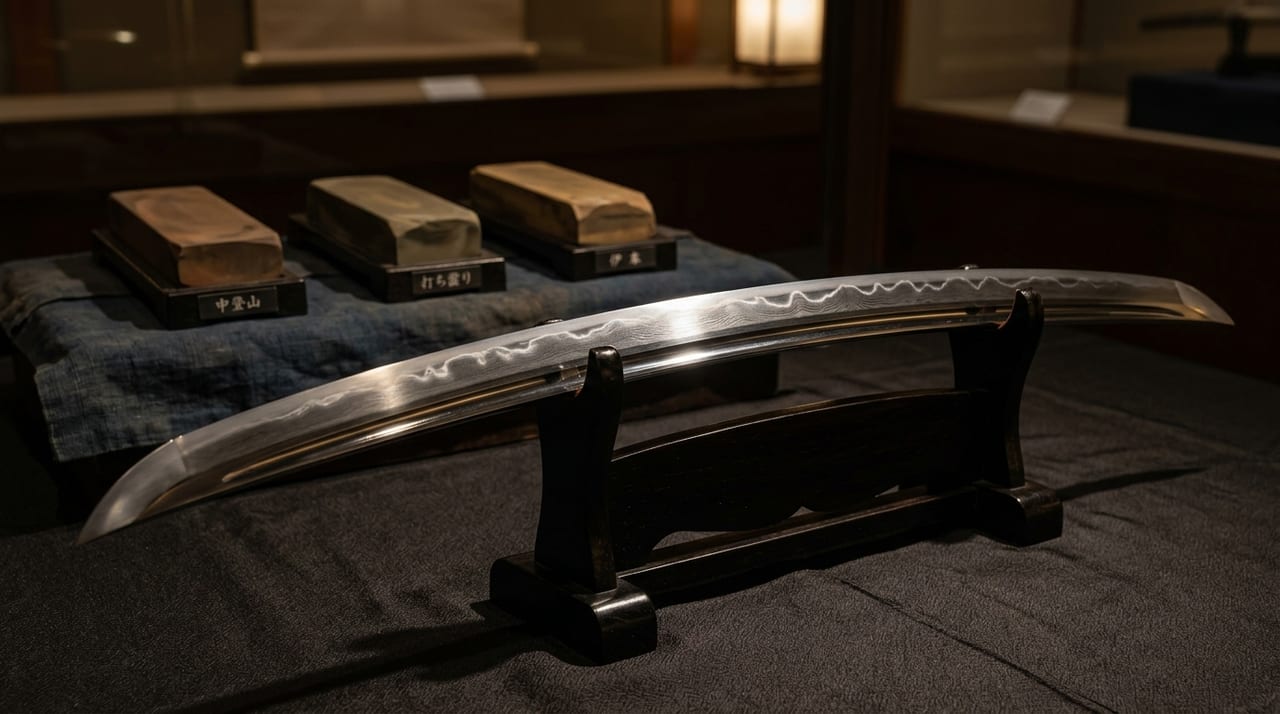 * Image is for illustrative purposes only.
Table of Contents
Definition of Tanto — The Smallest Japanese Sword
Tanto (tantō) refers to Japanese swords with a blade length under 30 cm in the classification of firearms and swords. While it is the most compact form among Japanese swords, its types and uses are surprisingly diverse. Due to its small size, the tanto excels in portability, but at the same time, the overall form is easy to take in at a glance, making the quality of the jihada and hamon directly influence the impression of the work. It is considered a field where the skill of the sword maker is readily apparent.
Tanto can be classified from the following perspectives:
- Classification by shape (construction and cross-sectional form)
- Classification by direction of curve
- Classification by use
- Classification by school and era
Classification by Shape (Construction)
Hira-zukuri Tanto (Flat-sided Tanto)
A flat cross-sectional shape without shinogi (ridge line). It is the most common form of tanto and, being thin and lightweight, excels in thrusting performance. Master craftsmen from the Awataguchi and Rai schools of the Kamakura period left excellent examples of hira-zukuri tanto. Compared to shinogi-zukuri, the blade width and the way the thickness is set directly affect the impression of the form, so even the same hira-zukuri appears different in character depending on the era and school.
Morohazukuri Tanto (Double-edged Tanto)
A sword-shaped tanto with a cutting edge on both the blade and the back. The "both-edged" (moroha) tanto functioned as a practical self-defense weapon. It inherits the form of the ancient "tsurugi" (sword) and is seen on shrine treasures and tanto dedicated before the altar. Compared to other construction methods, fewer examples survive, and it is a form that tends to attract attention as an object of appreciation and study.
Shinogi-zukuri Tanto
A form applying the same shinogi-zukuri used for katana and wakizashi to the tanto. It has the appearance of a small version of the uchigatana and overlaps with the category of "kodachi" (small sword). While it may appear to be a small hacking blade at first glance, the forging texture of the jihada and the action of the hamon become objects of appreciation just as they do in katana and wakizashi.
Kikuchi-yari-gata Tanto (Kikuchi Spear-shaped Tanto)
A special tanto with a diamond-shaped or triangular cross-section. Originating from the Kikuchi region in Kyushu, many examples have an inner curve (uchizori). It functioned as an "armor piercer" to thrust through gaps in armor (see separate article). Due to its thick cross-section, it is said to have high resistance to thrusting, and it is positioned as a form with strong practical characteristics.
Classification by Direction of Curve
Chokuto-gata Tanto (Straight Tanto)
A straight blade without curve. A common form in old swords from the Heian through Kamakura periods.
Uchizori Tanto (Inner-curve Tanto)
A special shape with a curve in the opposite direction from normal Japanese swords (curving toward the back). Seen primarily in old tanto (pre-Kamakura), it is one of the rarest forms today. It receives special consideration in authentication.
Shallow Koshizori Tanto
A shallow koshizori (a shape with the apex of the curve at the base) is sometimes seen in tanto. Common in Soshu-den tanto from the Kamakura period.
Classification by Use
Goshin Tanto (Self-defense Tanto)
A tanto carried daily by samurai, nobles, and women for self-defense. The kaiken also falls into this category. The blade length is usually around 15–25 cm, and they were stored and carried in shirasaya or elaborate koshirae.
Seppuku-yo Tanto (Seppuku Tanto)
A tanto used in the ritual suicide of samurai. While there is no special form, blades used in the ritual are sometimes called "seppuku-to." From the Edo period onward, wakizashi became increasingly used for this purpose.
Reisō-yō Tanto (Formal-dress Tanto)
A tanto worn with formal attire for ceremonies, weddings, and Shinto rituals. Elaborate koshirae is applied, and it has high artistic value. In modern Shinto weddings, the kaiken is still worn as a tanto.
Hōnō Tanto (Votive Tanto)
A tanto made as a votive offering to shrines and temples. It has stronger religious and artistic significance than practical use. Many votive tanto by master craftsmen have been handed down to the present day in excellent condition.
Points to Observe When Appreciating Tanto
When appreciating a tanto, it is good to observe the following in order: sugata (overall form), jihada (steel surface), hamon (blade pattern), and nakago (tang). In the form, confirm the construction, presence or absence of curvature, and the balance of blade width and thickness. In the jihada, observe the density of the forge texture and the presence or absence of jinie. In the hamon, observe the shape of the blade pattern, such as whether it is suguha (straight) or midareba (irregular), and whether nioi or nie is predominant. The nakago sometimes has a mei (maker's signature) cut into it, and together with the file marks and the shape of the nakago-jiri, it provides clues for determining the era and school.
These are perspectives shared with the appreciation of katana and wakizashi, but since the overall form of the tanto is easy to take in at a glance, it can be said to be an object whose characteristics are easy to grasp even for those viewing a Japanese sword for the first time.
Characteristics by School and Era
Awataguchi School Tanto — Early Kamakura
Awataguchi Yoshimitsu is a master craftsman of the early Kamakura period who is evaluated as "Japan's greatest tanto maker." Awataguchi school tanto is characterized by its slender and elegant hira-zukuri form, with multiple examples currently designated as National Treasures. "Ichigo Hitofuri" (owned by Toyotomi Hideyoshi, now an imperial treasure) is known as a tachi that Yoshimitsu is said to have forged only once in his lifetime (maintaining tachi status even after polishing).
Soshu-den Tanto — Late Kamakura
The Soshu-den of the late Kamakura period, represented by Masamune and Yukimitsu, produced many tanto with vigorous nie and wild, expressive hamon. With a powerful style favored by the warrior class, they left a collection of masterpieces among practical self-defense tanto.
Rai School Tanto — Kamakura to Nanboku-cho
The tanto of the Rai school, represented by Kunitoshi and Kunimitsu, is characterized by refined hamon with harmonious fine nie and nioi. Many works reflect the delicate spirit of Yamashiro (Kyoto).
Evaluation of Tanto in NBTHK Authentication
In the authentication by the Society for the Preservation of Japanese Art Swords (NBTHK), tanto are evaluated on an equal footing with katana and wakizashi as subjects for assessment as "juyo-token" (important sword) and "tokubetsu juyo-token" (specially important sword).
Tanto by master craftsmen such as Awataguchi, Masamune, and Rai exist among items designated as "National Treasures" and "Important Cultural Properties," and may receive the highest valuation in the collector's market. Because the tanto is small in form, the quality of the jihada and hamon, as well as the preservation condition of the nakago, directly influence its evaluation. Comparing the grade on the authentication certificate with the actual condition of the piece is a practical confirmation point when selecting tanto.
Basics of Storing and Maintaining Tanto
As is common to all Japanese swords, not just tanto, the blade should be stored in a dry environment to prevent rust, and it is basic practice not to touch it directly with bare hands. During maintenance, the routine is to wipe away old oil with washi paper, apply a thin coat of choji-abura (clove oil) or other sword-specific oil, and then store it in a shirasaya (plain wooden scabbard). While tanto are easier to handle compared to katana and wakizashi, the kissaki (point) and blade take up a larger proportion of the overall surface, so special attention should be paid to changes in humidity in the storage environment.
Conclusion — The Essence of Japanese Sword Condensed in a Small Blade
The tanto is the smallest among Japanese swords, yet it possesses the most diverse forms and uses. From self-defense to ritual, from practical to artistic — it is in the tanto that the craftsmanship of the sword maker and the spirituality of its user are most condensed and embodied. When appreciating a tanto, by observing the form, jihada, hamon, and nakago in order, one can obtain clues to decipher which era and school a particular blade belongs to.