The lacquering techniques of the sayashi——practical processes and material selection for roiro lacquer, ishime-nuri, and togidashi maki-e applied to sword saya
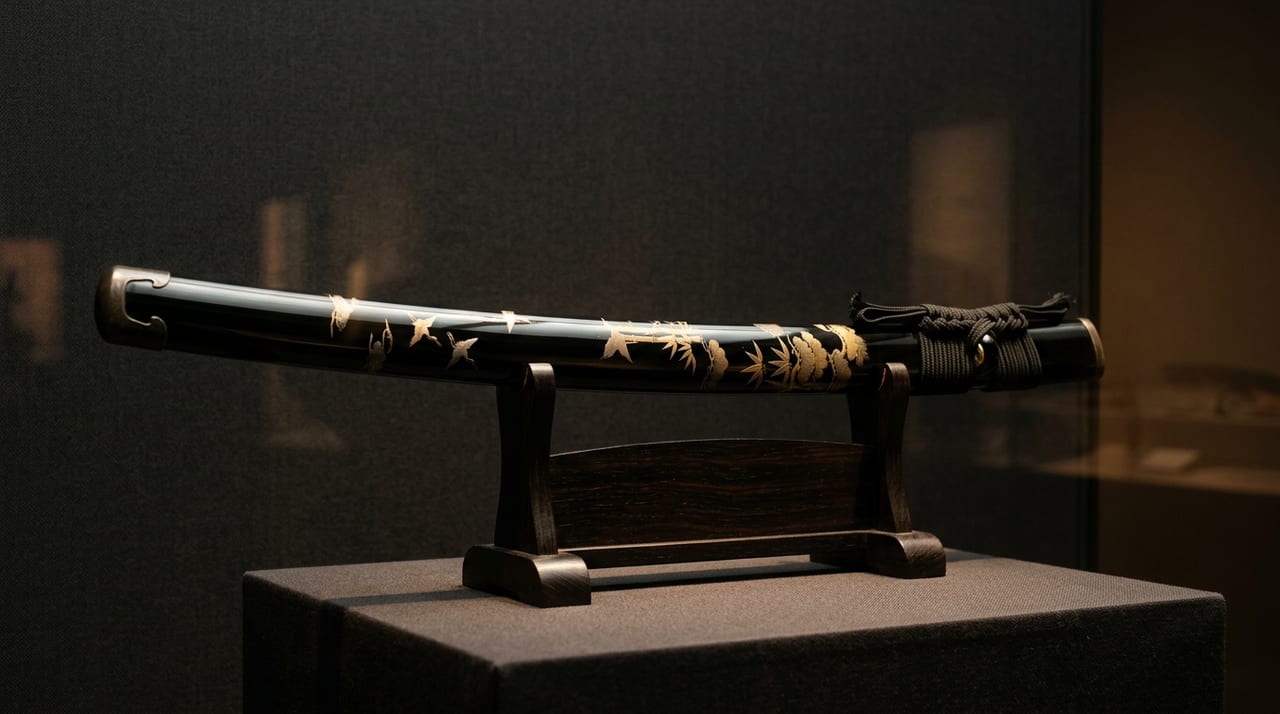 * Image is for illustrative purposes only.
Table of Contents
The role of lacquer in the sayashi's work
A Japanese sword saya is not merely a "storage case for the sword." The saya protects the blade, enhances the appearance when worn at the hip, and constitutes an essential element of the sword's overall artistic value. The lacquer that covers the surface of the saya is the stage at which the sayashi's skill is most rigorously tested, in terms of both durability and aesthetics.
The sayashi's work divides broadly into "kiji-zukuri (the woodworking stage)" and "the lacquering stage." Kiji-zukuri is the core stage that determines the shape of the saya, but it is no exaggeration to say that lacquering determines the saya's final impression. This article focuses on the lacquering techniques of the sayashi, explaining the processes and materials in detail.
Lacquering is not completed in a single pass; it is an accumulation of repeated cycles of application, drying, and polishing. Because lacquer has the property of hardening only in a humid environment, the sayashi proceeds by slowly drying each layer in a dedicated humidity-controlled drying cabinet called a "urushi-buro." If the next layer is applied before one layer has fully dried, internal stresses remain, which can cause shrinkage and cracks to appear on the surface in later years. Working without haste and completing each stage reliably is an absolute requirement for fine saya lacquer.
Types of lacquer used on saya
There are several types of lacquer work applied to the saya, each differing in application and difficulty.
Roiro-nuri: Considered the most formal and refined technique, it involves building up many layers of black lacquer and finally polishing with charcoal powder (sumiko) to produce a deep, mirror-like luminous gloss. The term "roiro" refers to this distinctive deep black luster. It was widely used on the saya of ceremonial swords carried by high-ranking samurai, and is still used today in the finest koshirae. The polishing stage alone can take dozens of hours, making roiro-nuri the most time-consuming and technically demanding method.
Ishime-nuri: A technique in which small irregularities are created on the lacquered surface using rapeseed (natane) particles or special tools before drying, producing a distinctive texture resembling the surface of stone. Because it is difficult to slip even with sweaty hands, it was frequently used in practical koshirae. It was one of the lacquer methods favored by Edo-period samurai for actual daily carry, and is applied in various colors including black, vermilion, and brown.
Roiro nashiji-nuri: A technique that produces a finely textured surface resembling pear skin; a roiro finish is applied over a "nashiji" ground created by blending gold or silver powder into the lacquer and sprinkling it on. It has a luxurious character and often requires collaboration with a maki-e craftsman.
Each lacquer method differs not only in its finished appearance but also in practical qualities such as the texture when held and resistance to slipping. It is customary for the sayashi to decide on the type of lacquer in consultation with the client, based on the overall rank of the koshirae and the intended use (ceremonial or practical, and so on).
The togidashi maki-e process——collaboration between the sayashi and the maki-e craftsman
The most refined saya lacquer is known as "togidashi maki-e." This technique cannot be completed by the sayashi alone; a division of labor with a maki-e craftsman is required.
The process is as follows. First, the sayashi completes the kiji and applies a ground lacquer (shitaji-urushi). Next, the maki-e craftsman draws the design using gold powder, silver powder, and colored powders, fixing them with lacquer. After the maki-e has dried, layers of suki-urushi (transparent lacquer) or roiro lacquer are applied over it, burying the maki-e design beneath the lacquer. Finally, the surface is worked with charcoal and abrasives to reveal the buried maki-e design rising up through the lacquer.
A saya made by this technique has a distinctive depth in which the design appears to float within the lacquer while the surface remains perfectly smooth. Auspicious motifs such as the aoi-mon, kiri-mon, and shōchikubai, as well as natural motifs such as sansui landscapes, waves, and tsuru-kame, were frequently used.
The togidashi stage is an irreversible operation fraught with tension: grind too deep and the design itself is abraded away; not deep enough and the design remains submerged beneath the lacquer, never coming to light. The sayashi (or maki-e craftsman) relies solely on fingertip sensitivity to judge the depth of the grinding, and this discernment is the measure of mastery in togidashi maki-e.
The importance of ground preparation——asanuno-zumi and ji-sabi-katame
For the production of high-quality lacquered saya, the "ground preparation" carried out before lacquering begins is critically important. Insufficient ground preparation leads to cracking and flaking of the lacquer.
Asanuno-zumi: The process of adhering hemp cloth to the kiji with lacquer. It prevents lacquer cracking caused by the movement (expansion and contraction) of the wood, and is used especially at vulnerable points such as corners and curved sections.
Ji-sabi-katame: The process of applying "ji-sabi-urushi" — lacquer mixed with iron powder and charcoal powder — to level out surface irregularities. A smooth ground is built up by applying multiple coats. Alternating with polishing (shitaji-togi) is required, and even for a skilled sayashi, the ground preparation alone can take several weeks.
Ground preparation is a stage that becomes invisible after completion, but it is fair to say that most of a saya's durability is determined at this stage. If ground preparation is omitted or simplified, shrinkage and lifting of the lacquer surface will appear within years to decades, even if the finish looks complete at first. Accordingly, how much care was invested in ground preparation is a major clue to assessing the thoroughness of the sayashi's work.
Shu-urushi and kawari-nuri techniques
In addition to black-toned lacquers, many saya are also made using shu-urushi (red lacquer containing cinnabar and mercuric vermilion). Vermilion saya are commonly seen on swords dedicated to shrines and on women's futokoro-gatana and ko-gatana, characterized by their vivid coloring. Today, synthetic vermilion (iron-sulfide based) is also used, but traditional cinnabar vermilion has a deeper, incomparable beauty of color.
Many other special techniques also exist, collectively called "kawari-nuri," including uzu-nuri, nagashi-nuri, and hakeme-nuri, all employing inventive approaches to give the lacquer a distinctive character. These went in and out of fashion by period, and the sayashi selects among them according to the client's preferences and the overall design of the sword.
Basic care and storage after completion
A lacquered saya continues to respond to its environment even after hardening, as if breathing, so everyday handling determines its lifespan.
- Extended exposure to direct sunlight or strong artificial light causes changes to the luster and color of the lacquer, so choose a shaded storage location.
- Neither an extremely dry environment nor one with trapped moisture is desirable for lacquer. Avoid sudden changes in temperature and humidity and store in as stable an indoor environment as possible.
- When inserting or drawing the blade, handle the koiguchi and the interior of the saya carefully to avoid hard rubbing. Forcing the blade can lead to chipping or cracking of the lacquer surface.
- Wipe away sweat and skin oils with a dry soft cloth only; do not wipe with liquids containing solvents or alcohol, as these can damage the lacquer surface.
The basic principle of daily care is "handle as little as possible, wipe as little as possible"; it is worth bearing in mind that excessive care can itself damage the lacquer.
Modern sayashi and transmission of lacquering techniques
Even today the number of sayashi is small, and among them those who undertake full-scale lacquer work are even fewer. Transmitting the culture of high-quality sword fittings requires the cooperation of multiple craftsmen — sayashi, lacquer craftsmen, and maki-e craftsmen — and maintaining that network is itself a challenge.
In cultural property restoration, sayashi are required to analyze the lacquer of old koshirae and restore it as closely as possible to the original materials and methods. Combining knowledge of traditional techniques with modern analytical technology is one of the roles expected of today's sayashi.
The lacquer of a saya continues to harden and stabilize slowly over decades even after completion. A fine lacquered saya retains its luster a hundred years later — it is truly a "craft object that reaches completion over time."
When selecting a sword with koshirae, it is reassuring not only to assess the condition of the blade itself but also to check that the saya lacquer has no major chips, lifting, or deep cracks. When a kanteisho (appraisal certificate) is included, comparing the information recorded there with the actual condition while examining the piece should deepen one's understanding of the sayashi's work.