The Tacit Knowledge of the Tōshō — The Embodied Knowledge of Sword Forging Acquired Through "Eyes," "Ears," and "Hands," and the Skills That Cannot Be Written Down
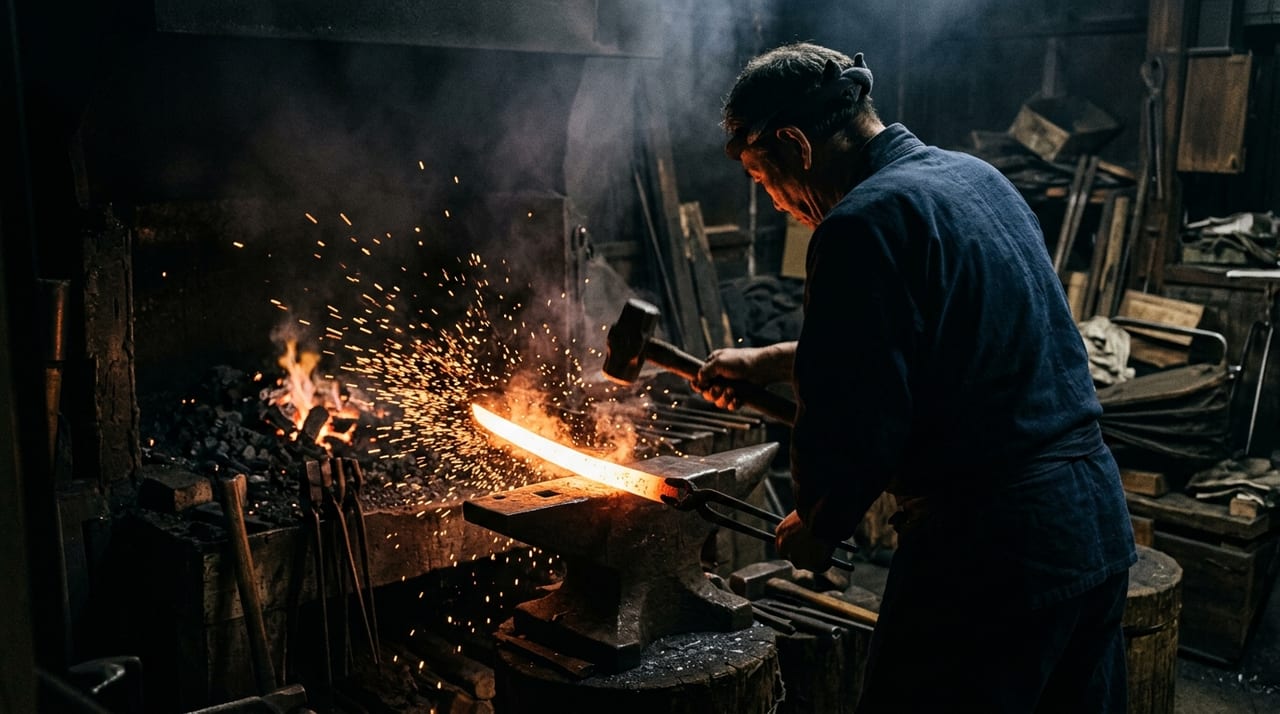 * Image is for illustrative purposes only.
Table of Contents
What Is Tacit Knowledge — Two Kinds of Knowledge in the World of the Kaji
"Tacit knowledge" (tacit knowledge) as proposed by philosopher Michael Polanyi refers to "knowledge and skills that cannot be conveyed in words." The well-known analogy "you cannot teach someone to ride a bicycle through writing alone" is famous, but the forging techniques of Japanese swords represent a craft in which this tacit knowledge occupies an exceptionally high proportion.
Since ancient times, a variety of documentary means have been used to transmit sword-forging techniques — secret transmission documents, oral traditions, illustrated records, and more (see Oral Traditions and Secret Transmission Documents of the Tōshō for details). However, what documents can convey is only a partial aspect of the technique: the selection of materials, the sequence of processes, and an overview of rules of thumb accumulated through experience. It is fundamentally impossible to convey in writing the "sensation" itself involved in actual physical judgment.
At the core of the tacit knowledge that a tōkō must acquire are three sensory judgments: "hiiro (fire color)," "uchigoro (the right moment to strike)," and "ne (sound)." These are inscribed in the body through years of training and lead to a state called "shokunin no tai (the craftsman's body)," in which they are triggered reflexively without conscious calculation.
Hiiro Judgment — The Eye's Skill of Reading Temperature with the Naked Eye
In the forging process, temperature management of iron is one of the most fundamental yet most difficult skills. In modern metalworking, high-precision thermometers and infrared sensors are used, but in the traditional kaji workshop, the tōkō estimates the temperature by reading the color of the furnace (hiiro) with the naked eye.
Stages of hiiro: Iron glows in different colors depending on its temperature. At low temperatures it emits a dark red (black-red to red); at medium temperatures it turns orange to bright orange (700–900°C); at high temperatures it gives off yellow to white light (above 900°C). The hiiro corresponding to temperatures suitable for tanren (roughly 800–1,000°C) falls in the range from "yellow-orange" to "bright orange," and the actual temperature varies due to multiple factors such as "the warmth of one's wrists," "the intensity of sunlight," and "the state of the charcoal inside the furnace."
The problem of lighting conditions: Hiiro judgment is greatly affected by the lighting environment. Under bright midday sunlight, the furnace color appears whitish and tends to be misjudged as a higher temperature, while in the dim early morning it tends to look cooler than it actually is. For this reason, many traditional kaji workshops deliberately keep windows small or maintain low lighting, creating a visual environment in which hiiro can be read consistently.
Acquiring "eyes that can read hiiro" is said to require at least several years of training. Beginning apprentices start by watching alongside their master, absorbing the correspondences — "that color means that temperature" — into their bodies. In recent years, attempts have been made to train by matching thermometer readings with visual perception, but ultimately "being able to judge accurately without looking at a thermometer" is considered the mark of a craftsman.
The Sense of Uchigoro — The Tacit Knowledge of "Ma" in Hammer Striking
In the world of forging (tanzō), where iron is hammered into shape, a concept called "uchigoro" is shared among tōshō. Uchigoro is a sensory concept referring to the state in which heated iron is suitable for hammering — retaining the softness appropriate for forging while still maintaining the right temperature.
What happens when uchigoro is missed: If the iron cools too much, it hardens and there is a risk that hammering will cause "kiretsu (cracks)." Conversely, if it is struck hard while overheated, the iron may melt and deform, or impurities may become mixed in. In other words, correctly judging uchigoro is directly linked to efficient forging and the formation of high-quality steel structure.
Sensory indicators of uchigoro: The following sensory indicators are handed down for judging uchigoro.
- State of the sparks: The quantity, direction, and size of the sparks that scatter during hammering reflect the temperature and condition of the iron. At the right temperature, sparks scatter finely and uniformly; as the temperature drops, they become large and irregular.
- "Tegotae (feel)" of the iron: The rebound sensation and impact felt the moment the hammer strikes the iron conveys its softness. At the right uchigoro there is a sensation of the hammer sinking in "nurutto (smoothly)," while when the iron has cooled too much it returns a hard, "kachitto (clacking)" rebound.
- Changes in ne (sound): The sound of hammering changes with the temperature and state of the iron. A skilled tōshō instantly judges "that sound just now was the sound of slightly cooled iron" and decides when to return it to the furnace.
Judging the Condition of Iron by Sound — Sensory Knowledge of the Ear
The technique of judging the condition of iron by "ne (sound)" is considered one of the areas among the tacit knowledge that tōshō must acquire that is most difficult to put into words.
In the sound of hammering during forging, multiple variables are reflected in complex combination: the temperature of the iron, the carbon content of the steel, the state of internal stress, and the thickness of the spot being struck. A skilled tōshō unconsciously analyzes the current condition of the iron from this composite sound and connects it to the next judgment. However, it is extremely difficult to explain in words how that analytical process takes place.
Oral traditions do exist, such as "when you hear this sound, return it to the furnace" and "this sound is a signal that the iron is in good condition." But what "this sound" specifically sounds like cannot be understood without direct experience. The memory of sound is inscribed in the body; it becomes "knowledge that has taken hold" only after performing the same operation thousands or tens of thousands of times beside one's master.
The Mechanism by Which the Master-Apprentice System Transmits Tacit Knowledge
The mechanism by which a tōshō's tacit knowledge is passed on through the master-apprentice system is composed of three stages: "observation," "imitation," and "experience."
The stage of observation: In the early period of training, apprentices maximize their opportunities to observe the master's work at close range. The phrase "learn by watching" indicates that "bodily input through observation" is the most important aspect in acquiring tacit knowledge that cannot be put into language.
The stage of imitation: The apprentice attempts to reproduce the master's movements themselves. At this stage, priority is given to physical imitation of "how it is done" rather than asking "why it is done that way." The craftsman's world's teaching "hands before reasoning" conveys through accumulated experience that physical imitation is more effective than verbal explanation in transmitting tacit knowledge.
Accumulation of experience: Through repeated practice, each individual judgment reaches a state of "being able to do it without thinking" (automatization). By performing the same movements tens of thousands of times in the kaji workshop, sensory judgment comes to be triggered in a manner close to a spinal reflex. This is the state called "shokunin no tai ga dekita (the craftsman's body has been formed)."
The tacit knowledge of Japanese swords has come to be partially visualized and quantified through modern measurement technology and video recording. However, the essential nature of "acquiring it through the body" remains unchanged. What the master-apprentice system has passed down is not "information" about technique but "experience" of technique itself.