The Art of Hi-iro Judgment — A Tōshō's Intuition and Training Methods in Reading Temperature from the Color of Steel During Forging
 * Image is for illustrative purposes only.
Table of Contents
A World Without Thermometers — The Craftsman's Eye as the Measuring Instrument
In modern manufacturing, thermocouples and pyrometers are used to manage temperature. However, in the traditional Japanese sword forging workshop, the tōshō still relies on the "eye" alone to judge the temperature inside the furnace. This is not merely an expression of custom or conservatism, but a rational technical system rooted in the very nature of the forging process itself.
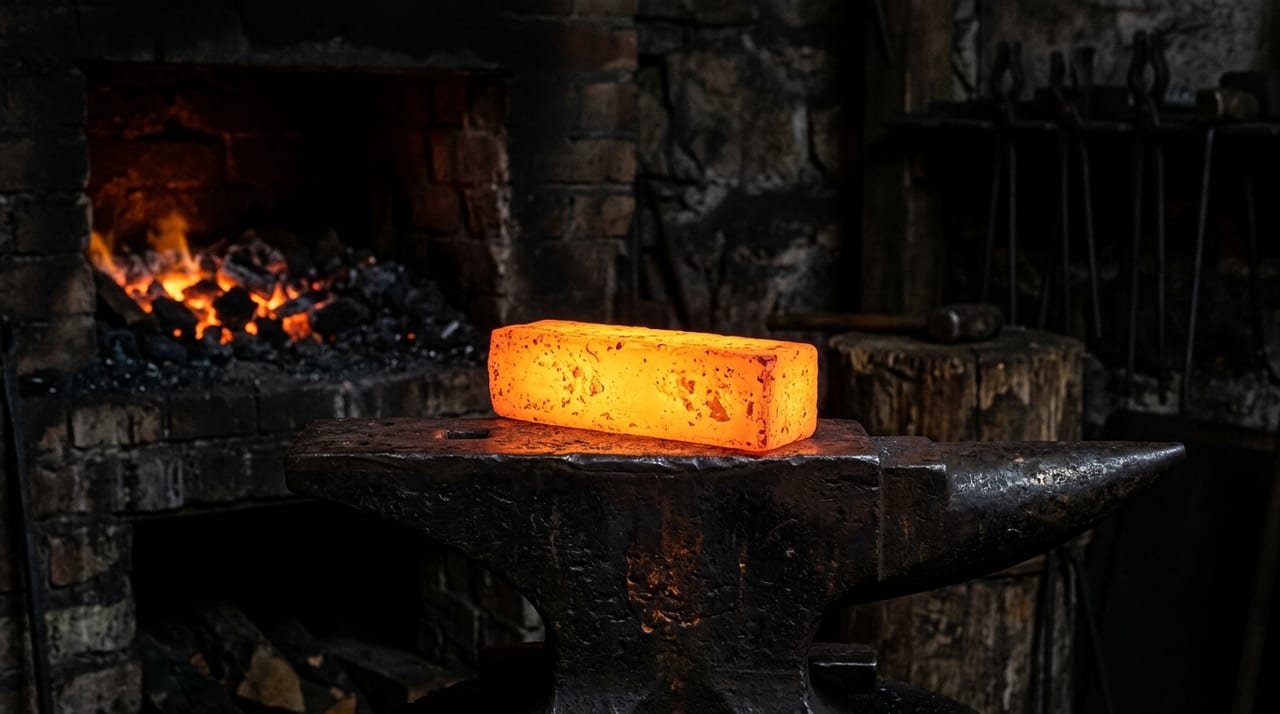
Steel changes its luminous color according to temperature when heated. This phenomenon corresponds to what physics calls "blackbody radiation," but in the world of the tōshō it has long been referred to collectively by the word "hi-iro." By accurately reading the changes in hi-iro, the tōshō can grasp the state of the steel without a thermometer.
Using a thermocouple allows temperature to be recorded as a numerical value, but forging is a dynamic operation in which the steel is moved in and out of the fire bed while wielding a hammer, and there is no time to check a measuring instrument against the steel with each blow. While wielding the hammer, the tōshō continuously judges the timing for returning the steel to the furnace and the timing for finishing a strike based on momentary changes in hi-iro. This is where a practical rationality difficult to replace with measuring instruments lies.
The Correspondence Between Temperature and Hi-iro — Reading the State of Steel from Its Color
The luminous color of steel corresponds roughly as follows. All of these are universal phenomena based on the law of blackbody radiation.
"Dark red" (an-sekishoku) is approximately 550–650°C, the stage at which the steel barely begins to take on a reddish tint. It is still not suitable for forging. "Red" (akai-ro) is approximately 700–800°C. The steel begins to soften, but the temperature is still too low for orikaeshi tanren. From "bright red" to "vermilion red" (shu-aka) is approximately 800–950°C, where softening advances and this becomes the starting point for forging. "Orange" (daidai-iro) is approximately 950–1050°C. This is optimal for the main processes of orikaeshi tanren and is the color the tōshō faces for the longest time. From "yellow-orange" to "white heat" (hakunetsu) is approximately 1100–1300°C. This is a high-temperature zone close to the melting point; if this temperature continues, "burning" begins, in which the carbon in the steel is oxidized and lost, making it a danger zone.
The tōshō performs the great majority of forging between orange and yellow-orange, and continuing to watch this color is one of the cores of training.
It should be noted that what hi-iro indicates is the luminous emission of the steel's surface. In thicker sections, temperature differences can arise between the surface and the interior, so the tōshō judges not only by color but also by the feel of the hammer upon striking and the way the steel spreads. Hi-iro is not treated as a standalone indicator but as one among multiple sources of sensory information.
The Effect of Forging Temperature Differences on the Sword
Why is temperature management so important? It is because the forging temperature directly affects the final structure of the sword.
If the temperature is too high, "burning" occurs: in addition to carbon oxidation, crystal grains coarsen (overheating structure), causing the sword to lose its toughness. Conversely, if the temperature is too low, the steel does not soften sufficiently, and forging proceeds without the internal stresses and cracks being resolved, which can later appear as "surface cracking" (hada-ware) in subsequent processes.
By striking in the optimal temperature range, the carbon within the steel is distributed uniformly, inclusions (impurities) are eliminated, and an ideal jigane structure is formed. The precision of this temperature management directly connects to the beauty of the final hamon and the fineness of the jigane texture.
Orikaeshi tanren is not a one-time process but an operation of repeatedly heating and hammering. If the temperature varies each time, variations arise in the steel's structure as well. Whether the same hi-iro can be stably reproduced time and again determines the uniformity of the jigane as a whole.
The Bellows and Charcoal — How the State of the Furnace Affects Hi-iro
To accurately read hi-iro, maintaining a constant state within the furnace is also essential. Since the color of the flame and the luminosity of the steel change depending on the type and amount of charcoal and the volume of air blown by the bellows (fuigo), if furnace management is inadequate, reading hi-iro itself becomes difficult.
A skilled tōshō also simultaneously reads the color of the flame inside the furnace itself — whether it is a reducing flame or an oxidizing flame. A bluish "reducing flame" (kangen-en) indicates an ideal state in which the combustion of carbon is minimized; a yellow-to-white "oxidizing flame" (sanka-en) indicates a dangerous state in which the steel is prone to oxidation. The cooperation of the tōshō and the fuigo operator in maintaining the quality of the flame is a prerequisite for hi-iro judgment to function.
Aligning the position and angle at which the steel is placed into and removed from the furnace each time also becomes important for comparing hi-iro. Many tōshō develop the habit of viewing the steel from a fixed position and distance in the furnace, thereby reducing variation in the apparent color caused by differences in viewing angle and distance.
Points the Tōshō Keeps in Mind for Hi-iro Judgment
- Align the angle and distance of viewing the furnace each time
- View the fire bed for only an instant, and do not continue to stare (staring allows the eye to adapt to the brightness, making subtle changes in color harder to discern)
- Check not only the surface of the steel but also the color of thicker sections
- Also simultaneously check the color of the furnace flame (whether it is a reducing flame or an oxidizing flame)
Training and Mastery — How to Develop an Eye for Reading Hi-iro
The skill of hi-iro judgment cannot be acquired through classroom study; it can only be developed by standing continuously before the furnace. In the early stages of training, an apprentice primarily manages the furnace as a fuigo operator, and through observing the relationship between the flame and the steel, accumulates the empirical rule that "the master begins striking when the color is around this shade of orange."
Next, as a teko, holding the steel at the master's side, the apprentice repeatedly memorizes the hi-iro at the moment the master judges "strike now." When further assigned to forge independently, the apprentice must manage the furnace fire and judge the temperature with their own eyes.
In this process, many apprentices experience failures from misreading temperature. Steel that burned, steel that was too hard, steel that cracked — the memory of such failures shapes the sense of "the correct hi-iro." Hi-iro judgment is also a skill that cannot be fully conveyed through words and diagrams alone. This is also why, in many workshops, oral transmission from master to apprentice and repeated observation remain the central means of passing on the skill, rather than systematic manuals.
The Influence of the Light Environment — Why the Forge is Dark
It is no accident that traditional forges are designed with a dim environment. Under direct sunlight or bright lighting, the luminous color of the steel is lost among the surrounding light, making it impossible to read accurately. A dim environment is precisely the optimal lighting condition for hi-iro judgment.
This principle remains unchanged even in modern tōshō workshops. Even in workshops that have introduced electric hammers, the space in front of the furnace is kept intentionally dark. Among Japan's traditional crafts, this is noteworthy as an example where the management of the light environment itself is directly connected to the technique.
In many forges, the position and size of windows are also considered, arranged so that outside light does not shine directly onto the furnace flame. Measures are taken so that even when outside brightness changes with the weather and time of day, the area around the furnace alone can maintain a constant level of darkness.
The Moment of Yaki-ire and Hi-iro — The Most Tense Moment
Hi-iro judgment becomes important not only in the forging process. Immediately before the yaki-ire that produces the hamon, when heating the blade to which tsuchioki has been applied, the tōshō also relies on hi-iro to determine the timing for stopping the heating.
The reason many tōshō perform yaki-ire in a darkened room or at night is the same principle touched on regarding the light environment: to accurately capture even the slightest changes in the luminous color of the steel. If temperature judgment is mistaken at the yaki-ire stage, there is a risk that the hamon will not appear as intended, or the steel may crack during rapid cooling. This is a moment that demands a one-time, irreversible judgment even more than forging, and is considered one of the moments when a tōshō's concentration in hi-iro judgment is most tested.
Summary — Hi-iro as the Tōshō's Sixth Sense
Hi-iro judgment is a typical example of a sensory skill that cannot be quantified, and it concisely demonstrates that Japanese craftsmanship is an accumulation of "tacit knowledge." The moment of feeling "now" when seeing orange-colored steel is judged by physical memory cultivated through thousands of forgings, bypassing conscious thought. This skill of "thinking with the body" is one of the factors that makes the Japanese sword one of the world's foremost handcrafted objects.
The very fact that even in the modern age when measuring instruments have become widespread, this intuition-based judgment has not been replaced speaks to the high degree of completion of hi-iro judgment as a technique.