Jitte and Jittejutsu — the Edo-Period Arresting Weapon That Entrapped Swords, and Its Unexpected Connection to the Sword Industry
 * Image is for illustrative purposes only.
Table of Contents
What Is the Jitte — "Natural Enemy" of Swords and Its Kindred
If the Japanese sword is the soul of the warrior, the jitte could be called the "natural enemy of swords." This iron weapon, carried by okappiki (informants) and dōshin (constables) of the Edo period, was born from a completely original concept: its primary purpose was to "receive, entangle, and neutralize" an opponent's sword — making it an entirely distinctive defensive and restraining weapon.
The relationship between the jitte and the sword industry is not adversarial. Rather, the manufacture of jitte was also the work of sword smiths, made from the same iron as swords and crafted using the same metalworking techniques. Understanding the jitte means understanding the diversity of Japan's metalworking culture and weapons manufacturing.
The Structure of the Jitte and the Names of Its Parts
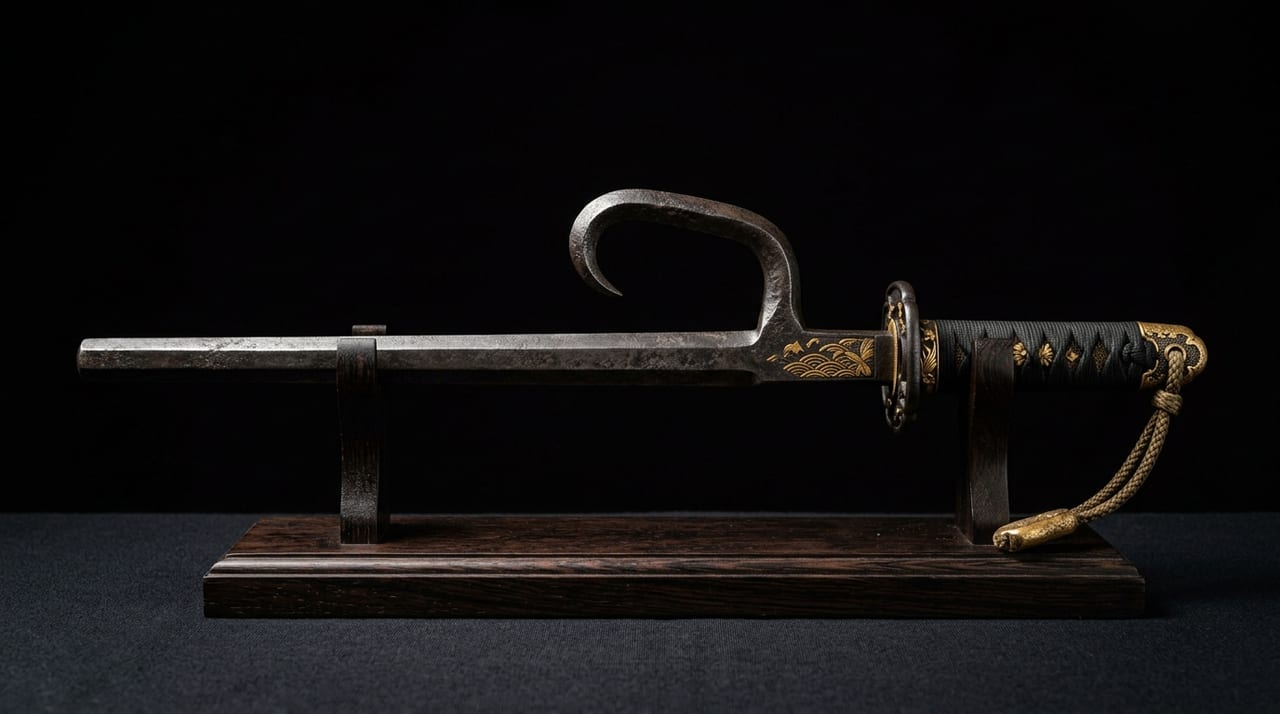
The basic structure of the jitte is simple but functionally sophisticated.
- Main body (kagi / thrusting tip): Overall length is generally 30 to 50 centimeters. Cross-sections come in various shapes — circular, hexagonal, octagonal — and the tip forms a sharp thrusting point. Iron was the primary material, and forging gave it a combination of toughness and hardness. Manufacturing methods varied widely, including steel pieces that had undergone orikaeshi tanren and monolithic forgings heat-treated uniformly throughout. Because there was no need to create a hardened cutting edge as on a sword, making the iron uniformly consistent was the top priority.
- Kagi (hook projection): A lateral projection set near the tsuka of the main body — this is the most distinctive feature of the jitte. When receiving an opponent's sword, this kagi hooks the blade and entangles it. The shape of the kagi ranges from the "ippō kagi," which projects in a single direction, to the "moro kagi," which has projections on both sides. The widely known theory for the name "jitte" is that the combined shape of the main body and the kagi resembles the Chinese numeral for ten. The angle and length of the kagi varied subtly by school, region, and intended use, which directly relates to the individual variation in jitte and the diversity of their appraisal as antiques.
- Tsuka (grip): The grip portion, finished with leather, braided cord, and metal fittings to prevent slipping from perspiration. Unlike swords, jitte had no saya, and were carried either directly through the belt or in a dedicated pouch called a jittebukuro. There was also proper etiquette for how to wear them through the belt; it is generally said that they were worn on the left side of the waist, in front of the sword, in a position allowing immediate drawing.
- Fusa (tassel): A decorative cord attached to the end of the tsuka. Colors such as red, white, and navy blue sometimes indicated rank and affiliation. It is also said that among okappiki, those who had accumulated achievements were permitted specific colors, and the color of the fusa functioned as a mark indicating the status of its owner.
The Okappiki System and the Bugyōsho Organization — The Social Role Borne by the Jitte
To speak of the jitte, one must understand the organization to which its carriers belonged. Public order in the Edo period was maintained by the bugyōsho organization headed by the machi bugyō. The active forces of the bugyōsho were the yoriki and the dōshin, and dōshin informally employed several to a dozen okappiki per person, using them for intelligence gathering, surveillance, and assistance in on-site arrests.
Okappiki were not an official position of the shogunate; they were "goyōkiki" (informants) employed at the dōshin's personal expense, so their compensation was unstable and their social standing was low. However, the role that okappiki played in actual investigations and intelligence gathering was significant, and it is said that their information network, spread like a web, underpinned public order in Edo.
The way okappiki were permitted to carry jitte was through an act by the responsible dōshin called "shita-watasu" (delegation). Although informal, this delegation served as proof of commission from the dōshin and was the basis for okappiki to conduct investigative activities in the name of "goyō." It is said that the number of okappiki throughout Edo reached from several hundred to around one thousand, making the jitte a weapon carried by that many ordinary townspeople.
Dōshin themselves also carried jitte as official weapons. Officially issued pieces had a mass-produced finish, but wealthy dōshin sometimes commissioned elaborate custom pieces from metalworkers. Some of these personal jitte had family crests or preferred patterns engraved on them, and they are known as highly valued items in today's antique market.
Jittejutsu — A System of Techniques for Controlling the Sword
The jitte was not merely a tool; its use involved a systematic set of techniques called jittejutsu.
The basics of jittejutsu are "receiving and capturing." Against a sword attack, one deflects using the main body or the kagi of the jitte, and at the moment the sword is caught on the kagi, the sword is neutralized. After controlling the sword, the sequence of movements continues into "torinawa," in which the opponent is pinned down and bound with rope.
Famous schools that systematized jittejutsu include the Sekiguchi-ryū and the Araki-ryū. These schools placed great importance on sparring practice against swords using the jitte, and the core of training was considered to be the ability to read the trajectory of a sword, agility of body movement, and calculation of interval. As technique names, each school preserves its own forms, including sweeping motions that brush up a sword from below, motions of receiving a kesagiri slash while opening the body, and motions of winding the blade with the kagi.
Also, the jittejutsu used in actual combat by okappiki and dōshin differed from the formal patterns of the schools and was more impromptu and practical in nature. It is recorded that "kyōgeki" (flanking), in which multiple jitte users cooperated to surround a single swordsman, was also a common tactic. In actual arrests, rather than directly countering a sword attack, the priority was to encircle with multiple people, exploit a momentary opening, and apply the rope.
Extant Materials — Museum Holdings and the Antique Market
Actual jitte, as Edo-period arresting implements, are still held today in museums and resource centers throughout Japan. Compared to swords, they tend to be accorded lesser importance as cultural properties, but in recent years a reevaluation has been progressing in the context of Edo's security culture. In local history museums and historical museums throughout the country, actual jitte are often included as part of exhibits related to the bugyōsho, and one can directly observe how differences in the color and shape of the fusa reflect the status distinctions of the time.
In antique dealers specializing in swords and at antique markets, period jitte are regularly put up for sale. Pieces bearing a mei (tōkō signature) and elaborate decorative custom pieces are particularly highly regarded, and they serve as an entry point for sword collectors to broaden their interest to include "kobuki" (old weapons) in general, such as jitte, fundō-gusari, and shuriken.
The Modern Transmission of Jittejutsu
Today, schools and organizations that continue the practice of jittejutsu still exist. In dōjō of classical martial arts, kata practice incorporating the jitte is still passed down as a living martial art, and there is a continuing demand for practice jitte made of iron, aluminum, and wood. Interest in jittejutsu is also high in the context of self-defense and martial arts research, and organizations working on the preservation and dissemination of traditional techniques continue their activities throughout Japan.
Sword Smiths and the Manufacture of Jitte — "The Sword's Counterpart" Made by Iron Craftsmen
The manufacture of jitte in the Edo period was carried out primarily by sword smiths and metal fittings craftsmen. Handling the same iron material as swords, the processes of forging, yaki-ire, and polishing also overlap significantly with sword production.
However, the decisive difference from a sword is that jitte have "no blade." Since jitte are not intended for cutting or slashing, the yaki-ire process of creating a hamon is unnecessary; rather, the priority was to give the entire implement a uniformly tough resilience. In the opposite direction from the hard and brittle cutting edge of a sword, it is a product that takes advantage of the properties of iron.
Jitte of the Edo period came in a wide range of grades, from common pieces to fine work from the hands of master craftsmen. Officially issued pieces supplied by the bugyōsho had a mass-produced finish, but wealthy dōshin and goyōkiki sometimes commissioned elaborate jitte from metalworkers to their own specifications.
The Intersection of Jitte and the Sword Industry in the Modern Era
In the modern sword industry, jitte have formed a certain market as an independent collecting object. Period jitte are put up for sale as antiques at sword fairs and antique markets, and particularly pieces with mei (sword smith signatures) and high-grade pieces with elaborate carvings are traded at high prices.
Among sword specialty shops, there are stores that handle not only swords but "kobuki" (old weapons) in general, dealing in weapons other than swords such as jitte, fundō-gusari, kusari-fundō, bō, and shuriken. This diversification in handled items is also related to the rise in inbound demand. Overseas enthusiasts of weapons and martial arts have a broad interest in Japanese weapons culture in general, not just Japanese swords, and jitte are one such example.
The Depth of Japan's Metalworking Culture as Seen Through the Jitte
The jitte tends to be overlooked in the shadow of swords, but it is an important legacy that demonstrates the depth of Japan's metalworking culture, weapons manufacturing, and martial arts systems. The fact that the same group of craftsmen was responsible for both "making" swords and "controlling" them demonstrates the flexibility of the craftsman society of the Edo period.
For sword collectors and enthusiasts of sword culture, broadening one's perspective to include "weapons other than swords" such as jitte, shuriken, and tessen leads to a more three-dimensional understanding of Japan's history of weapons manufacturing and martial arts. In terms of expanding the base of the sword industry, the dissemination, exhibition, and sale of such "peripheral weapons" can also be said to be a worthwhile endeavor.
Related column: Edo-Period Sword Culture and the Refinements of the Samurai