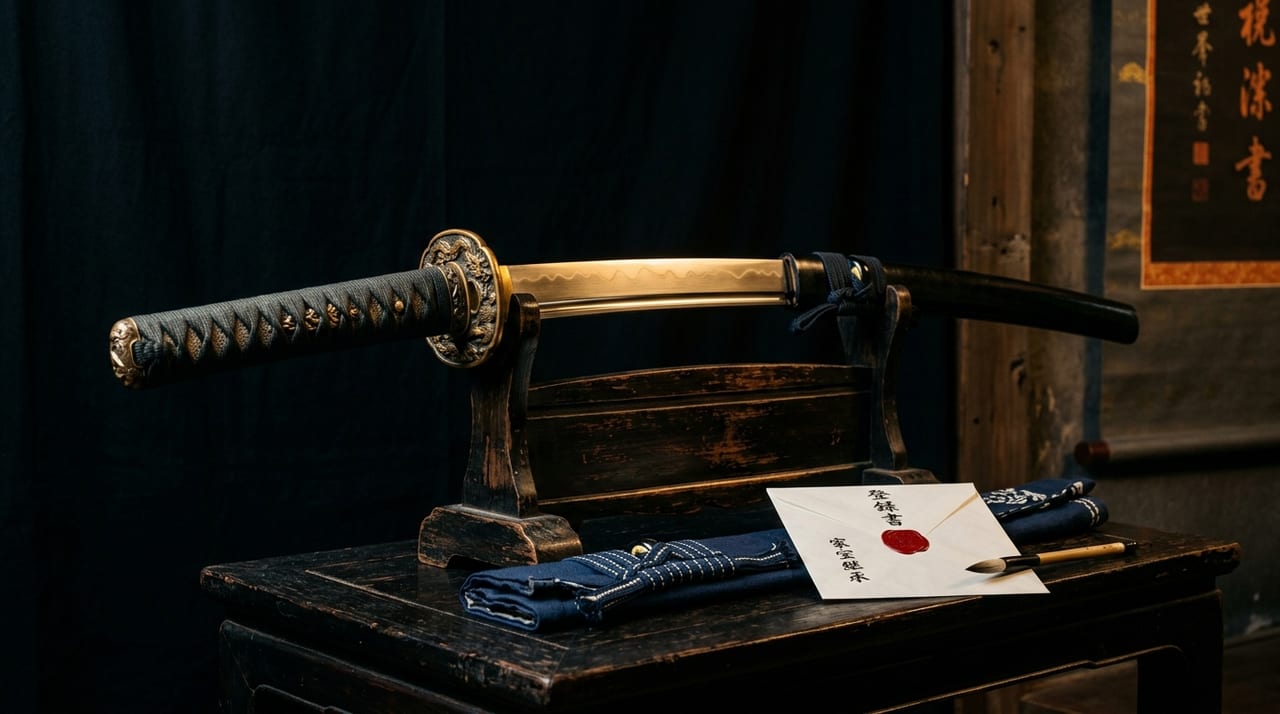
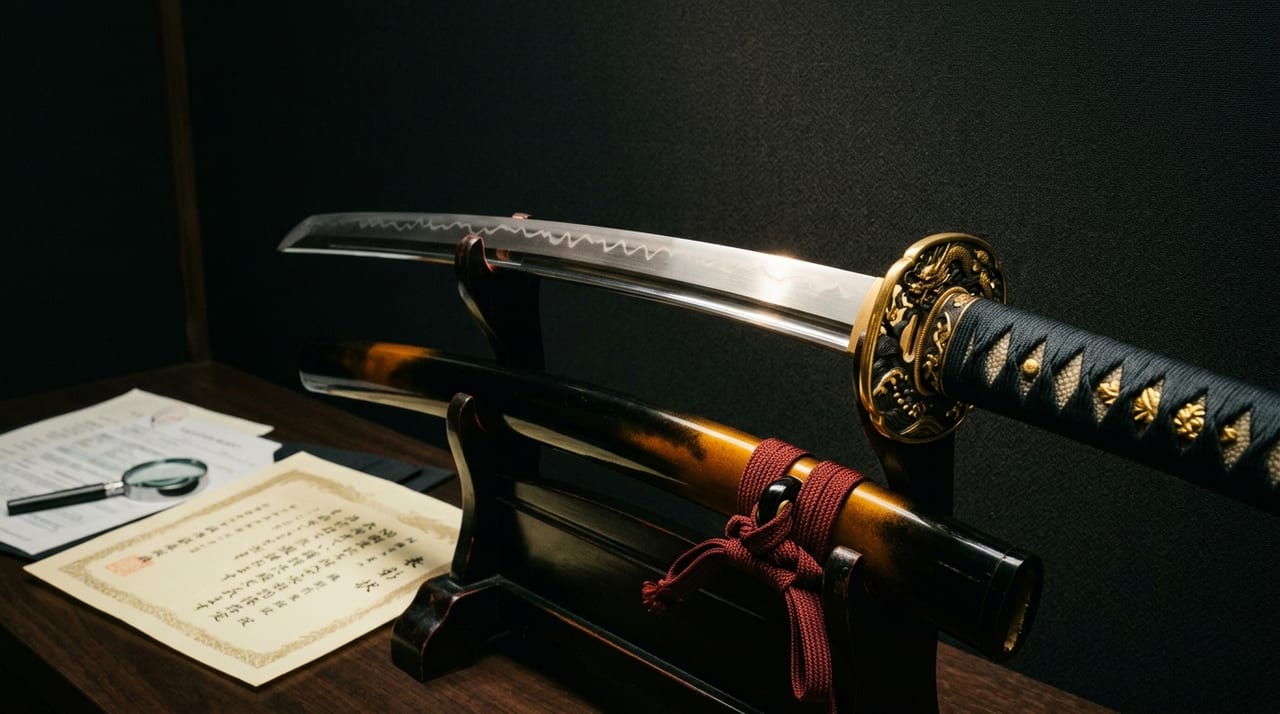
Complete Legal Guide to Japanese Swords | The Firearms and Swords Control Act (Jūtōhō), Registration Certificates (Board of Education), Possession, Buying and Selling, and Penalties for Carrying
 * Image is for illustrative purposes only.
Table of Contents
Introduction — Is the Nihontō an "Art Object" or a "Deadly Weapon"?
The nihontō is a craft recognized worldwide, and many works have been designated jūyō bunkazai (Important Cultural Property) or jūyō bijutsuhin (Important Art Object) by the state. At the same time, as a bladed instrument capable of injuring people, it is also a dangerous item. For this reason, Japan's Act for Controlling the Possession of Firearms or Swords and Other Such Weapons (Jūtōhō) sets out clear rules governing all aspects of possession, carrying, transport, and export. Violations can result in criminal penalties even if committed unknowingly, so enthusiasts, collectors, and those who have inherited a sword should be sure to read this article.
Scope of the Firearms and Swords Control Act (Jūtōhō): Which Swords Are Subject?
Article 2, Paragraph 2 of the Firearms and Swords Control Act (Jūtōhō) defines "tōkenrui (swords and other such weapons)" as swords, spears, and naginata with a blade length of 15 cm or more, swords (ken) with a blade length of 5.5 cm or more, aikuchi (daggers), and certain switchblades (Act for Controlling the Possession of Firearms or Swords and Other Such Weapons (e-Gov Legal Search)). In the case of nihontō, virtually all swords exceed this standard.
The specific regulated tōkenrui categories are as follows.
- Katana: nagasa (blade length) of 2 shaku (approx. 60.6 cm) or more
- Wakizashi: nagasa of 1 shaku or more and less than 2 shaku (approx. 30.3–60.6 cm)
- Tantō: nagasa of less than 1 shaku (approx. 30.3 cm); if the blade length is 15 cm or more it falls under the definition of tōkenrui (blade length categories from Nagoya Sword Museum)
- Naginata and yari (spear): different blade-length standards apply, but they are regulated in the same way
On the other hand, replica swords (not live blades) and practice swords for iai (made of zinc alloy, etc.) do not fall under "tōkenrui." However, metal replica swords that closely resemble regulated tōkenrui are prohibited from being carried without a legitimate occupational or other justification (Article 22-4).
Registration System: Prior Notification to the Board of Education is a Prerequisite
The only way to legally possess a nihontō is to obtain a "registration certificate." A nihontō without a registration certificate is illegal to possess, even if it has value as an art object.
Registration Process
- Application for examination: Bring the sword in person or send it by mail to the prefectural Board of Education for a firearms and swords registration examination. Examinations are held several times a year (varying by prefecture).
- Examination criteria: The examination determines whether the sword qualifies as a "tōkenrui of value as an art object," based on the assessment of registered examination commissioners (Article 14). Manufacturing method, form, historical background, and other factors are verified.
- Issuance of the registration certificate: After passing the examination, a "registration certificate" is issued in the name of the prefectural Board of Education. The registration certificate records the characteristics of the sword (length, mei (signature), form, etc.).
- Fees: A fee set by the prefecture is charged.
If the Examination Is Not Passed
If a sword is judged to have "no value as an art object or antique," registration is refused and the sword becomes subject to disposal or neutralization. If there is concern about whether a sword will pass, it is recommended to consult the Board of Education in advance.
In the Case of Inheritance or Transfer
If a registered sword is inherited or received as a transfer, the new owner must notify the Board of Education of the prefecture that conducted the registration within 20 days (Article 17 of the Firearms and Swords Control Act (Jūtōhō)). Failure to make this notification is subject to imprisonment of up to one year or a fine of up to 300,000 yen (Article 32, Act for Controlling the Possession of Firearms or Swords and Other Such Weapons (e-Gov Legal Search)).
If an Unregistered Sword Is Found
If an unregistered sword is found during estate clearance or while cleaning out a storehouse, it must be reported to the nearest police station immediately. Reporting it will not result in prosecution for illegal possession, but leaving it unreported will be treated as unlawful possession and can result in penalties.
Rules for Possession, Carrying, and Transport
Possession with a registration certificate is lawful, but there are clear distinctions between "possession," "carrying," and "transport."
Possession at Home
Keeping a sword at home together with its registration certificate is lawful. However, in the event of theft or loss, there is an obligation to report to the police promptly.
Transport (When Moving the Sword)
When taking a sword outside the home, a legitimate reason is required. Examples of recognized legitimate reasons include the following.
- Bringing the sword to a sword dealer, appraisal session, or museum
- Transporting it to a craftsperson for polishing or repair
- Moving it for the purpose of buying, selling, or transferring
- Bringing it to an iaidō or battōjutsu dōjō (martial arts purposes)
When transporting the sword, always carry the registration certificate and keep the sword in a sword bag or dedicated case. Carrying a sword exposed is treated as "carrying" and is illegal without a legitimate reason.
Prohibition on Carrying in Public
Article 22 of the Firearms and Swords Control Act (Jūtōhō) prohibits carrying bladed instruments in public without a legitimate reason. Acts such as walking on a public road with a nihontō drawn from its sheath are illegal regardless of blade length, and actual arrests have been reported.
Foreigners Possessing a Nihontō in Japan
Foreigners residing in Japan as tourists, students, or workers can, in principle, legally possess or purchase a nihontō as long as the sword comes with a registration certificate. However, the following points require attention.
At the time of purchase: When purchasing from a Japanese sword dealer within Japan, always confirm that a registration certificate is attached to the blade. A sword without a registration certificate may be unregistered, and an unregistered sword — even if it is an antique — cannot in principle be possessed (Article 3, Paragraph 1). Even a registered sword must be transferred together with its registration certificate (Article 18, Paragraph 2).
Change of ownership at the time of buying, selling, or transferring: Even when a foreigner receives a sword as a transfer from a Japanese person, the new owner has an obligation to submit a change-of-ownership notification to the Board of Education of the prefecture where the sword was registered within 20 days (Article 17, Paragraph 1). Since the notification documents are in Japanese, it is advisable to use an interpreter or the assistance of a Japanese-speaking person if needed.
When leaving or returning to Japan: If you wish to take a nihontō you possess back to your home country, the "procedures for taking swords overseas" described later (obtaining an export appraisal certificate for antique art objects from the Agency for Cultural Affairs, customs declaration, etc.) are required. It is also essential to check in advance the import regulations of the destination country.
Common Misconceptions and the Correct Understanding
"The registration certificate records the owner's name"? — Incorrect. The registration certificate is an "identification document for the sword" issued by the Board of Education, and the owner's name is not recorded. Therefore, as long as the registration certificate matches the blade, whoever possesses it (having properly submitted a change-of-ownership notification) is acting lawfully. Conversely, since the registration certificate alone does not prove "whose sword it is," a separate report to the police is important in the event of theft.
"Old swords are fine without registration"? — Incorrect. Even kotō (old swords) from before the Meiji period, and even swords designated as jūyō bunkazai (Important Cultural Property), cannot in principle be possessed without registration (Article 3, Paragraph 1). Cultural and historical value and lawfulness under the Firearms and Swords Control Act (Jūtōhō) are separate matters.
"If you are not walking around carrying the sword, it does not count as 'carrying'"? — Incorrect. Even having a sword loaded unpackaged in a car trunk can, without a legitimate reason, become a problem as "transport." It is important to always place the sword in a bag or case, carry the registration certificate, and have a clear purpose for the move.
"No secondhand dealer license is needed for private transactions"? — If an individual buys and sells on a one-time basis, no secondhand dealer license is needed, but if buying and selling becomes continuous and repeated, it may be judged to be "carried out as a business," in which case a secondhand dealer license under the Secondhand Articles Dealer Act may be required.
Procedures for Taking Swords Overseas
Taking a nihontō overseas (exporting it) requires procedures involving multiple laws.
Regulation under the Act on Protection of Cultural Properties
Swords designated as kokuhō (National Treasure) or jūyō bunkazai (Important Cultural Property), or swords recognized as jūyō bijutsuhin (Important Art Object), are in principle prohibited from being taken out of the country. Even for other swords, an "export appraisal certificate for antique art objects" must be obtained from the Agency for Cultural Affairs for export (Agency for Cultural Affairs "Export Appraisal Certificate for Antique Art Objects"). At the point of export, the registration certificate becomes void, and the old registration certificate must be returned to the Board of Education of the prefecture where the sword was registered (Tokyo Metropolitan Board of Education "When Exporting Firearms and Swords").
Foreign Exchange and Foreign Trade Act
Under the Foreign Exchange and Foreign Trade Act, approval from the Minister of Economy, Trade and Industry (METI) is required for kokuhō (National Treasure), jūyō bunkazai (Important Cultural Property), jūyō bijutsuhin (Important Art Object), and similar items (Item 43 of Appended Table 2 of the Export Trade Control Order), as well as for swords destined for Russia (as an economic sanction measure). There is no procedure to apply to the Ministry of Economy, Trade and Industry (METI) for an export license or approval when sending ordinary registered swords to general-destination countries (Export Trade Control Order (e-Gov Legal Search)). An export declaration to customs is a separate matter.
General Procedure at the Time of Export
- Obtain an export appraisal certificate for antique art objects from the Agency for Cultural Affairs (the application must include a copy of the front of the registration certificate; the registration certificate itself must be returned to the Board of Education that registered the sword after export)
- Make an export declaration for tōkenrui at customs (airport or port), submit the original appraisal certificate, and present a copy of the registration certificate
- Check in advance the import regulations of the destination country (some countries prohibit or strictly restrict the import of tōkenrui)
One point requiring particular attention is that carry-on aboard aircraft is not permitted (the sword must be packed in special packaging as checked baggage), and each airline has different rules for checking in bladed instruments. It is essential to check with the airline in advance.
Penalties for Violations
Violations of the Firearms and Swords Control Act (Jūtōhō) are serious crimes that can result in imprisonment even if they appear minor. The main violations and penalties are summarized below.
| Violation | Penalty |
|---|---|
| Possession of unregistered tōkenrui (Article 3) | Imprisonment of up to 3 years or a fine of up to 500,000 yen (Article 31-16) |
| Carrying a blade exceeding 6 cm without legitimate reason (Article 22) | Imprisonment of up to 2 years or a fine of up to 300,000 yen (Article 31-18) |
| Failure to submit a change-of-ownership notification (Article 17) | Imprisonment of up to 1 year or a fine of up to 300,000 yen (Article 32) |
| Transferring without the registration certificate (Article 18) | Imprisonment of up to 6 months or a fine of up to 200,000 yen (Article 33) |
The provisions can be confirmed at the Act for Controlling the Possession of Firearms or Swords and Other Such Weapons (e-Gov Legal Search).
Cases where an unregistered sword found in an estate is kept without being reported, or where a sword believed to be a replica turns out to be real, may also constitute unlawful possession of an unregistered sword. Since the claim of "I didn't know" does not constitute legal grounds for immunity, early notification is important.
What Happens if You Possess a Nihontō Without a Firearms and Swords Registration Certificate?
Merely possessing an unregistered sword constitutes a violation of the Firearms and Swords Control Act (Jūtōhō) (Article 3, Paragraph 1) and is subject to imprisonment of up to 3 years or a fine of up to 500,000 yen (Article 31-16 of the Firearms and Swords Control Act (Jūtōhō), Act for Controlling the Possession of Firearms or Swords and Other Such Weapons (e-Gov Legal Search)). If you have merely lost the registration certificate for a registered sword, possession itself does not become unlawful, but you must promptly report it and obtain a reissue (Article 15, Paragraph 2). If an unregistered sword is found during inheritance or estate clearance, the lawful route is to submit a "found-item report" to the nearest police station before moving it, and then obtain a registration certificate through a registration examination session at the prefectural Board of Education.
Is a License Required to Simply Store a Nihontō at Home?
Unlike firearms, no license is required to possess a nihontō with a registration certificate. However, the registration certificate must be kept with the sword, and when ownership changes due to transfer or inheritance, the new owner has an obligation to notify the Board of Education of the prefecture that conducted the registration within 20 days (Article 17). Failure to notify is subject to imprisonment of up to 1 year or a fine of up to 300,000 yen (Article 32, Act for Controlling the Possession of Firearms or Swords and Other Such Weapons (e-Gov Legal Search)).
What Is Illegal When Taking a Nihontō Outdoors?
Carrying a blade exceeding 6 cm without legitimate occupational or other justification is prohibited under Article 22 of the Firearms and Swords Control Act (Jūtōhō), and violations are subject to imprisonment of up to 2 years or a fine of up to 300,000 yen (Article 31-18, Act for Controlling the Possession of Firearms or Swords and Other Such Weapons (e-Gov Legal Search)). Appraisal sessions, registration examination sessions, requests for polishing, and carrying a sword home immediately after purchase all qualify as legitimate reasons, but it is essential to be prepared for police questioning by packaging the sword so the blade is not exposed, taking the most direct route, and keeping a note of the destination and travel time.
What Should Be Kept in Mind Legally When Buying or Selling a Nihontō?
Buying and selling itself is lawful, but the original registration certificate must be handed over together with the blade, and the buyer must submit a change-of-ownership notification to the Board of Education within 20 days. A secondhand dealer license under the Secondhand Articles Dealer Act is required for continuous transactions carried out as a business, while private transactions between individuals are not subject to this licensing requirement. It must also not be overlooked that selling to an overseas customer requires an additional export appraisal certificate for antique art objects from the Agency for Cultural Affairs (at the time of export, the registration certificate becomes void and must be returned to the Board of Education).
What Should Be Done First When Inheriting a Nihontō?
The first step is to confirm whether a registration certificate is attached to the blade. If there is a registration certificate, submit a change-of-ownership notification to the prefectural Board of Education within 20 days. If the registration certificate cannot be found, first confirm with the Board of Education that conducted the registration whether the registration still exists; if it can be confirmed, obtain a reissue (Article 15, Paragraph 2). For a sword where registration cannot be confirmed (discovery of an unregistered sword), submit a found-item report to the nearest police station before moving it, and undergo a registration examination at the Board of Education following police instructions. It is important not to rush the estate division or disposal, but to complete the legal procedures first.
Related columns: Firearms and Swords Registration Certificate | Legal Criteria for Nihontō Possession | Legal Guide to Nihontō Export Regulations and Taking Swords Overseas
Conclusion: Correct Knowledge Protects the Sword
Following the proper procedures, anyone can legally possess, appreciate, and buy and sell a nihontō. The two key points are "whether a registration certificate exists" and "having a legitimate reason when carrying or transporting." In all cases — inheritance, purchase, or discovery — consulting the Board of Education or the nearest police station first is the best starting point. Respecting the law also contributes to protecting the nihontō, a piece of cultural heritage, for future generations.