Sword Registration Certificate — The 'Passport' of Japanese Swords
 * Image is for illustrative purposes only.
Table of Contents
What is a Gunpowder Firearm and Sword Registration Certificate
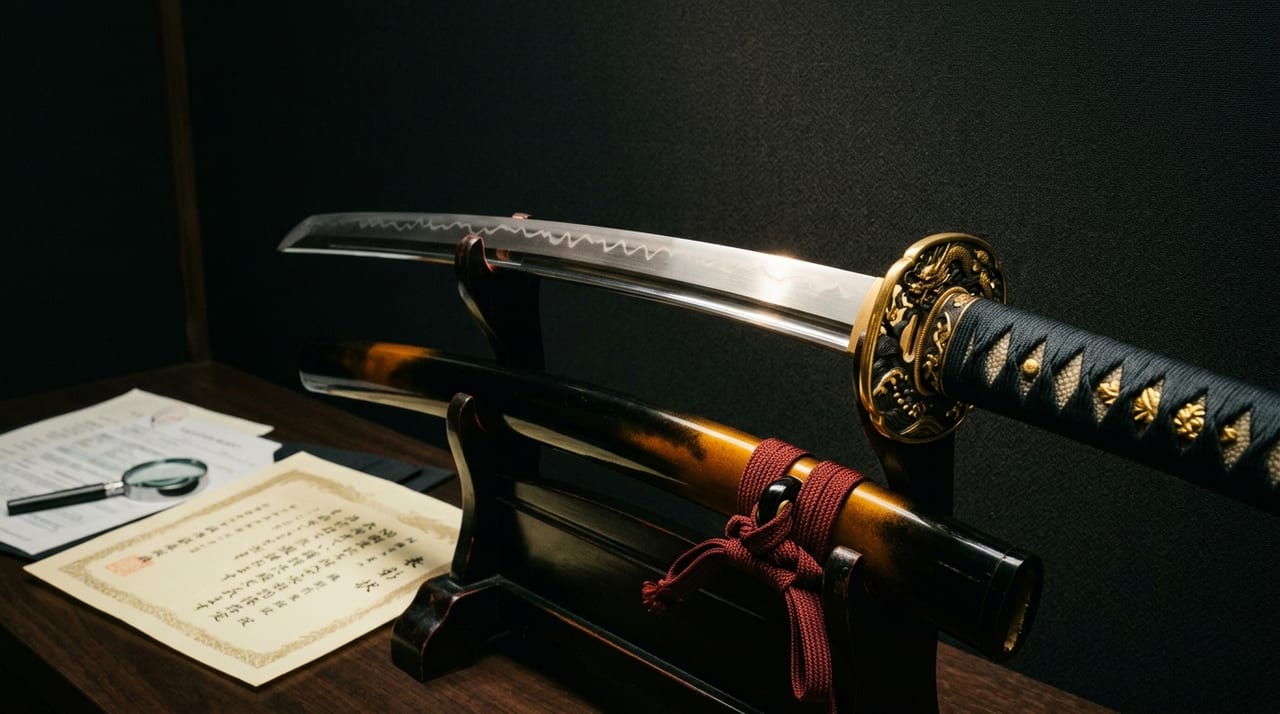
To legally own a Japanese sword, a "Gunpowder Firearm and Sword Registration Certificate" is essential. This is an official document issued by the Board of Education of each prefecture based on the Law Controlling Possession of Firearms and Swords (Gunpowder and Sword Law), and is called the "sword's passport" among sword enthusiasts.
What is important is that this registration certificate is tied to the sword blade itself. Even if the owner changes, the registration certificate moves with the sword, and the new owner inherits its contents. The registration certificate contains detailed physical characteristics of the sword, including type (tachi, katana, wakizashi, tanto, etc.), blade length, curvature, signature, and number of mekugi holes, functioning as the sword's "family register."
Swords that have not been registered may not, in principle, be possessed (Article 3, Paragraph 1 of the Gunpowder and Sword Law), and violations are subject to criminal penalties. The registration certificate is the document showing that the sword has been registered; losing it does not cancel the registration, and the owner reports the loss and has the certificate reissued (see below). Regardless of whether the acquisition is through purchase, inheritance, or gift, the existence of this registration certificate is a prerequisite in all situations involving obtaining a Japanese sword.
The Background Behind the Registration System
The current registration system was established after World War II. During the disarmament process by GHQ, many bladed weapons, including Japanese swords, were targeted for confiscation and destruction. However, the recognition grew that the Japanese sword is not merely a weapon but an art and craft object embodying the techniques of sword craftsmen and Japanese spiritual culture. With the amendment to the Gunpowder and Sword Law in 1958, a registration system was established to legally possess and appreciate Japanese swords as art objects.
Through this system, historically significant swords such as those made by Masamune, Muramasa, and the Osafune school have been preserved and passed down carefully in museums and private collections without being scattered. The registration certificate is not merely a permit but rather the institutional foundation for protecting sword culture.
Procedures for Obtaining a Registration Certificate
Newly discovered unregistered swords (found during house demolition or while cleaning out a storehouse, for example) must first be promptly reported to the nearest police station. Failure to do so could result in a violation of the Gunpowder and Sword Law.
After reporting to the police, the sword is brought to a "registration examination meeting" held periodically by the Board of Education. At the examination meeting, sword examiners designated by the prefectural Board of Education (usually certified examiners from the Japan Art Sword Preservation Society) directly examine the sword and determine its value as an art object. Examination criteria are diverse, including hamon, jihada, blade shape, and overall workmanship, and swords that are severely rusted and do not retain their original form or are clearly imitations cannot be registered.
Upon passing the examination, the prefectural Board of Education issues the Gunpowder Firearm and Sword Registration Certificate. This registration certificate is assigned a unique registration number and is thereafter managed in a national database by that number.
Procedures for Sales and Transfers
When a Japanese sword is transferred through sale, gift, inheritance, or other means, the new owner must file a notice with the Board of Education of the prefecture that handled the sword's registration within 20 days of receiving it (Article 17, Paragraph 1 of the Law Controlling Possession of Firearms and Swords, Gunpowder Firearm and Sword Possession Control Law (e-Gov Legal Search)).
The documents required for the notice are generally as follows:
- Gunpowder Firearm and Sword Registration Certificate (original)
- Owner Change Notice Form (in the format of each prefecture)
- Documents confirming the address and name of the transferor and transferee
Many prefectures accept this procedure by mail, and depending on where you reside, it can be completed without visiting the office. Similarly, when moving across prefectures, notification to the Board of Education at your new address is also required.
Failure to file the notice can constitute a legal violation, so prompt completion of the procedure is essential when obtaining a sword. When purchasing from a trusted sword dealer, whether they provide careful guidance on these procedures is one indicator of the store's trustworthiness.
In Case of Loss or Damage to the Registration Certificate
If the registration certificate is lost or significantly damaged, you must notify the prefectural Board of Education that issued it and have the certificate reissued (Gunpowder Firearm and Sword Possession Control Law (e-Gov Legal Search), Article 15, Paragraph 2). In Tokyo, reissuance always requires an inspection of the actual sword at a review session, and how long it takes depends on the review session schedule. The reissuance fee is 3,500 yen (Tokyo Metropolitan Board of Education, "Procedures for Reissuing a Registration Certificate"). Procedural details differ from prefecture to prefecture, so please check with the Board of Education where the sword was registered.
Additionally, if the contents recorded on the registration certificate do not match the actual sword (such as recording errors or if a signature is later identified), you can apply to have the contents corrected or amended. However, depending on the nature of the correction, re-examination may be necessary.
It is recommended to keep the registration certificate and the sword together at all times, and to store them in a clear file or dedicated case to prevent deterioration. It is also important to keep a copy in a separate location as protection against potential fire or flood damage.
Regarding Export Abroad and Importation
When taking a Japanese sword overseas, you obtain the Agency for Cultural Affairs' "Certificate of Export Inspection for Antique Art Objects". Swords designated as National Treasures or Important Cultural Properties and swords recognized as Important Art Objects are in principle prohibited from being taken out of the country, and this certificate is issued after the Agency for Cultural Affairs confirms that the sword to be exported is none of these (Agency for Cultural Affairs, "Certificate of Export Inspection for Antique Art Objects"). The registration certificate becomes invalid the moment the sword is taken out of the country and must be returned to the Board of Education of the prefecture where the sword was registered (Tokyo Metropolitan Board of Education, "When Exporting Firearms and Swords").
Conversely, when importing a Japanese sword from overseas, registration application with the prefectural Board of Education is necessary alongside customs clearance. There has been an increasing number of cases in recent years where Japanese swords that flowed overseas return home, and in such cases, too, the sword is registered with the Board of Education of the prefecture where the owner lives. The documents and procedures required at the time of export are explained in detail in How to Export a Japanese Sword Overseas.
All swords sold come with a valid Gunpowder Firearm and Sword Registration Certificate. If you are considering acquiring a Japanese sword, please feel free to contact us.