Reading the Blade Construction—Shinogi-zukuri, Hira-zukuri, Kiriage-zukuri, and Katakiriae-zukuri: Types and Historical Context
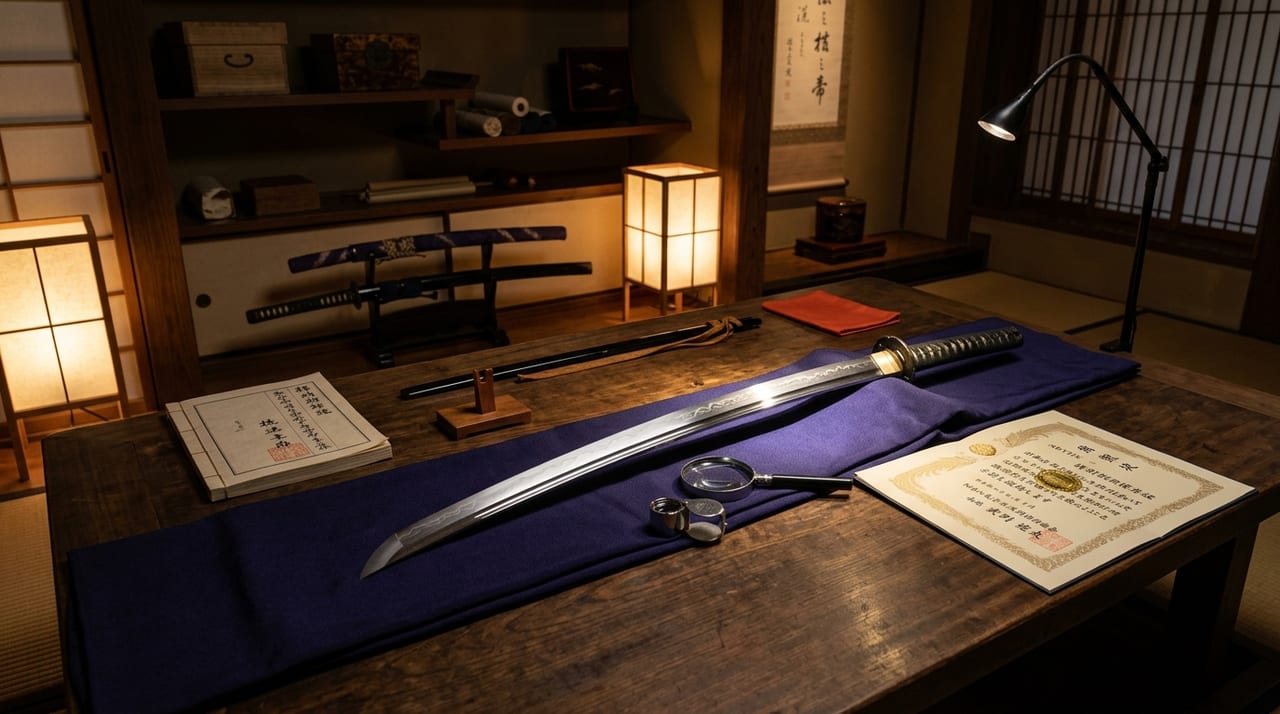 * Image is for illustrative purposes only.
Table of Contents
Understanding "Blade Construction"—The Structure That Defines a Sword's Form
When we speak of Japanese swords, what first catches the eye is their overall silhouette—the depth of curvature, the length of the blade, the shape of the point, and other broad outlines. Yet equally important is the cross-sectional form of the blade itself, what is known as "blade construction" (造り込み). Blade construction refers to how the forged steel is finished into a particular cross-sectional shape, and it directly determines a sword's cutting ability, strength, weight distribution, and intended use. Even two swords of identical dimensions will feel entirely different in the hand and behave in utterly distinct ways when cutting, if their constructions differ.
Japanese swordsmiths throughout history have varied their construction methods according to the era, region, and the patron's requirements. In modern appreciation, this knowledge is indispensable; understanding blade construction illuminates the historical context in which a particular sword was created and reveals the maker's intentions.
Shinogi-zukuri—The Dominant Standard in Blade Construction
The quintessential Japanese sword construction is shinogi-zukuri (鎬造り). A raised ridge line, called the "shinogi" (鎬), runs along the flat face of the blade, creating a cross-section roughly diamond-shaped. The area from the shinogi toward the cutting edge is called the "shinogi-ji" (鎬地), while the portion extending toward the spine is called the "mune" (棟). This ridge line provides vertical rigidity to the blade, creating a structure that is light yet highly resistant to bending.
Shinogi-zukuri has been adopted on the majority of uchigatana and tachi, appearing on everything from warring-states-era combat blades to Edo-period daimyo fittings. In authentication, the height and width of the shinogi provide clues to the work's school and era. For instance, tachi from the Bizen tradition typically display a shinogi that is relatively low and transitions smoothly, while the Soshu tradition often features a high, sharply defined shinogi known as "high shinogi" (高鎬). Even the minute details of the shinogi serve as important indicators for regional attribution.
Hira-zukuri—Understated Beauty Suited to Tantō and Wakizashi
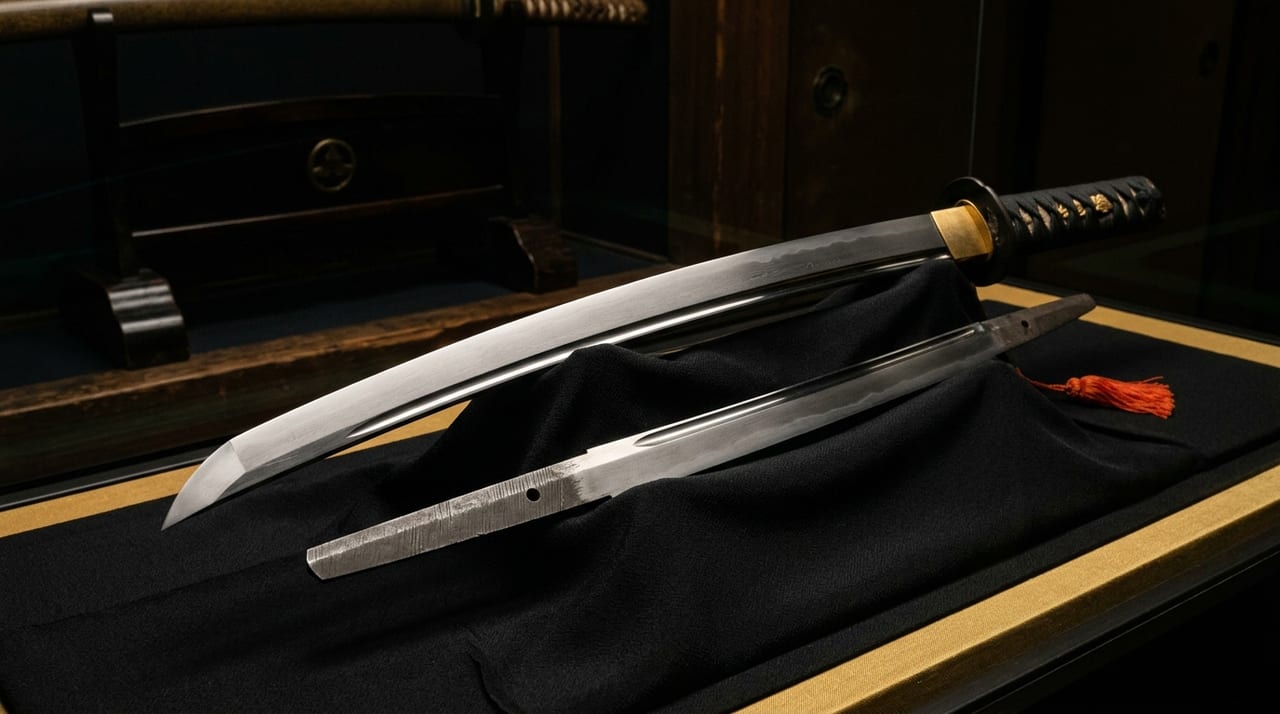
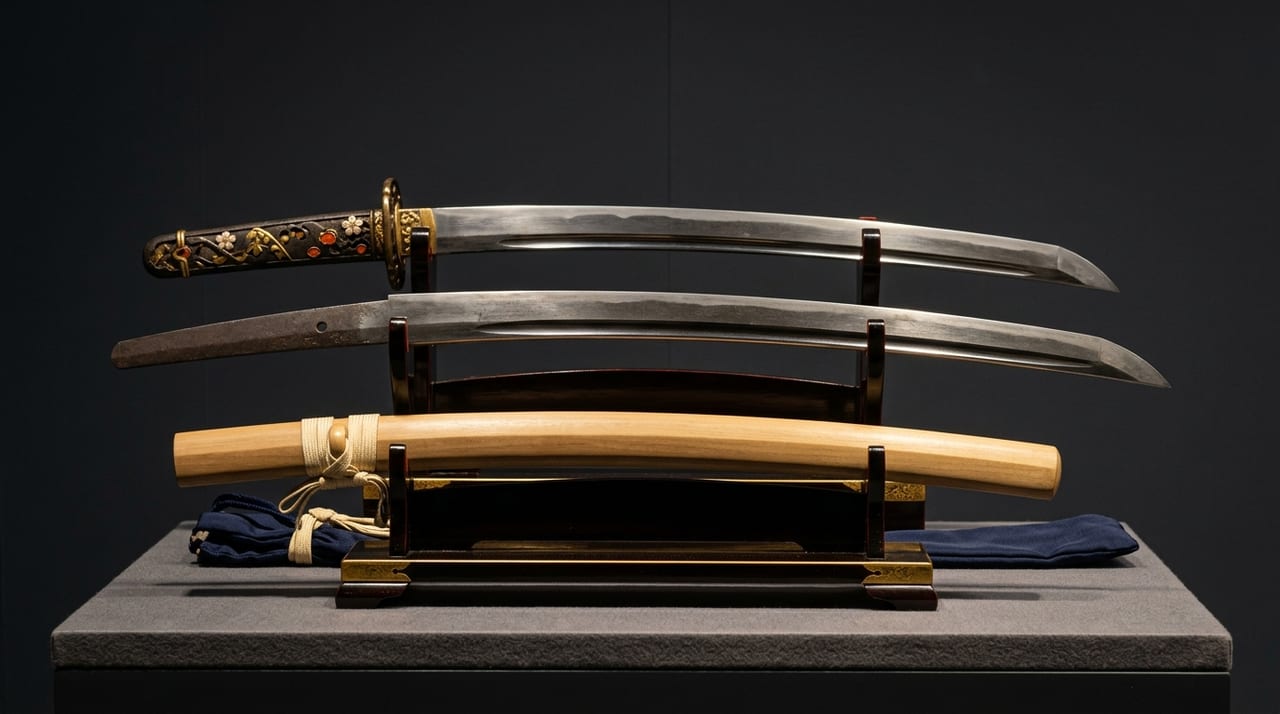
Hira-zukuri (平造り) lacks a shinogi entirely, presenting a literally flat cross-section. With no ridge line mediating between the face and cutting edge, the blade cross-section becomes a relatively thin wedge. While hira-zukuri sacrifices some of the vertical rigidity of shinogi-zukuri, with shorter blade lengths such a loss of strength is not problematic; consequently, this construction has long been favored for tantō and wakizashi.
Hira-zukuri tantō flourished from the late Kamakura through the Nanboku-chō periods, with many examples made at impressive dimensions. This era saw spectacular wavy temper lines (乱れ刃) worked across each section of the blade, and combined with the clean lines of hira-zukuri construction, the result is a powerful, commanding beauty. Hira-zukuri tantō by master craftsmen of the Soshu tradition such as Masamune and Yukihiro are emblematic of this period, with many designated as National Treasures or Important Cultural Properties.
Furthermore, hira-zukuri offers advantages in observing the blade's surface and steel. Without the step created by a ridge line, the grain pattern (肌目) and "working" (映り, the subtle reflections in the steel) can be observed directly and clearly, making this a construction especially easy to appreciate visually.
A variant of hira-zukuri known as shobu-zukuri (菖蒲造り) is also recognized. A shinogi line runs from near the habaki (blade collar) to the point, producing a slender, iris-leaf-like profile; this construction was preferred on longer wakizashi and harmonized beautifully with formal samurai dress, lending an air of refinement.
Kiriage-zukuri—A Refined Structure Retaining the Character of the Koto Period
Kiriage-zukuri (切刃造り) is understood as a variant of shinogi-zukuri. Where a standard shinogi-zukuri blade has the ridge line running through the middle of the cross-section, in kiriage-zukuri the shinogi is positioned lower, nearer to the cutting edge. As a result, the cutting-edge side is steep and angular, while the spine side forms a gentle, broad surface—in effect, an asymmetrical cross-section.
This construction appears frequently on tachi from the late Heian through early Kamakura periods and represents one of the characteristic styles of the Koto period (roughly before the Edo). When combined with deeply curved, lengthy tachi proportions, kiriage-zukuri evokes an ancient martial dignity befitting mounted combat. Among surviving early tachi, one can observe examples that retain vestiges of kiriage-zukuri while gradually transitioning toward shinogi-zukuri—fascinating historical documents for understanding how the Japanese sword took its shape.
Katakiriae-zukuri—A Rare Asymmetrical Construction with Edges on Only One Side
Katakiriae-zukuri (片切刃造り) is an extraordinarily rare construction: one face is flat (like hira-zukuri, without a shinogi) while the opposite face is cut-blade style (like kiriage-zukuri, with a shinogi). The cross-section shows one side opening outward flatly, while the other side bears a low ridge line. This construction is renowned for appearing on tantō by the great Kamakura-period master Kagemitsu (景光) of the Bizen school, and it remains known in connoisseur circles today as "Kagemitsu's katakiriae-zukuri."
As to why one would create such an asymmetrical form, one theory proposes that it was intended to limit the direction of the cut and optimize the blade for a specific use (or perhaps a formal technique). In any case, it represents a pursuit of distinctive functional beauty over versatility. In modern times, some swordsmiths have attempted katakiriae-zukuri, but its difficulty means few have mastered it, and it remains a treasured, scarce category of work.
Blade Construction and Historical Context—Why Forms Changed Over Time
The evolution of blade construction is not merely a matter of stylistic fashion; it is deeply intertwined with changes in combat methods, social structure, and materials technology across the ages.
From the Heian through Kamakura periods—the era of mounted samurai—long tachi suitable for downward cuts from horseback were the standard, and kiriage-zukuri or older-style shinogi-zukuri were widely employed. By the Nanboku-chō period, infantry-centered group combat had increased, raising demand for shorter blades and tantō emphasizing mobility. This is when hira-zukuri flourished.
In the Edo period, actual combat became rare, and the sword's character shifted toward being a "sashiriō" (差料)—a status symbol denoting a samurai's rank. In blade construction, practical considerations alone no longer dominated; beauty, rarity, and adherence to school traditions became paramount. While shinogi-zukuri remained the mainstream, custom tantō and coordinated fittings sometimes called for hira-zukuri or variant constructions selected deliberately for their aesthetic harmony.
The blade point itself reflects its era:
- Early to mid-Kamakura long tachi featured small points (favored by the court nobility)
- Nanboku-chō great swords displayed large points
- Warring-states practical blades, designed to pierce armor, featured blunt, boar-neck points (猪首切先)
On tantō, an inward curve—uchizori (内反り)—also appears, known from blade types like the Kikuchi-yari tantō as a construction suited for portable self-defense.
Training Your Eye to Read Blade Construction
To observe blade construction, it is best to begin by confirming the presence and position of the shinogi. If a shinogi is present, it is either shinogi-zukuri or kiriage-zukuri; if absent, it is hira-zukuri. Going further, by examining the shinogi's height, width, and proportion relative to the overall blade, one can begin to estimate the construction's era and school.
When viewing Japanese swords in museums and galleries, deliberately vary your viewing angle and observe the cutting edge, spine, and cross-sectional aspects. As the light changes, the shinogi line will appear and recede, allowing you to grasp the three-dimensional quality of the construction more clearly. Simultaneously, you may observe whether the steel's grain pattern and the temper line work in harmony with the construction.
A Japanese sword is a unified work of art in its totality, and blade construction is its structural skeleton. By understanding the construction alongside other elements—the overall form, curvature, temper line, and carving—the depth of narrative embodied in a single blade grows immeasurably richer. By beginning with the question "What construction does this blade possess?", new dimensions of sword appreciation will surely open before you.