Masamune's Ten Great Pupils — Ten Geniuses Taught by the Greatest Master
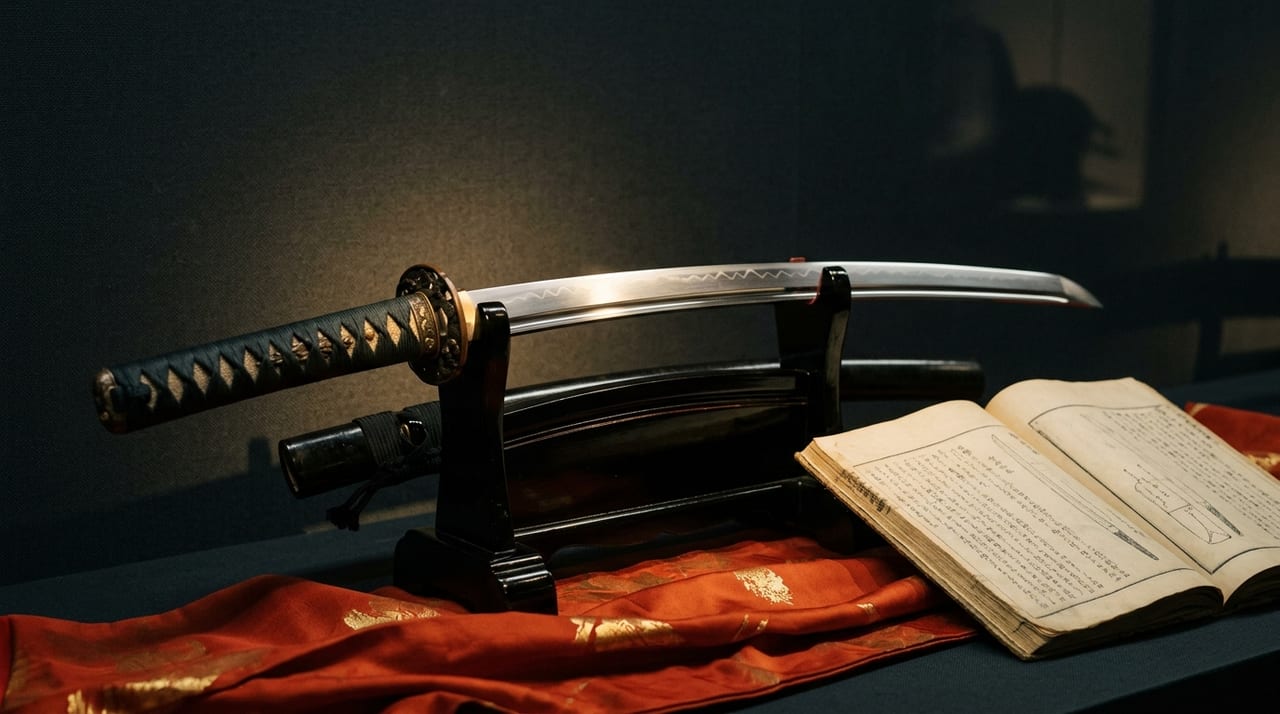 * Image is for illustrative purposes only.
Table of Contents
Masamune of Okazaki as the Pinnacle
Masamune of Okazaki, active from the late Kamakura period through the Nanboku-chō period, is widely recognized as the greatest swordsmith in the history of Japanese swords. As the perfector of the Sōshū tradition forged in Sōshū (present-day Kanagawa Prefecture), his blades—with their abundant jinie skin, vigorous hamon, and iron that achieved both beauty and resilience—exerted immeasurable influence on later smiths.
Blades authenticated as Masamune's work are rare today, and most have been certified through later appraisals by the Honami family. As scarcity and authority converged, Masamune's name eventually became a symbol of the "genius swordsmith." What was systematized from the Edo period onward was the concept of ten renowned smiths—the Ten Disciples of Masamune—said to have studied under Masamune.
What Are the Ten Disciples?
The term "Ten Disciples of Masamune" appears in Edo-period sword texts. Following the Confucian custom of calling Confucius's distinguished disciples the "Ten Disciples of Confucius," Masamune's leading pupils came to be called the Ten Disciples. However, the identities of the ten vary depending on the source, and there is considerable doubt as to whether some of them actually studied under Masamune. This is because the periods of their activity sometimes did not overlap, or they were geographically too distant.
Yet beyond such debate, what matters is the fact that the techniques of the Sōshū tradition spread throughout Japan with Masamune at its pinnacle. The framework of the Ten Disciples serves as a symbolic map that visualizes the genealogy of this transmission.
The Individuality and Techniques of Each Disciple
- Sadamune is believed to have been Masamune's biological or adopted son, positioning him closest to Masamune among the Ten Disciples. While faithfully inheriting the fundamentals of the Sōshū tradition, his hamon is somewhat gentler, with nie working in a more open manner. His style is characterized by a composed elegance that subtly contains Masamune's intensity.
- Samoji was a renowned smith of Chikuzen (present-day Fukuoka Prefecture) and is credited as the pioneer who transmitted the Sōshū tradition to Kyushu. Known for signing only with the single character "sa," this simplicity carries the bearing of a master. His jigane is tight, and his hamon, with its small nie-deki curved form, evokes the climate and landscape of Kyushu.
- Nagayoshi was a smith of Bizen Osafune (present-day Okayama Prefecture) who incorporated Sōshū's robustness into the Bizen tradition. Excelling in choji-midare and dai-midare, his large-scale compositions, with hamon work extending even to the shinogi-ji, possess overwhelming presence.
- Gō Yoshihiro was an Etchū smith (present-day Toyama Prefecture) and one of the Ten Disciples who displayed the most distinctive jigane. His forging, which interweaves small itame with mokume, shifts complexly and draws in the viewer. With extremely few extant works, his mystique as a "phantom swordsmith" remains high.
- Kanemitsu was a renowned master representing Bizen Osafune who achieved the pinnacle of choji-midare hamon. The brilliantly undulating choji requires advanced heat-treatment technique, and his achievement in retaining Bizen's refinement while absorbing Sōshū influence is highly valued.
- Shizu Saburō Kanetoki was a smith of Mino (present-day Gifu Prefecture) who established a unique style blending Sōshū's power with Mino's practicality. Important as a figure who laid the foundation for the later Mino tradition, tracing the origins of mass-produced Mino blades from the Muromachi period onward leads to Kanetoki.
- Kaneshige was a Mino tradition smith who originated in Echizen and moved to Mino, possessing a solid and reliable style without ostentation. With excellent jigane quality, his blades were prized as practical tools. While a modest figure among the Ten Disciples, his style was highly respected.
- Norishige was an Etchū smith known for complex jigane called matsu-kawa-hada. This distinctive expression is said to have been born from Etchū's climate and metalworking technique.
- Hiromitsu was a Sōshū smith who excelled at hitsura. This technique, in which most of the blade receives hardening, is vastly more difficult than normal hamon work, and Hiromitsu's hitsura, with nie filling even the shinogi-ji and near the ridge, is highly valued as one of the Sōshū tradition's achievements.
- Akihiro was a Sōshū smith said to have studied under Masamune in his later years and is positioned as the final inheritor of his techniques. His vigorous nie-filled hamon and refined jigane evoke Masamune's lineage.
The Technical Essence of the Sōshū Tradition
What is the essence of the Sōshū tradition that spread throughout the regions through the Ten Disciples? In short, it lies in "the control and expression of nie." Nie are fine iron particles that appear along the edge of the hamon, varying greatly depending on the temperature control during hardening and the water application technique. The Sōshū tradition required nie to work abundantly and vigorously, and jinie-deki—where nie spreads throughout the entire jigane—was the ideal.
Such techniques are realized only through the combined factors of iron sand quality, water hardness, charcoal type, and the smith's experience. The ten disciples carried the techniques nurtured by the environment of Masamune's Sōshū (near Kamakura) back to their home regions, developing them into distinct schools by combining them with local materials.
What the Legend Tells Us
Scholars continue cautious debate regarding the historical accuracy of the Ten Disciples of Masamune. Some figures' periods of study do not align, and others are estimated to have been older than Masamune, suggesting that the concept of the "Ten Disciples" likely contains later fabrications.
Yet behind the broad acceptance of this concept since the Edo period lies the undeniable fact that Masamune's techniques exerted a decisive influence on later smiths. Whether the master-disciple relationships were literal or metaphorical expressions of spiritual and technical transmission, the framework of the Ten Disciples eloquently testifies to the magnitude of the role the Sōshū tradition played in the history of Japanese swords.
A master swordsmith cannot exist in isolation. Excellent techniques are passed from master to disciple, transformed through different lands and people, and generate new masterworks. The narrative of the Ten Disciples of Masamune is a grand epic in the history of Japanese swords, symbolizing both the chain of technical transmission and the richness of creative innovation.