Legal Standards for Possessing Nihontō — Practical Guide to Antique Certification, Types of Registration Certificates, and the Risk of Invalidation
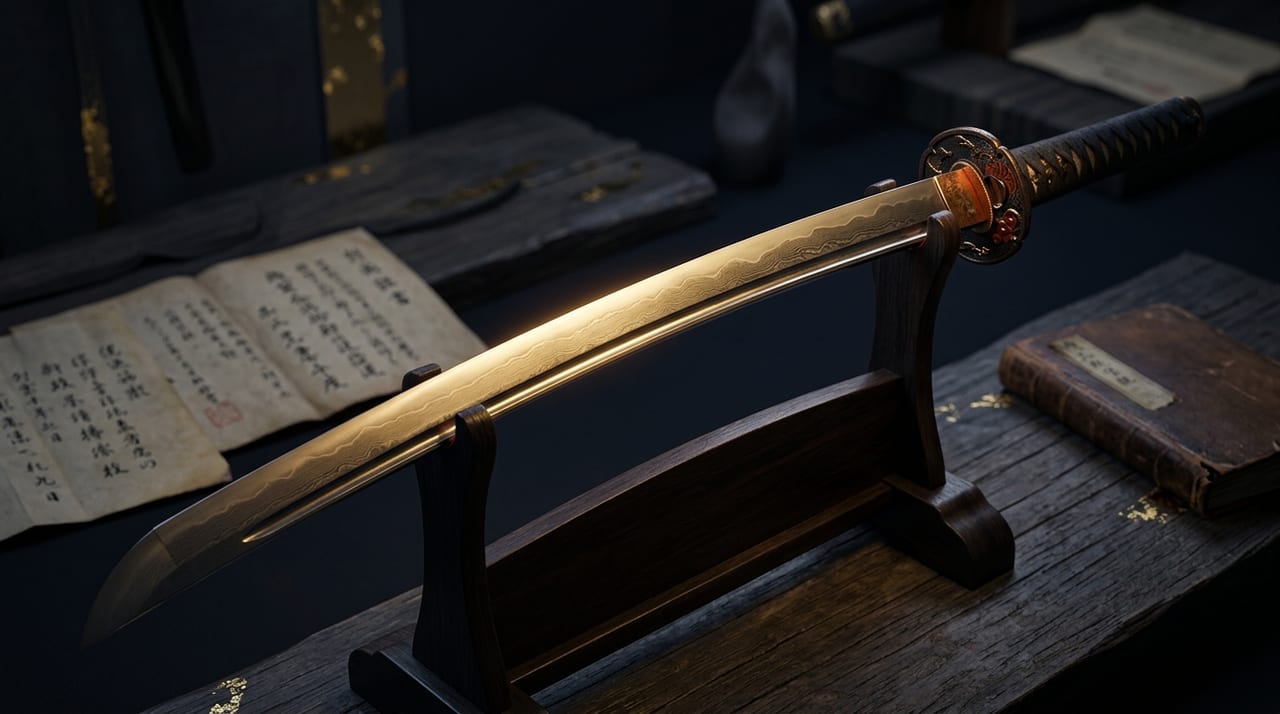 * Image is for illustrative purposes only.
Table of Contents
Background of the Registration System — Why the "Board of Education" Manages Swords
The Act for Controlling the Possession of Firearms or Swords and Other Such Weapons (Jūtōhō) was enacted in 1958 (Shōwa 33). With the echoes of the disarmament carried out under GHQ occupation still lingering, the newly formed Japanese government in principle prohibited the general possession of bladed weapons. At the same time, however, from the perspective of protecting swords as cultural properties, an exemption was established allowing possession of swords strictly classified as "art objects" on the condition that they be registered with the prefectural Board of Education.
This is why the Board of Education — which oversees cultural preservation — became the registering authority. Nihontō are positioned not merely as weapons but as "craft objects," many of which are nationally designated jūyō bunkazai (Important Cultural Properties) or jūyō bijutsuhin (Important Art Objects). That their examination falls under educational administration rather than the police or the Ministry of Economy, Trade and Industry (METI) is, from the spirit of the legislation, a natural consequence.
Understanding this historical context makes the true nature of the "registration certificate" clear. It is not merely a possession permit; it is a certificate demonstrating that a single sword has been recognized by the state as an art object possessing cultural and artistic value.
The Reality of "Art Object Certification" — Three Perspectives Examiners Consider
Registration examinations by prefectural Boards of Education are conducted at "sword examination committees" held several times a year. Examiners are in many cases sword researchers or members associated with the All-Japan Swordsmith Association. Holding the actual piece, they render judgment centered on the following three points.
First: Traditionality of Manufacturing Technique
Whether the sword was made using traditional forging methods employing tamahagane or watetsu (Japanese iron) is the first hurdle. Shōwa-era "sighting-type guntō" mass-produced in modern factories are often ineligible for registration because their blades are manufactured from rolled steel. On the other hand, "Shōwa-tō" forged by hand by a tōshō (swordsmith) even during the Shōwa era can be eligible for registration. Distinguishing the boundary between machine-made and hand-forged from the actual object requires a trained eye, and this is where the examiner's experience and knowledge are tested.
Second: Completeness of the Blade's Form
It is verified whether the hamon (temper line) and jigane (steel of the blade surface) are in a visually discernible state, and whether the blade has no critical chips or breaks. Swords whose hamon has been completely obliterated by deep rust, or those broken more than halfway through, may be rejected on the grounds that they have lost their "value as art objects." However, the determination of whether rust is "recoverable through polishing" or "corrosion that has damaged the blade itself" is made with care.
Third: Verification of Mei and Provenance
The mei (signature) is a required entry on the registration certificate, and swords bearing a false or altered mei are subject to registration refusal. In addition, while art object certification can be granted even to swords of unknown provenance, if illegal acquisition of a designated cultural property is suspected, an obligation to report to the police arises.
"Types" of Registration Certificates — Differences Between Prefectures
Because registration certificates are issued independently by each prefectural Board of Education, the format, paper, and order of entries differ by prefecture. However, the required entries are unified by ministerial ordinance, and the registration number, type, blade length, sori (curvature), number of mekugi holes, and mei text are common to all.
One important point to note: there is no problem if the prefecture listed on the registration certificate differs from the prefecture where the current owner resides. The registration certificate is tied to the sword, and re-registration with the Board of Education governing the owner's address is not required. There is no procedural obstacle to someone living in Osaka legally possessing a sword whose registration certificate was issued by the Tokyo Metropolitan Board of Education.
The same principle applies to change-of-ownership notifications: they are submitted not to the Board of Education of the new owner's prefecture of residence, but to the Board of Education of the prefecture that registered the sword (i.e., that issued the registration certificate) (Act for Controlling the Possession of Firearms or Swords and Other Such Weapons, Article 17, Paragraph 1). For example, if someone living in Osaka inherits a sword registered with the Tokyo Metropolitan Board of Education, the notification is submitted to the Tokyo Metropolitan Board of Education. When dealing with inheritance or purchase, confirm which Board of Education is listed on the registration certificate before filing.
Risks of Registration Certificate Invalidation — Problems Arising from Discrepancy with the Actual Object
Registration certificates have no expiration date. However, in practice, the following situations can lead to "de facto invalidation."
Change in Blade Length Due to Polishing
Repeated polishing of a nihontō gradually shortens the blade length. If the difference between the value recorded on the registration certificate and the actual measurement exceeds the permissible margin of error, there is a risk that the sword will not be recognized as the same blade. It is recommended to keep a record of regular polishing history, and to consult with the Board of Education if a discrepancy arises.
Addition or Modification of Mekugi Holes
When replacing the tsuka (hilt), adding a new mekugi hole creates a discrepancy with the content recorded on the registration certificate. It is essential to consult a specialist in advance before making any modifications to the blade.
Loss of Registration Certificate and the Difficulty of Reacquisition
If a registration certificate is lost, stolen, or damaged to the point of being illegible, the owner must report this to the Board of Education of the prefecture that registered the sword and receive a reissued certificate. In the case of Tokyo, for a loss, a report of lost property must be filed at a police station, a reissuance application form and the report of filing must be submitted in advance, and the actual object must then undergo an on-site examination at an examination committee. If it matches the registration record (registration ledger), a reissued certificate can be obtained; if it does not match, inquiries are sent to all prefectural Boards of Education, and if there is no matching record anywhere, the matter is handled as a new registration at the owner's prefecture of residence (Tokyo Metropolitan Board of Education, "Procedures for Reissuance of Registration Certificates"). Procedures differ by prefecture, so confirm with the Board of Education that issued the registration. This is why collectors say "handle the registration certificate more carefully than the blade itself."
Taking Swords Abroad and Re-importing Them — A Blind Spot for International Collectors
In recent years, cases have been increasing of inbound tourists purchasing nihontō domestically and returning home with them, and of Japanese collectors living abroad acquiring swords during a temporary return to Japan.
When exporting a sword from Japan, the Agency for Cultural Affairs' "Examination Certificate for Export of Antique Art Objects" must be obtained. Kokuhō (National Treasures), jūyō bunkazai (Important Cultural Properties), jūyō bijutsuhin (Important Art Objects), and the like cannot in principle be exported, and this certificate indicates that the sword in question does not fall into those categories (Agency for Cultural Affairs, "Examination Certificate for Export of Antique Art Objects"). The registration certificate becomes invalid at the point of export, and must be returned to the Board of Education of the prefecture that issued it. A sword brought back to Japan must be re-registered with the prefectural Board of Education of the owner's prefecture of residence (Tokyo Metropolitan Board of Education, "When Exporting Firearms or Swords"). Bringing an unregistered sword in from abroad is strictly regulated; if a sword does not pass registration examination after being brought in, its return or disposal will be required.
Discovering an Unregistered Sword — The Correct Course of Action
The following is the procedure for handling an unregistered sword discovered while sorting through a deceased person's belongings or clearing out a storehouse.
- Before removing the sword from the home, telephone the local police station for advice
- Bring the sword to the police station, submit a "Notification of Discovery of Firearms or Swords" form, and receive a "Certificate of Discovery Notification"
- After obtaining the Certificate of Discovery Notification, apply for registration by bringing the actual object to the next examination committee of the prefectural Board of Education
- Pay the examination fee (which differs by prefecture but is generally around 5,000–7,000 yen per sword)
- If approved, a registration certificate is issued and legal possession becomes possible
Note that "going directly to the examination committee without contacting the police while keeping the sword at home" may constitute illegal continued possession of an unregistered sword, and caution is advised.
The Two Pillars Supporting Legal Possession
Legal possession of a nihontō rests on two things: "the existence of a prefectural Board of Education registration certificate" and "notification of change of ownership within 20 days of transfer of title." The registration certificate is proof that the sword has been certified as a culturally significant art object, and the obligation to notify within 20 days is the institutional mechanism by which the state tracks the location and ownership of swords.
In order to properly pass on a sword collection to the next generation, it is essential to store the registration certificate together with the blade in strict safekeeping, and to faithfully carry out the required procedures each time ownership changes. Compliance with the law is also a responsibility for connecting the history and beauty held by a single sword to the future.