The Psychology Behind Japanese Sword Collecting: Why People Keep Swords and the Patterns Behind Collecting Motivation
 * Image is for illustrative purposes only.
Table of Contents
"Why Do You Collect Japanese Swords?" — A Question
When you ask collectors themselves "Why do you collect Japanese swords?", the answers that come back are remarkably diverse. "I was drawn to the beauty of the hamon," "I wanted to hold history in tangible form," "My iaido instructor told me to acquire one," "My father's sword was my first one"—though all are called "collectors," their motivations differ from one another.
Differences in motivation directly affect collecting style, budget allocation, and the ease of long-term continuity. Understanding the typology of motivations becomes the starting point for clarifying one's own collecting approach and selecting a sword that brings satisfaction. The following five types differ in their central interests and characteristic behaviors.
| Motivation Type | Central Interest & Characteristic Behavior |
|---|---|
| Aesthetic Appreciation Type | Focuses on the visual and formal beauty of hamon and jihada; seeks "a sword felt to be beautiful" regardless of school or era |
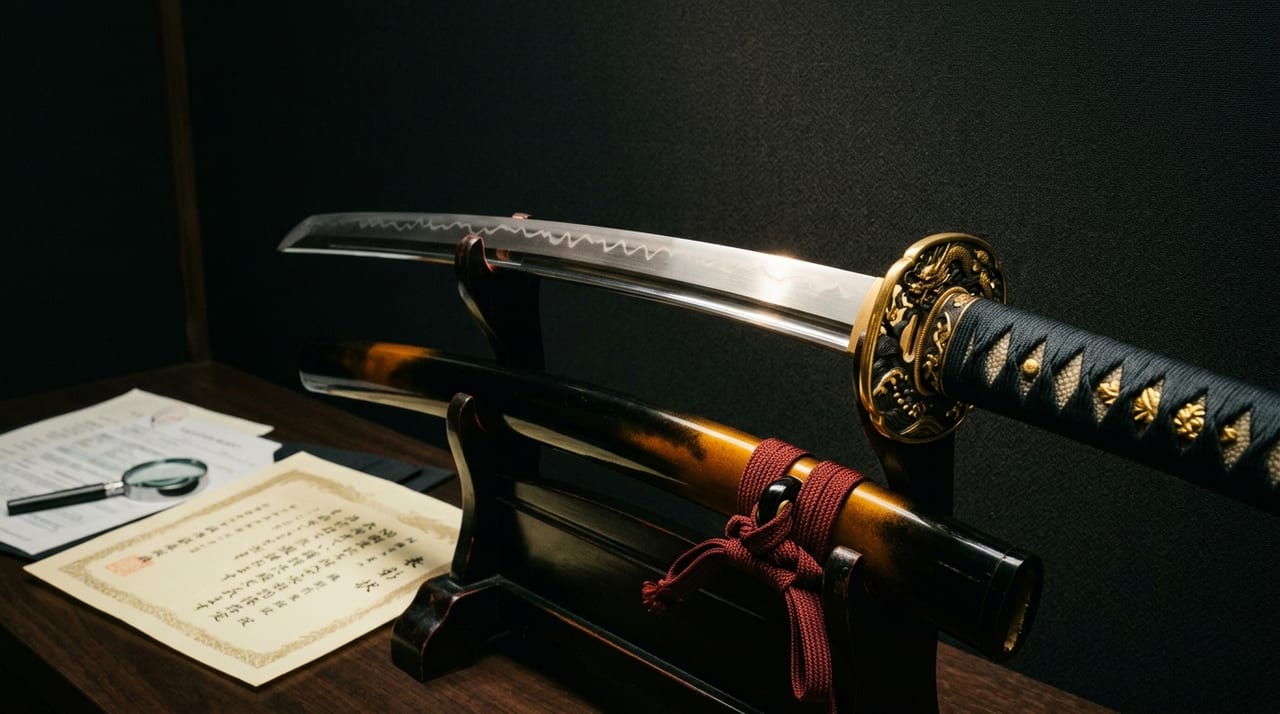
| Historical Research Type | Emphasizes connections with eras, schools, figures, and events; pursues documentary and physical evidence such as authentication papers, signatures, box inscriptions, and records of former owners |
| Martial Arts Practice Type | Begins with the physical relationship of wielding a sword in practice; owns separate swords for practice and appreciation |
| Asset Ownership Type | Emphasizes valuation as alternative assets; selects based on presence of authentication papers (NBTHK, etc.), designation status, and liquidity |
| Cultural Inheritance Type | Centers on the mission to transmit evidence of Japanese culture to the next generation; considers participation in Japanese sword societies and preservation associations, as well as selection of heirs and recipient institutions |
Motivation Type 1: Aesthetic Appreciation Type
This type views Japanese swords as "metalwork crafts possessing the beauty of hamon and jihada." Maximum attention is placed on visual and formal value—the form, action, and quality of the hamon, the subtlety of the jihada's surface texture, the balance of the blade's shape.
This type shows high motivation to invest in developing appraisal skills and frequently attends sword museums and appreciation gatherings. Since this type prioritizes "any sword felt to be beautiful" without being bound by school or era, collections tend to become diverse. When budget is limited, an aesthetic choice emerges—selecting swords where "though not by a master smith, the hamon stands out."
Though a motivation that allows for long-term continuity, as appreciation skills improve, collectors may face the connoisseur's dilemma—"becoming unable to be satisfied with what was collected before."
Motivation Type 2: Historical Research Type
This type finds joy in connecting Japanese swords to specific eras, schools, figures, and events, positioning them within historical context. Characteristic is an obsession with provenance and lineage—"this sword may have been used in a certain domain during the Sengoku period," "I want to track all works by this swordsmith."
This type values documentary and physical evidence related to swords—authentication papers, signatures, box inscriptions, records of former owners. There is a tendency to be familiar with specialized books, academic papers, and classical documents, and to prefer interaction with sword researchers and museum curators. The collection as a whole tends to become systematized as "a cross-section of a specific era" or "the lineage of a specific school."
Swords with clear provenance and high research value are highly valued in the market, tending to be expensive. On the other hand, since provenance is prioritized over condition, there are cases where swords with insufficient polishing are actively acquired.
Motivation Type 3: Martial Arts Practice Type
This type consists of martial artists who practice iaido or kenjutsu and own and collect swords for practice and appreciation. The starting point is the physical relationship of "holding a sword that I wield."
In many cases, they own separate swords for practice (functional swords capable of test cutting) and appreciation (art swords). Sometimes they receive guidance from their instructor—"this era of sword suits this school"—and collect accordingly. They often have networks for acquiring swords and exchanging information through martial arts communities, making it easy to establish acquisition channels that bypass dealers.
Due to continuous investment in martial arts, sword-related budgets tend to be more constrained than other motivation types. However, since they understand "swords as tools," they tend to become practical collectors skilled in handling hilts and scabbards and proper maintenance.
Motivation Type 4: Asset Ownership Type
This type evaluates Japanese swords as "alternative assets." Famous swords designated as Important Swords are said to be less affected by yen weakness and inflation, and have certain value as long-term holdings. This is a particularly common motivation among overseas investors and wealthy collectors.
This type emphasizes the presence of authentication papers (NBTHK, etc.), designation status, and clarity of provenance, prioritizing the establishment of trust relationships with authentication organizations. There is a tendency to select "highly liquid swords" with an awareness of the possibility of sale or resale.
The Japanese sword market has low liquidity even within the art market, and determining when to sell is a challenge. If collecting begins purely for asset purposes, collectors may enter the market with only shallow understanding of the cultural value of swords, risking misjudgment of fair prices.
Motivation Type 5: Cultural Inheritance Type
This type centers on the mission to protect Japanese swords as "evidence of Japanese culture" and transmit them to the next generation. Often triggered by family connections (ancestral swords, hereditary works) or ties to local culture.
Rather than personal aesthetic preference, this type possesses a long-term perspective—"can I pass this sword to someone?" Through participation in Japanese sword societies, preservation associations, and regional cultural heritage protection activities, they often gain institutional support for collection management. Characteristic is "future planning for the sword," with consideration for heirs, donation, and deposit recipients.
Compound and Transformation of Motivations
In practice, collectors rarely continue collecting with just one motivation. Motivations transform and compound over time, as illustrated by examples such as "I initially acquired one as an extension of martial arts, but shifted to aesthetic appreciation as my appraisal skills developed" or "I started as a historical researcher but added an asset ownership perspective after recognizing the asset value of fine swords."
Recognizing which motivation is primary helps with decisions about "where to allocate the budget" and "which sword to select next." When doubt arises about collecting direction, returning to the original motivation—"why do I hold swords?"—becomes the source of sustained practice as a collector.