Awataguchi Yoshimitsu and the Pinnacle of Tanto Mastery
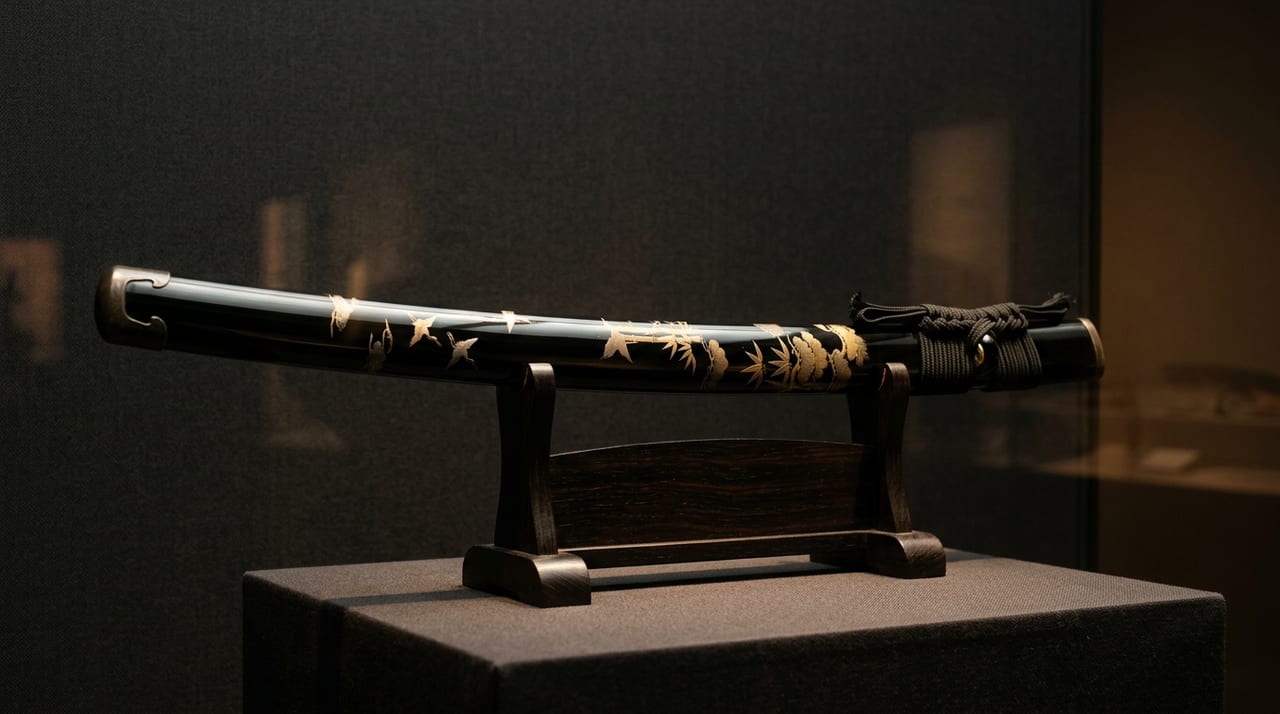 * Image is for illustrative purposes only.
Table of Contents
Who was Awataguchi Yoshimitsu
Awataguchi Yoshimitsu was a swordsmith who flourished in Awataguchi in Yamashiro Province (present-day Kyoto Prefecture) during the mid-Kamakura period—roughly the latter half of the 13th century. Numbered among the "Three Greatest Swordsmiths" (tenka sansaku) alongside Masamune and Gō Yoshihiro, he has been revered throughout history as one of the most highly regarded swordsmiths in the history of Japanese blades.
Before Yoshimitsu, Awataguchi was home to a group of swordsmiths known as the "Eight Masters of Awataguchi"—Kunitomo, Kuniyasu, Kunikiyo, Fujiwara Kunihira, and others—who had laid the foundations of the Yamashiro tradition. Yoshimitsu is positioned as the culmination of this tradition, leaving works in multiple fields including tachi, tanto, swords, and naginata. Among these, he is regarded as unsurpassed from ancient to modern times as a maker of tanto, and together with Shintōgo Kunimitsu, who laid the foundations of the Soshu tradition, he is celebrated as one of the two greatest masters of tanto (Touken World "Yoshimitsu").
It should be noted that Yoshimitsu's dates of birth and death are not clearly documented, and most biographical facts rest upon later texts. There are not many extant works bearing Yoshimitsu's signature, and authentication of genuine works has long relied on certificates of appreciation (origami) issued by the Honami family.
Yoshimitsu's Techniques — Nashiji Skin and Refined Straight Blade
The greatest technical elements that characterize Yoshimitsu's works are the following three points.
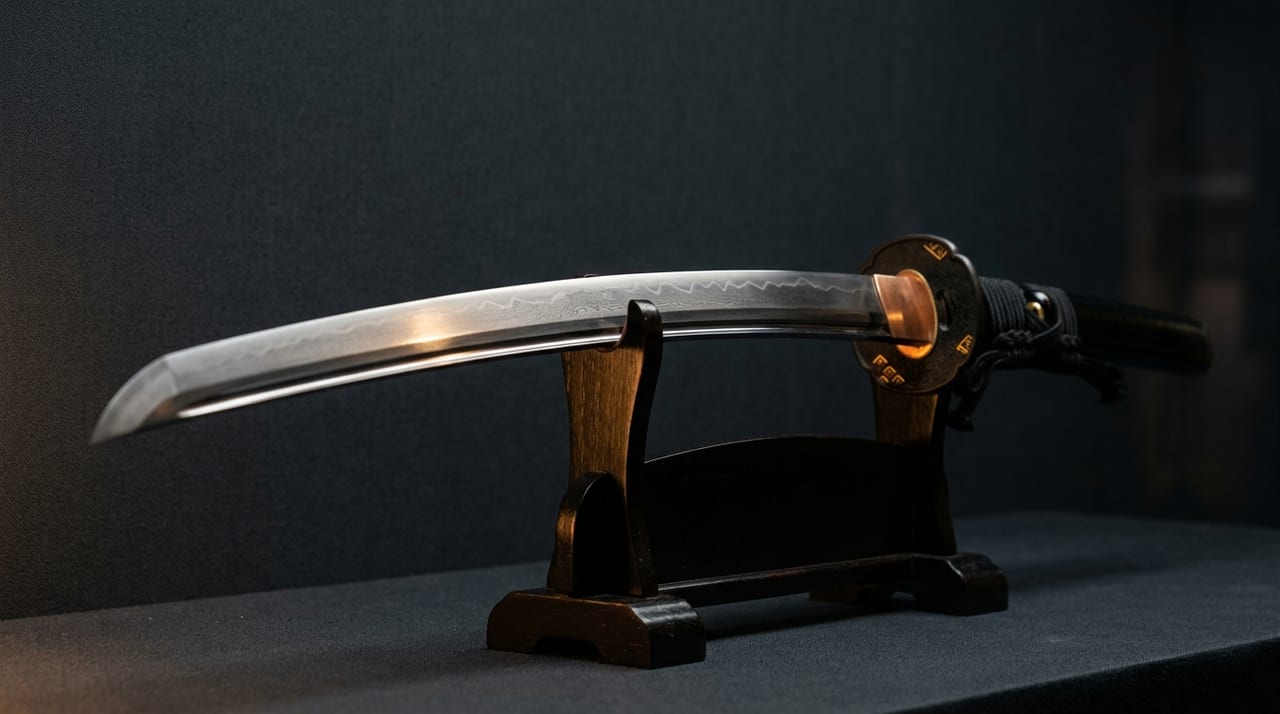
- Nashiji skin (nashiji hada): The steel (jigane) is packed finely and uniformly like the surface of a pear, forming a beautiful grain pattern with a lustrous, darkened tone. This steel, also described as "tightly packed small itame grain" (ko itame hada), demonstrates Yoshimitsu's precision in material selection and forging technique, and modern researchers highly evaluate it from a scientific perspective. The texture of the steel changes in depth and luster depending on the angle of light, possessing a complexity that rewards extended viewing.
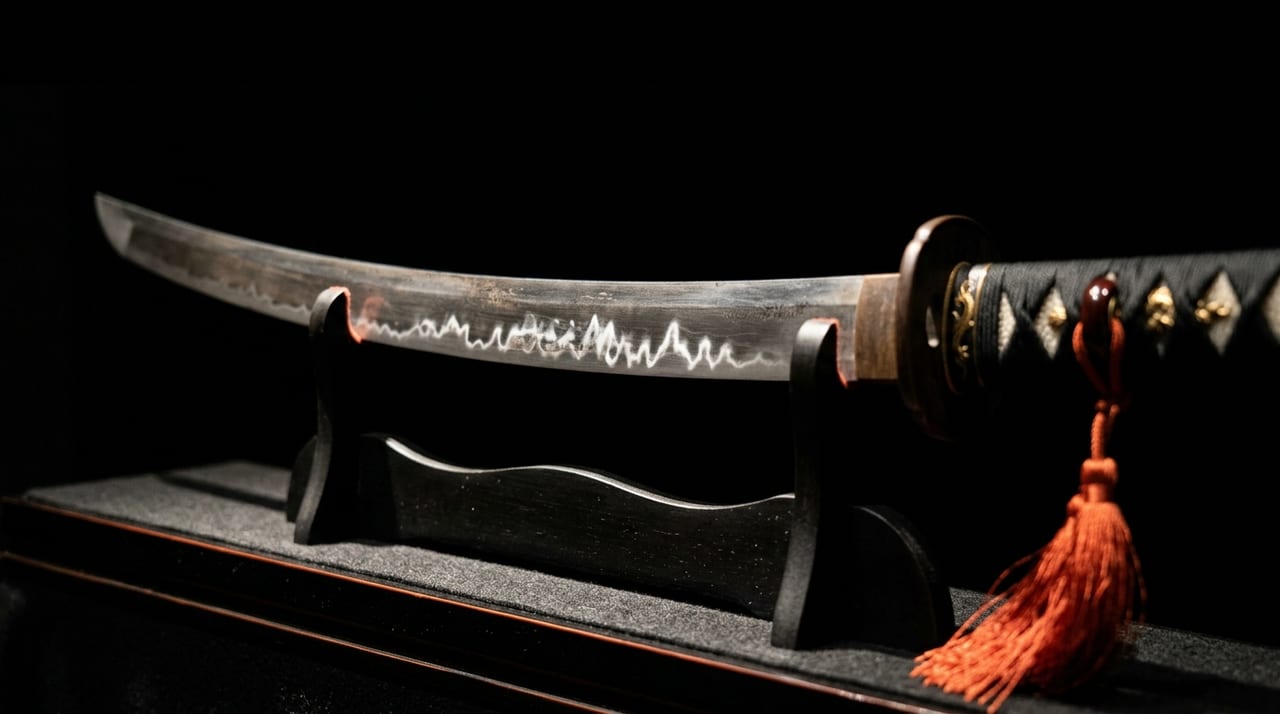
- Sublime straight blade (suguha): The blade pattern is based on a straight line, yet is not monotonously uniform; rather, extremely fine minor irregularities (ko midare) and small nie are interspersed, imparting a sense of deep moisture and depth. The quality of the nie is characterized by a tightly constrained but soft nioi guchi, with the entire blade pattern possessing a poetic quality as if "mist had settled" upon it.
- Small and stable form: Yoshimitsu's tanto typically feature a narrow width and an elegant inward curve (uchizori). The overall proportions maintain harmony, and functional beauty and decorative beauty are fused at a high level. Unusually for a Kamakura-period tanto, it pursued stylistic beauty that prioritized artistic perfection over practical combat function.
Representative Works — Celebrated Masterpieces
While genuine works by Yoshimitsu are few in number, several celebrated masterpieces known to later generations as "meibutsu" (celebrated blades) survive.
- Ichigo Hitofuri (ichigo hitofuri): A tachi that Toyotomi Hideyoshi possessed, now held by the Imperial Household Agency as an imperial treasure (gyobutsu) and therefore exempt from Important Cultural Property designation. The name "Ichigo Hitofuri" means "one masterpiece in a lifetime," and is said to be the greatest work Yoshimitsu ever forged. As a tachi, it is a rare work by Yoshimitsu and is most widely known as his representative work due to the clarity of its provenance and artistic perfection.
- Namazuo Tōshirō (namazuo tōshirō): A tanto named for the shape of the blade resembling a catfish's tail. A celebrated treasure passed from Oda Nobunaga to Toyotomi Hideyoshi to the Tokugawa family, it is now preserved in the collection of the Tokugawa Art Museum (Nagoya) as an Important Cultural Property.
- Honebami Tōshirō (honebami tōshirō): A wakizashi refashioned from a naginata, said to possess such sharpness that it could "crush bone." Possessed by Toyotomi Hideyoshi and later donated to Toyokuni Shrine (Kyoto), it remains in the shrine's collection as an Important Cultural Property.
- Goto Toshiro (goto toshiro): A tanto that passed through the Goto family. The refined steel and harmonious straight blade are particularly prized, earning it high credibility as a genuine work.
Beyond these celebrated blades, multiple tanto bearing the epithet "Toshiro" have been transmitted through history. "Toshiro" was Yoshimitsu's common name, and came to be widely used as a synonym for Yoshimitsu tanto.
Yoshimitsu Among the Three Greatest Swordsmiths — Comparison with Masamune and Gō Yoshihiro
The comparison of the Three Greatest Swordsmiths is an eternal theme in Japanese blade authentication and collection.
- Masamune (masamune): An embodiment of the Soshu tradition. His blade pattern features bold, dynamic nie-made (nie produced) irregular forms, powerful steel, and diverse works including tachi, tanto, and naginata. The greatest difference from Yoshimitsu lies in the dynamism of the blade pattern. If Masamune is "power," then Yoshimitsu is "elegance."
- Gō Yoshihiro (gono yoshihiro): A swordsmith from Etchu and one of the Ten Disciples of Masamune (Masamune Juttetsu). The Etchu tradition's large-scale nie blade pattern occupies an intermediate character between Masamune's Soshu tradition and Yoshimitsu's Yamashiro tradition, and remains the most mysterious of the three, with extremely few surviving genuine works.
The point for which Yoshimitsu is particularly celebrated is the refinement achieved through the tanto form itself. At a time when practical demand for tanto increased during the turbulent mid-Kamakura period, Yoshimitsu elevated this form to an artistic apex. In subsequent eras—from the Muromachi through the Azuchi-Momoyama to the Edo period—Yoshimitsu tanto were collected and treasured as "the finest tanto," eagerly sought after by tea masters, daimyo, and warriors alike.
Yoshimitsu Within the Awataguchi School
Awataguchi, where Yoshimitsu emerged, in present-day Higashiyama Ward, Kyoto, was known from ancient times as a sword-producing region in Yamashiro Province, and its geography with the sacred mountain of Higashiyama at its back provided high-quality water and charcoal. Yoshimitsu appeared within this collective of community swordsmiths as an exceptionally talented craftsman, embodying as it were the technical pinnacle of the Yamashiro tradition.
It was Yoshimitsu who expressed the characteristics of the Yamashiro tradition—straight blade, itame skin, and refined steel—at the highest level of sophistication, thereby creating an aesthetic entirely distinct from Masamune's Soshu tradition. The assessment, repeated by later authentication experts as established doctrine, that "in blade pattern beauty, Soshu (Masamune) reigns supreme; in steel beauty, Yamashiro (Yoshimitsu) reigns supreme" became the standard evaluation.
Today, genuine works by Yoshimitsu are held in sword museums, the Tokyo National Museum, various temples and shrines, and the collections of former daimyo houses throughout the country, and continue to be the focus of attention of researchers and collectors of Japanese sword art around the world as representing the highest pinnacle of the art.