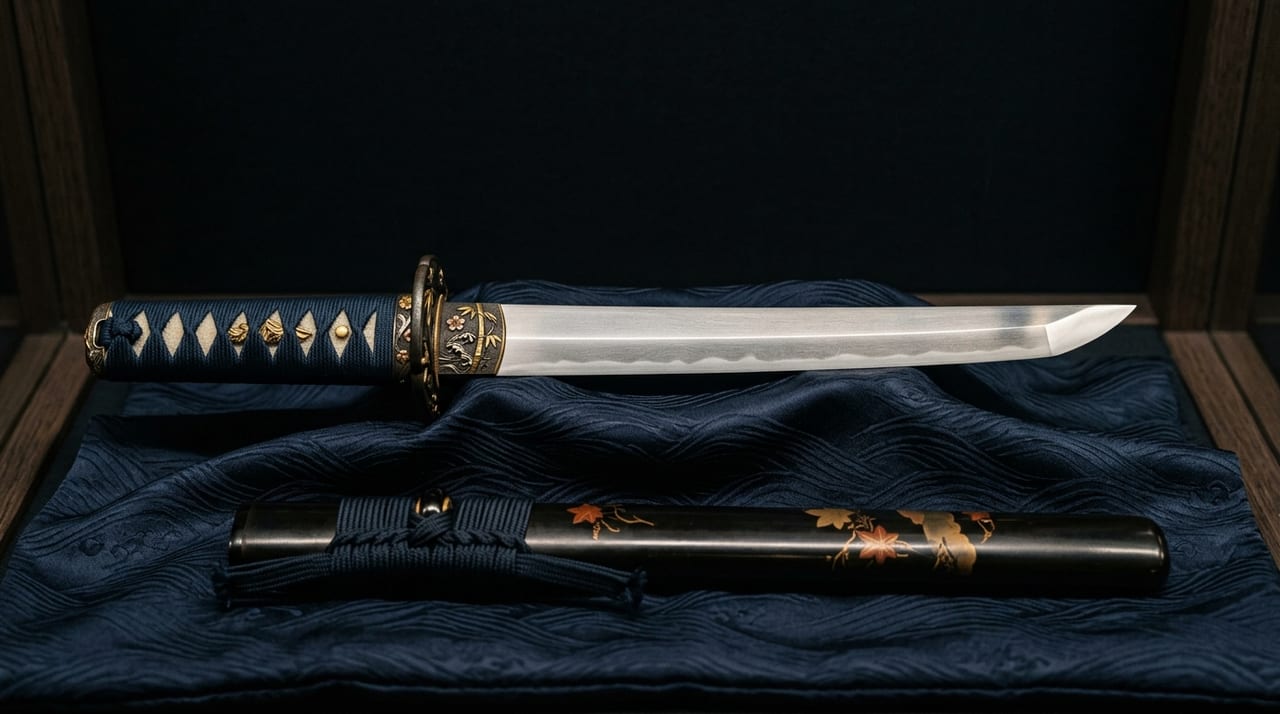
 * Image is for illustrative purposes only.
Yagen Tōshirō
薬研藤四郎
Also known as: Medicine Grinder
Description
Overview of the Blade
A masterwork of Awataguchi Yoshimitsu, one of the Three Greatest Smiths, most vividly embodying the legend of "will" that dwells in Japanese swords.
The Smith Who Forged It
Awataguchi Yoshimitsu (also known as Tōshirō Yoshimitsu) was a swordsmith who lived in Awataguchi, Yamashiro Province during the mid-Kamakura period. He is regarded as one of the highest-ranking figures in Japanese sword history as a master of tantō and sword (ken), and stands alongside Masamune and Gō Yoshihiro as one of the "Three Greatest Smiths." Yoshimitsu's tantō have been treasured above all others from the Kamakura period to the present day, maintaining their exceptional status. His tantō frequently bear the honorific title "Tōshirō," and include celebrated examples such as the Yagen Tōshirō, Ichigo Hitofuri, Honebami Tōshirō, and Namazuo Tōshirō—all masterworks in the history of Japanese swords.
Forging Method and Characteristics
Yoshimitsu's style is characterized by finely finished steel with closely packed small itame grain. The fine forge texture displays a lustrous quality reminiscent of pear-skin. His hamon is based on a straight-line pattern with bright, keen, and dignified appearance, embodying the quintessence of the Yamashiro tradition that values elegance and purity above brilliance. The name "Yagen Tōshirō" derives from a remarkable legend associated with this tantō. During the Meīō Incident (Meīō 2, 1493), when Hatakeyama Masanaga, realizing his defeat, attempted to take his own life, this tantō repeatedly refused to pierce his flesh—as if the blade itself were unwilling to harm its master. The enraged Masanaga then struck the blade against a yagen (a metal mortar used for grinding Chinese herbal medicines) that lay nearby, and it pierced the hard iron with effortless ease. "It cannot cut people, yet it can pierce iron"—this paradoxical tale was transmitted among samurai with reverence and awe.
The Blade's Provenance
Its provenance traces back to the Ashikaga shoguns. During the Sengoku period, it passed through the hands of Matsunaga Hisahide before being presented to Oda Nobunaga. It is said to have vanished in flames alongside Nobunaga during the Honnō-ji Incident on June 2, Tenshō 10 (1582), and no longer exists.
Legends & Stories
The legend of Yagen Tōshirō symbolizes the belief that Japanese swords possess a will of their own. During the Ōnin War, Hatakeyama Masanaga realized his defeat and attempted seppuku, but no matter how he tried, the tantō would not pierce his flesh — as if the blade itself refused to harm its master. When Masanaga furiously drove it into an iron medicine mortar, it punched through effortlessly. 'It refuses to cut a person, yet penetrates iron' — this tale was passed down with awe among the samurai class. At the Honnō-ji Incident, it vanished in the flames alongside Nobunaga, deepening its legend as 'the blade that perished with its lord.' In Touken Ranbu, it is portrayed as a tantō fiercely loyal to Nobunaga and enjoys great popularity.