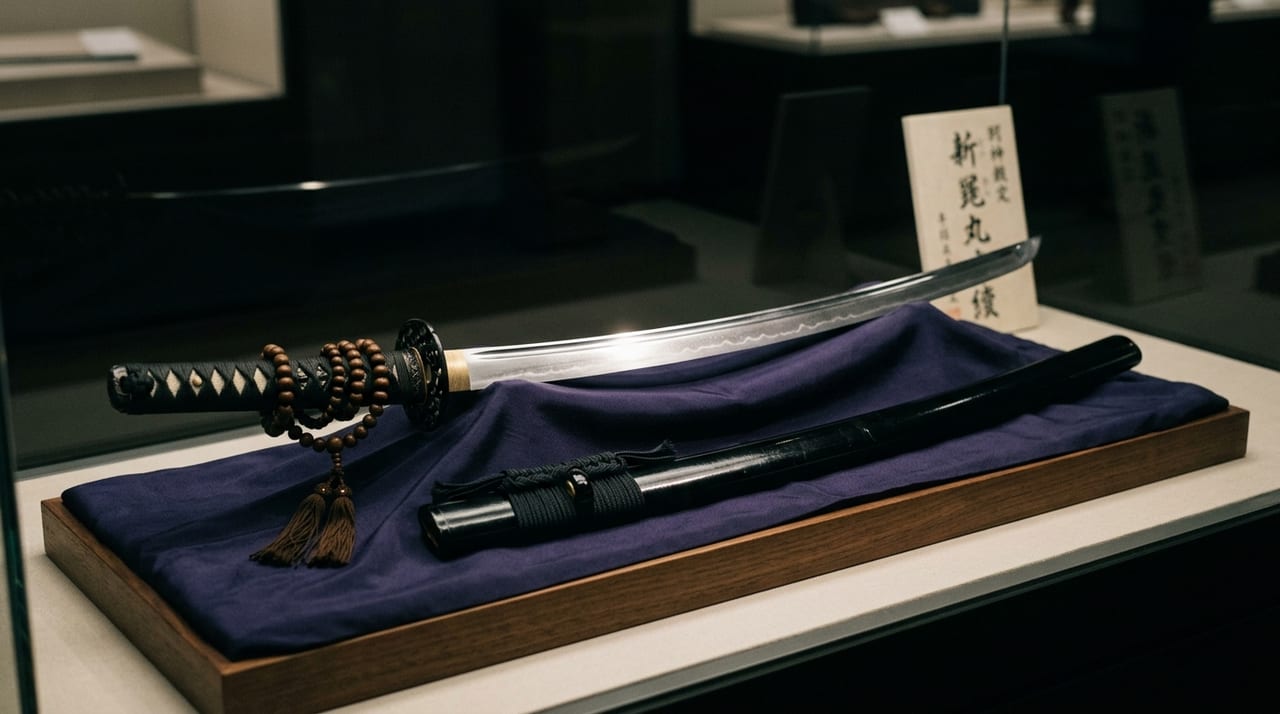
 * Image is for illustrative purposes only.
Hizen Tadayoshi
肥前忠吉
Also known as: Founder of the Hizen School • Master of Tachibana Kunihiro's Lineage • Father of Hizen Swords
Description
Hizen Tadayoshi Overview and the Birth of the Hizen School
Hizen Tadayoshi (肥前忠吉) was a swordsmith who flourished during the early Edo period and holds an important position in Japanese sword history as the founder of the "Hizen School" (肥前伝)—a major sword-producing region and tradition centered in Hizen Province (present-day Saga and Nagasaki Prefectures). His given name was Hashimoto Shinzaemon. After studying swordsmithing and technique under Umemada Myoju (埋忠明寿), a renowned Kyoto master, he returned to his native Hizen Province and began forging blades under the signature "Tadayoshi." Under the patronage of Nabeshima Naoshige (鍋島直茂), lord of Saga Domain, and Naoshige's son Katsushige (勝茂), Tadayoshi established a distinctive sword-making style in Kyushu and laid the foundation for the "Hizen sword" tradition that would follow. Throughout the Edo period, Hizen swords were renowned as the highest-quality sword-producing region in the nation, and in the present day, "Hizen swords" continue to be regarded as the finest new-style swords of the Edo period.
Technical Characteristics—The Aesthetics of the Hizen School
The technical hallmark of First-Generation Hizen Tadayoshi's swords is their "crisp jigane and dignified hamon." Hizen Tadayoshi's jigane possesses a distinctive texture called "Hizen skin" (肥前肌), characterized by exceptionally densely packed koitame with iron particles refined to uniform microscopic fineness, displaying a beautiful surface. This dense jigane is also evaluated as "approaching Awataguchiware blades" and embodies "the distinctive qualities of Kyushu steel," differing from the itame of Bizen or the raizuka of Yamashiro. The hamon is fundamentally a beautiful suguha (straight edge) with a crisp and luminous nioi, while displaying subtle variations of koguno-me (small interlocking pattern) and kochoji (small clove pattern) mingled quietly. The core of Hizen sword aesthetics is "purity and dignity"—a value system that prioritizes refinement over flashiness and simplicity over complexity, principles that were inherited by subsequent generations of Hizen smiths and form the foundation of the transmitted tradition.
Apprenticeship to Umemada Myoju and the Lineage of Technique
A pivotal moment in First-Generation Tadayoshi's career as a swordsmith came when he traveled to Kyoto in the first year of Keicho (1596) to study under Umemada Myoju (埋忠明寿), a renowned Kyoto master craftsman. Myoju was a distinguished figure active from the Momoyama through early Edo periods, recognized as having laid the foundation for new-style swords (shintō). After honing his foundational technique under Myoju for approximately three years, Tadayoshi returned to his native Hizen to establish himself independently. He elevated Myoju's teachings—the beauty of suguha and the pursuit of refined jigane—through his own exceptional talent and the distinctive properties of Kyushu steel, establishing an entirely original aesthetic: "Hizen suguha." In this sense, Tadayoshi's achievement is celebrated as "the ideal fruition of the master-disciple relationship"—inheriting his teacher's teachings while transcending his teacher to forge his own path. The narrative of how the refinement of Myoju, a Kyoto master, bloomed into a distinctive flower on the soil of Kyushu is one of the most beautiful examples of the regional development of technique in Japanese artisan culture.
The Patronage of Saga Domain and the Rise of Hizen Swords
The patronage that First-Generation Tadayoshi received from the Nabeshima lords of Saga Domain was decisive in the development of the Hizen School. Nabeshima Naoshige and his son Katsushige recognized Tadayoshi's exceptional talent early on and provided him with maximum support as the domain's official swordsmith. This patronage relationship guaranteed Tadayoshi access to the finest materials, equipment, and uninterrupted forging time; in return, he provided the highest-quality blades for the domain lords and samurai. Under the patronage of Saga Domain, Tadayoshi's workshop became a center for training disciples and successors, forming the foundation for "Tadayoshi's technique" to spread throughout Hizen. The second and third-generation Tadayoshis inherited and developed the founder's tradition, solidifying the foundation for "Hizen swords" to be recognized nationally as "the highest-quality new-style sword-producing region of the Edo period." The fact that a regional daimyo of Saga nurtured a major tradition that would endure in Japanese sword history is one of the most persuasive examples of the cultural and propagative power that investment in regional culture can yield.
Signature Variations and Research Considerations
First-Generation Hizen Tadayoshi's signatures took various forms depending on the period—"Tachibana Tadahiro" (橘忠広), "Tadayoshi" (忠吉), "Hizen no Kuni Tadayoshi" (肥前国忠吉), and "Musashi no Daijo Fujiwara Tadahiro" (武蔵大掾藤原忠広), among others—and the evolution of his signatures can be traced to determine the chronology of his forging work and stylistic changes. In particular, the official title "Musashi no Daijo" (武蔵大掾) which he received in the tenth year of Genwa (1624)—a designation granted by the imperial court—prompted him to change his signature to "Tadahiro." Works bearing this later signature constitute an important indicator that they represent a period of particularly high evaluation among the first generation's output. Distinguishing works by the first generation from those of later generations requires expert authentication, and developing the eye to discern the subtle stylistic differences among the first, second, and third generations represents one of the important challenges in Hizen sword scholarship.
Modern Evaluation of Hizen Tadayoshi and Hizen Swords
In contemporary sword circles, Hizen Tadayoshi holds an unshakeable position as "one of the foremost makers of new-style swords," and works of the first generation are regarded with particularly high esteem. Distinguished examples housed in major museums such as the Kyushu National Museum are regularly displayed, conveying the pure beauty of "Hizen suguha" to present-day viewers. In Saga Prefecture, the birthplace of Hizen swords, Tadayoshi's achievements are commemorated with pride as the highest cultural legacy of the region, forming one of the core elements of regional cultural identity. The fact that a tradition established by a single genius swordsmith in early Edo Kyushu continues to live on more than three centuries later as "Hizen swords" stands as one of the most eloquent proofs of the enduring power of the artisan's achievements as a cultural heritage.
Legends & Stories
## Nabeshima Naoshige as a Patron: His Discernment Nabeshima Naoshige (1538–1618) was an outstanding general who became the de facto founder of Saga Domain after the Battle of Sekigahara (1600), and was known not only for his strategic abilities but also for his cultural discernment. The keen eye with which Naoshige discerned the talent of the young Tadayoshi and appointed him as the domain's official smith embodied "the ideal of a patron nurturing exceptional craftsmen," transcending mere feudal hierarchy. Naoshige's decision to engage Tadayoshi as an official smith was grounded in the strategic judgment that "recruiting the finest swordsmith elevates the domain's cultural authority," and this decision subsequently yielded the significant cultural achievement of the flourishing of Hizen swords. The birth of the Hizen School from the meeting of Naoshige's "eye for discerning talent" and Tadayoshi's "exceptional skill" is handed down as one of "the finest encounters of wise patronage and genius in the cultural history of Japan." ## The Korean Campaign and the Experience of Kyushu Smiths The period immediately preceding Hizen Tadayoshi's flourishing—the Bunroku-Keicho invasions (1592–1598)—was an era when Kyushu's generals and soldiers fought directly on the Korean peninsula, and the generation of Tadayoshi's teachers directly experienced the practical demands placed on swords through actual warfare. Through this war, the smiths of Kyushu became acutely aware of "the demands of blades that could actually cut opponents" and "the challenges of forging techniques needed to meet those demands" as matters of immediate concern. Tadayoshi went to Kyoto in Keicho 1 (1596) and entered the studio of Umemada Myoju of Yamashiro, where he learned those techniques. There is a possibility that the techniques Tadayoshi acquired under Myoju had accumulated "the experience of an age tempered by actual warfare." The ideal of "refined practical swords" that Hizen Tadayoshi established can be interpreted not as a mere aesthetic abstraction but as an expression of "truly functional beautiful blades"—practical values grounded in the experience of warfare. ## Hizen Iron and Kyushu's Steelmaking Culture The Hizen region possessed a distinctive steelmaking culture from antiquity, and together with neighboring Chikuzen and Buzen, the whole of Kyushu constituted a center of abundant iron ore resources and steelmaking expertise. The "Hizen skin" (Hizenhada)—dense, uniformly fine koitame jigane—that Tadayoshi established should be understood not merely as a matter of swordcraft technique but as a regionally distinctive aesthetic expression born from the combination of Kyushu steel's inherent qualities with the steelmaking and refining traditions of Hizen. From the perspective that "the iron of the earth determines the beauty of the swords of that region," the distinctive jigane of Hizen swords is an expression of the very nature of Hizen's earth itself, and Tadayoshi served as a technical intermediary who drew forth the fullest potential of his region's iron. It is this "beauty born from the unity of regional materials, regional techniques, and regional culture" that provides the foundation for Hizen swords to transcend mere products of a sword-producing region and possess significance as "cultural expression." ## The Succession of Inheritors and the Flourishing of Hizen The successive generations of Hizen Tadayoshi who followed the founder inherited the founder's tradition not through "lateral diversification" but through "vertical deepening"—refining the same aesthetic to ever higher standards. The aesthetic of "Hizen suguha" passed down through the second, third, and fourth generations maintained consistency in its fundamental aesthetic principles while subtly incorporating individual character in each generation, thereby supporting the credibility of the "Hizen sword" regional brand. From the mid to late Edo period, the reputation of "Hizen swords" spread nationwide, and it is said that the evaluation "first, Hizen; second, . . ." became established among samurai. This reputation was born not from the work of a single genius but as a collective achievement of an entire family lineage that faithfully preserved the standards established by the founder across generations—a successful exemplification of "the power of tradition over individual genius," the essence of artisan culture. ## Contemporary Saga and the Legacy of Hizen Swords In contemporary Saga Prefecture, Hizen Tadayoshi and the tradition of "Hizen swords" are positioned as the highest cultural pride of the region and are introduced widely to the public through exhibitions at the Kyushu National Museum (Dazaifu) and elsewhere. Within Saga Prefecture, contemporary inheritors of the Hizen tradition are engaged in the revival and transmission of that tradition, and the aesthetic of "Hizen skin and Hizen suguha" established by the founder Tadayoshi continues to serve as a living tradition and standard for swordcraft in the present day. The fact that a tradition created by a single genius from nearly nothing in the early Edo period continues to live on nearly four centuries later as "Hizen swords" stands as one of the most moving proofs of the cultural endurance that true artisan achievement possesses. The name of the First Hizen Tadayoshi will be eternally remembered in Japanese sword history not merely as that of an exceptional swordsmith but as that of a cultural founder who laid the foundation for a great cultural tradition born from the earth of Kyushu. The pure and perfected beauty embodied in the swords of Hizen Tadayoshi is the crystallization of the spiritual strength of one craftsman who lived through an age of turmoil and the refined sensibility of Edo culture that blossomed under samurai patronage. The serene radiance that dwells in those blades is nothing other than proof of true art that continues to move the human heart across the ages. The soul of First Tadayoshi, nurtured by the earth of Hizen and the salt winds of the Ariake Sea, has been inherited across the span of a hundred years, continues to shine unchangingly as the unwavering foundation of the Hizen sword tradition, and that radiance is a gift to future generations.