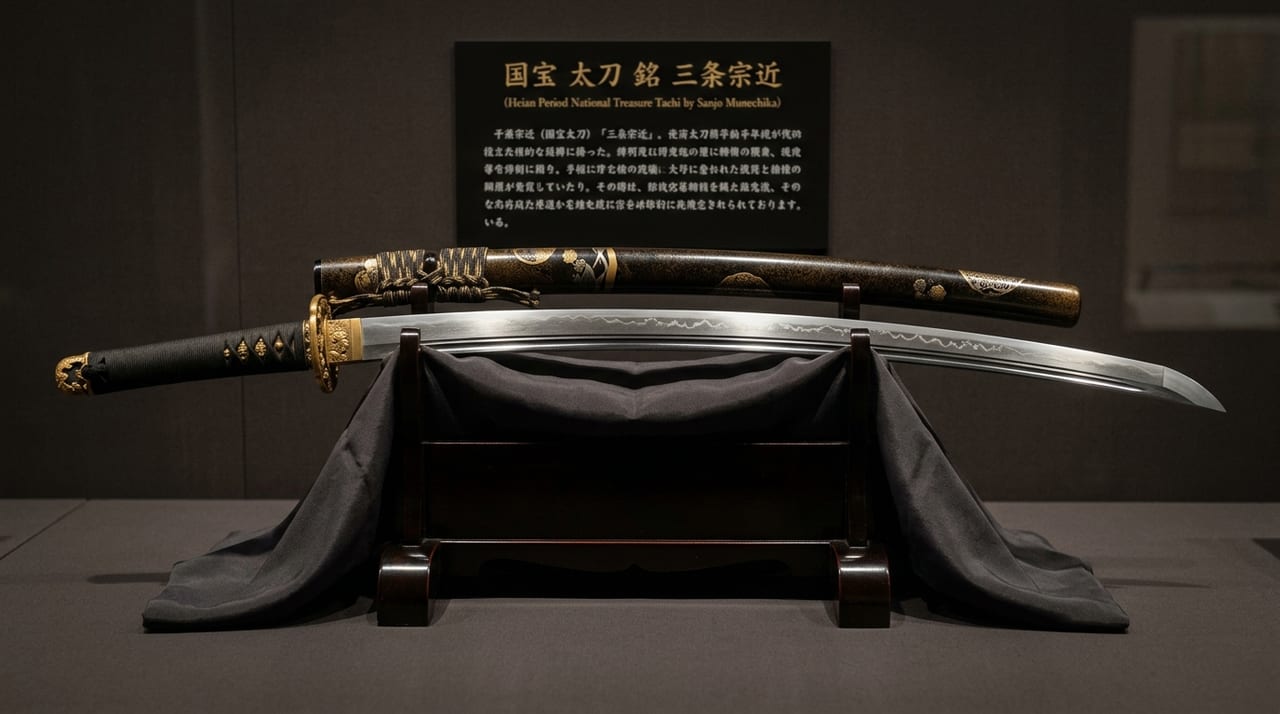
 * Image is for illustrative purposes only.
Ikeda Sadamune
池田貞宗
Also known as: A Masterpiece Tanto by Sadamune (Soshu Sadamune), Passed Down Through the Ikeda Family
Description
Ikeda Sadamune is a tantō forged by Sadamune (Hikoshirō Sadamune), successor to Masamune in the Sōshū tradition, and is designated an Important Cultural Property. The name "Ikeda" is said to derive from Ikeda Terumasa, a great daimyō who once held Bizen, Harima and other provinces and who possessed this blade. This work is designated an Important Cultural Property, but its whereabouts are currently unknown, and the Agency for Cultural Affairs is seeking information on its location.
The Ikeda were a daimyō house that produced Ikeda Terumasa, son-in-law of Tokugawa Ieyasu; his descendants, as lords of Okayama Domain, built up a powerful domain in the Setouchi region and devoted themselves to the promotion of culture and the arts as well. The family also had deep knowledge of swords, and the Ikeda family's sword collection was known as broad and of high quality, ranging from Bizen Osafune blades to famous Sōshū tradition works. Ikeda Sadamune is said to be a famous named blade (meibutsu) possessed by Ikeda Terumasa.
The blade of Ikeda Sadamune is said to be a masterpiece among Sadamune's tantō works, in which its dignity and high level of craftsmanship are especially evident. It measures 30.9 cm in length and has a hira-zukuri, mitsu-mune construction. The hamon displays the gentle nie-deki characteristic of Sadamune, and an elegant irregular pattern develops, with gunome intermingling with notare. The nie is fine, uniform and bright, and the sheen of the blade edge is soft and refined. Distinct from the fierce beauty of Masamune, the "perfected beauty" of the Sōshū tradition, which carried on from Masamune, is concentrated in this blade. The steel (jigane) has ko-itame-hada densely packed and clear, with fine and uniform ji-nie and chikei developing gently, displaying a beautiful surface. This work is unsigned (mumei) and has been certified as Sadamune's work.
It is highly regarded as a masterpiece by Sōshū Sadamune and as a celebrated work associated with Ikeda Terumasa.
Legends & Stories
The name Ikeda Sadamune is said to derive from Ikeda Terumasa (1564–1613), lord of Himeji Domain, who possessed this tantō.
It was designated an Important Cultural Property in 1954, but its whereabouts are currently unknown, and the Agency for Cultural Affairs is seeking information about its location.