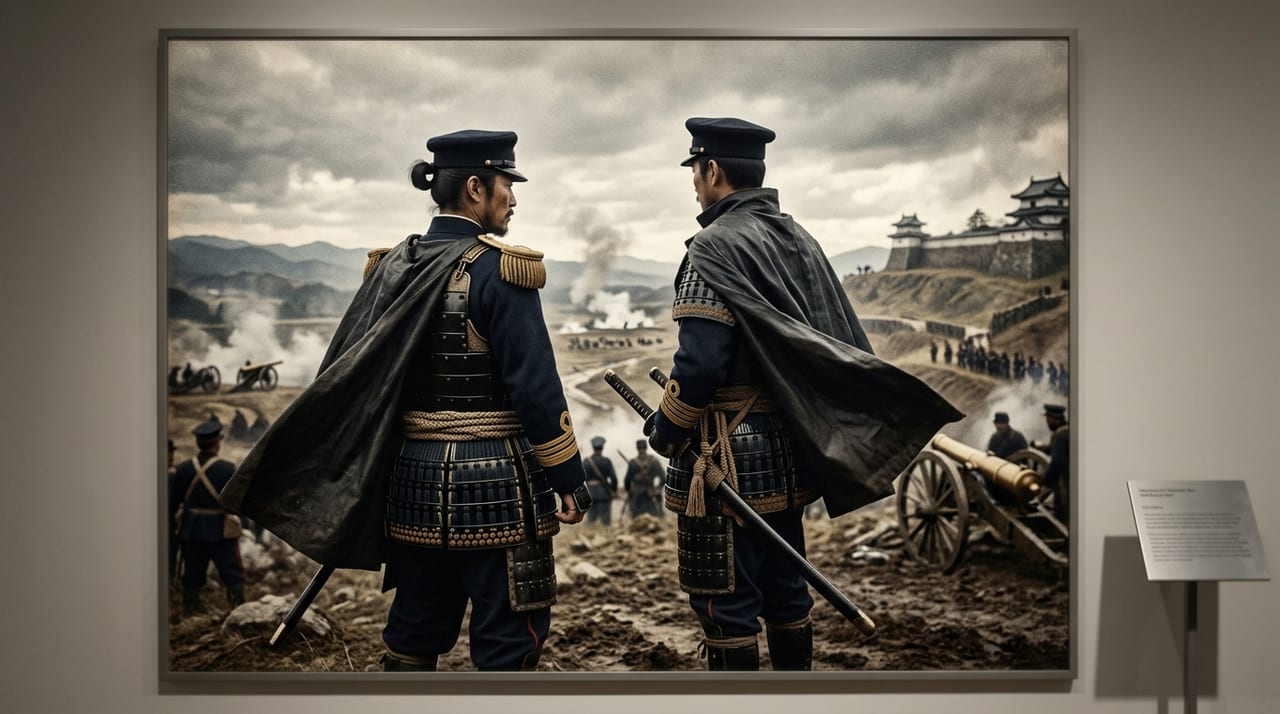
 * Image is for illustrative purposes only.
Ōmura Masujirō
大村益次郎
Father of the Meiji Army, Reformer of Modern Military System
Description
Ōmura Masujirō (1824–1869) was a military scholar and military reformer from Chōshū Domain who was active from the late Edo period into the early Meiji era. He is known as the "father of the Meiji army." Having mastered Rangaku (Dutch Learning) and Western military science, he directed the military operations of the new government's forces in the Boshin War. Using modern tactics against the forces of the Tokugawa shogunate, he won an overwhelming victory.
Ōmura was born in Suō Province (present-day Yamaguchi Prefecture), the son of a village physician. In Ōsaka he studied Rangaku at Ogata Kōan's Tekijuku, and while enrolled there he also studied in Nagasaki. After opening a village medical practice in his home region, he was invited to Uwajima Domain, where he lectured on and translated Western military science. In Edo he served as an instructor at the Kōbusho (the shogunate's military academy). In Man'en 1 (1860) he became a retainer of Chōshū Domain and took on the introduction of a Western-style military system.
Ōmura's true mettle was displayed in the Boshin War (1868–1869). Against the former shogunate forces centered on the Ōuetsu Reppan Dōmei, he conducted modern operations built on Western-style artillery and rifles. In the Battle of Ueno (1868) he commanded the punitive force and suppressed the Shōgitai in just one day. As aide to the headquarters of the Grand Commander of the Eastern Expedition, he contributed greatly to the victory of the new government's forces. After the Meiji Restoration, as Vice-Minister of Military Affairs (Hyōbu-taifu; equivalent to the later vice minister of the Army Ministry), he led the building of Japan's modern military system and laid the groundwork for the conscription system.
However, in Meiji 2 (1869), while he was staying at lodgings in Kyōto, he was cut down by former samurai who resented him. He was gravely wounded and died about two months later at the age of 46. His death also symbolized the historical turning point between the end of the age of the samurai sword and the beginning of the modern army.
In relation to Japanese swords, Ōmura's life is ironically positioned as that of "the person who announced the end of the age of the sword." The modern military system he promoted valued collective tactics with firearms and artillery over individual valor with the sword. The Japanese sword, a symbol of the samurai spirit, disappeared from the battlefield. Yet Ōmura himself lost his life to a sword. This paradox leaves an unforgettable page in the history of the Japanese sword. At Yasukuni Shrine in Kudan, Tokyo, stands a bronze statue of Ōmura erected in 1893.
Notable Swords
- The Assassin's Sword Used in the 1869 Attack