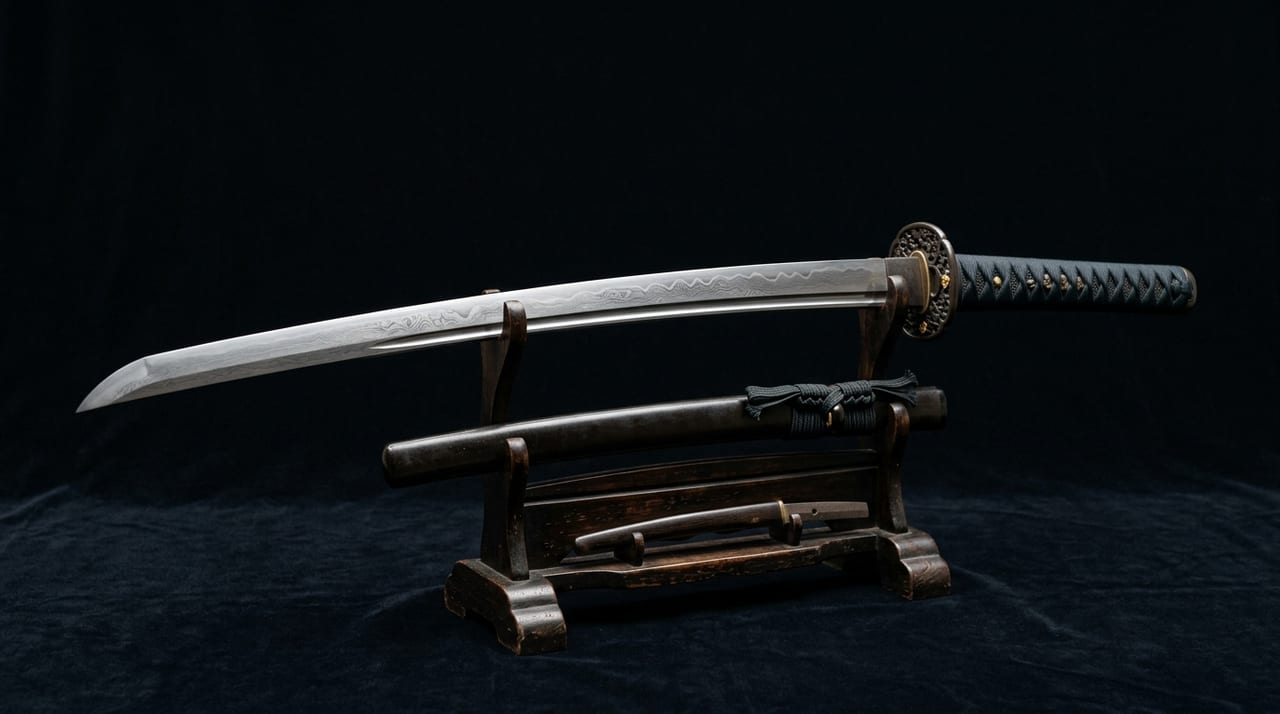
 * Image is for illustrative purposes only.
Mutsunokami Yoshiyuki
陸奥守吉行
Also known as: Sakamoto Ryōma's beloved sword
Description
Overview of the Sword
Mutsunokami Yoshiyuki is, as a katana favored by the Bakumatsu patriot Sakamoto Ryōma (1836–1867), one of the most famous “heroes' swords” in Japanese history. The sword Ryōma wore at his side carries the memory of the turbulent Bakumatsu–Meiji Restoration era and holds an unmatched significance as a historical witness. It is said to have been in his possession when he came to grief in the Ōmiya inn incident, and it is now held by the Kyoto National Museum (donated in 1931 by the Sakamoto family of Sapporo).
The Swordsmith Mutsunokami Yoshiyuki and Tosa Sword-Making
Mutsunokami Yoshiyuki (1650–1710) was a swordsmith of the early to mid Edo period, said to be from Nakamura in Mutsu Province or Sumiyoshi in Settsu Province. His personal name was Morishita Heisuke. He was the second son of Harimanokami Yoshinari, and together with his father and elder brother he entered the school of the first Yamatonokami Yoshimichi in Osaka to learn sword-making. In the Genroku era he was invited to the Tosa domain, became its forge magistrate, and later received the honorary title “Mutsunokami.” Because he moved to Tosa, he is also called Tosa Yoshiyuki. The Yoshiyuki Ryōma wore was a Sakamoto family heirloom that Ryōma asked his elder brother, Sakamoto Gonpei, for and received.
Blade Characteristics and Appreciation
The Yoshiyuki Ryōma wore during the Ōmiya inn incident has a blade length of two shaku two sun (about 67 cm) and is regarded as a shintō (new sword) with shallow curvature. The sword was damaged in a fire during the Taishō era, and because the curvature and hamon characteristic of Yoshiyuki were no longer visible, some questioned its provenance. However, re-examination with a scanner for cultural properties confirmed a distinctive hamon, and a letter passed down in the Sakamoto family showed that the blade had been re-polished after the fire. Through recent scientific investigation and examination of the documents handed down in the Sakamoto family, it was concluded to be authentic.
Sakamoto Ryōma's Life and the Path to the Restoration
Sakamoto Ryōma was born on the 15th day of the 11th month of Tenpō 6 (January 3, 1836) into a goshi family of the Tosa domain. After going up to Edo to train in swordsmanship, he was caught in the great upheaval Japan faced after Perry's arrival (Kaei 6, 1853), and of his own will leapt into the center of the times. Ryōma's actions were always several steps ahead of the times and broke through conventional wisdom: joining the Tosa Loyalist Party, leaving his domain, becoming a disciple of Katsu Kaishū, mediating the Satsuma–Chōshū Alliance, founding the Kaientai, and presenting the proposal for the return of governing power (taisei hōkan). While mastering the certificate of the Hokushin Ittō-ryū naginata (long-glaive) art, he said, “From now on it is the age of the gun,” reconciled the long-time rivals Satsuma and Chōshū, and had the shogunate return its governing power. Ryōma's character, which condensed such many-sided talent into a short life of thirty-one years, has lived on to this day as one of the heroes modern Japan loves most.
The Teradaya Incident: The Night He Fought Back with a Pistol
Around midnight on the 23rd day of the 1st month of Keiō 2 (1866), Ryōma, lodging at the Teradaya inn in Fushimi, was surrounded by more than thirty yoriki and torikata of the shogunate's Fushimi magistrate's office. Fighting alongside his bodyguard Miyoshi Shinzō, Ryōma resisted while firing a six-shot Smith & Wesson revolver, and escaped by a hair's breadth thanks to the quick wit of his lover Oryō, who sensed the disturbance while she was bathing. The Yoshiyuki that his elder brother Sakamoto Gonpei sent to Ryōma arrived around the 3rd month of Keiō 3 (1867), so on this night Ryōma had not yet taken this sword into his hands. Ryōma's contradiction, continuing to wear a sword while saying that swords were outdated, embodies the complexity of a man standing between the old and new ages.
The Ōmiya Inn Incident and Ryōma's Death
On the 15th day of the 11th month of Keiō 3 (1867), Sakamoto Ryōma was ambushed by assassins at the Ōmiya inn in Kawaramachi, Kyoto, and ended his short life at the age of thirty-three by traditional reckoning (thirty-one by Western reckoning). It was an assassination just after the success of the return of governing power (in the 10th month of that year), and Ryōma died without seeing the Restoration fulfilled. During the Ōmiya inn incident he carried a pistol but did not fire it. He was struck on the head while trying to stop the enemy's blade, before he could draw this Mutsunokami Yoshiyuki from its scabbard, and he died. As the sword that shared Ryōma's final moments, Mutsunokami Yoshiyuki has been passed down to posterity as a symbol of Ryōma himself. Many people still come before this sword, held at the Kyoto National Museum, and think of Ryōma's life and death.
Legends & Stories
Sakamoto Ryōma the Man
Sakamoto Ryōma was born into a family of gōshi (lower-ranking samurai) in the Tosa domain (present-day Kōchi Prefecture). After going up to Edo to train in swordsmanship, he was drawn into the turmoil of the late Edo period and changed the course of Japanese history. Mediating the Satchō Alliance, bringing about the restoration of imperial rule (Taisei Hōkan), and founding the Kameyama Shachū (later the Kaientai): the achievements Ryōma left in his short life of thirty-one years are remarkably great even among the shishi of the Restoration. He mastered both swordsmanship (Hokushin Ittō-ryū) and Western-style firearms, and while advocating the overthrow of the feudal system he still wore a sword as a samurai. Ryōma's figure was a typical example of a Japanese who lived in the gap between the old era and the new.
The Night at Teradaya——Ryōma Returns Fire with a Pistol
Late at night on the 23rd day of the 1st month of Keiō 2 (1866), Ryōma, who was staying at the Teradaya inn in Fushimi, was surrounded by more than thirty shogunate arresting men. Ryōma fought back together with his bodyguard, Miyoshi Shinzō, and Ryōma himself resisted by firing a six-shot Smith & Wesson pistol. His lover, Oryō (Ryō), who was bathing at the time, noticed the disturbance and alerted Ryōma, and as a result he escaped narrowly. It is also said that Ryōma was wounded in the hand at this time. The Teradaya scene, in which he resisted with a pistol, a weapon of the new era, symbolizes the duality of the Bakumatsu period.
Ryōma's Words and His Attitude toward the Sword
Ryōma is said to have remarked, “The age of the sword is over. From now on, it is a world of guns,” and in fact he favored Western-style handguns. Yet Ryōma had mastered the Hokushin Ittō-ryū and had been granted the Hokushin Ittō-ryū naginata (long-glaive) certificate (naginata heihō mokuroku) by his teacher Chiba Sadakichi, so he had not abandoned swordsmanship. This contradiction, Ryōma speaking of guns yet continuing to carry a sword, symbolizes that he was a figure who bridged the old and new eras. As a sword that embodies that contradiction, Mutsunokami Yoshiyuki conveys Ryōma's complex human image to the present day.
A Sword That Carries the Memory of the Restoration
In the present day, Mutsunokami Yoshiyuki is no mere uchigatana of the Edo period. As “Sakamoto Ryōma's sword,” it has become a national symbol that bears the memory of the Bakumatsu and Restoration era. Drawing the interest not only of sword enthusiasts but also of history fans and Ryōma fans, Mutsunokami Yoshiyuki stands at the crossroads of modern Japanese history and sword culture, an unparalleled historical heritage.