New Arrivals — Browse our catalog for the latest authentic Japanese sword arrivals. Browse →
March 2, 1657 (Meireki 3, 1st month, 18th–20th day of the lunisolar calendar; the fire lasted until about March 4)
Edo — Edo Castle and most of the city
Forces
Tokugawa shogunate (affected and rebuilding side)
About 14 min read
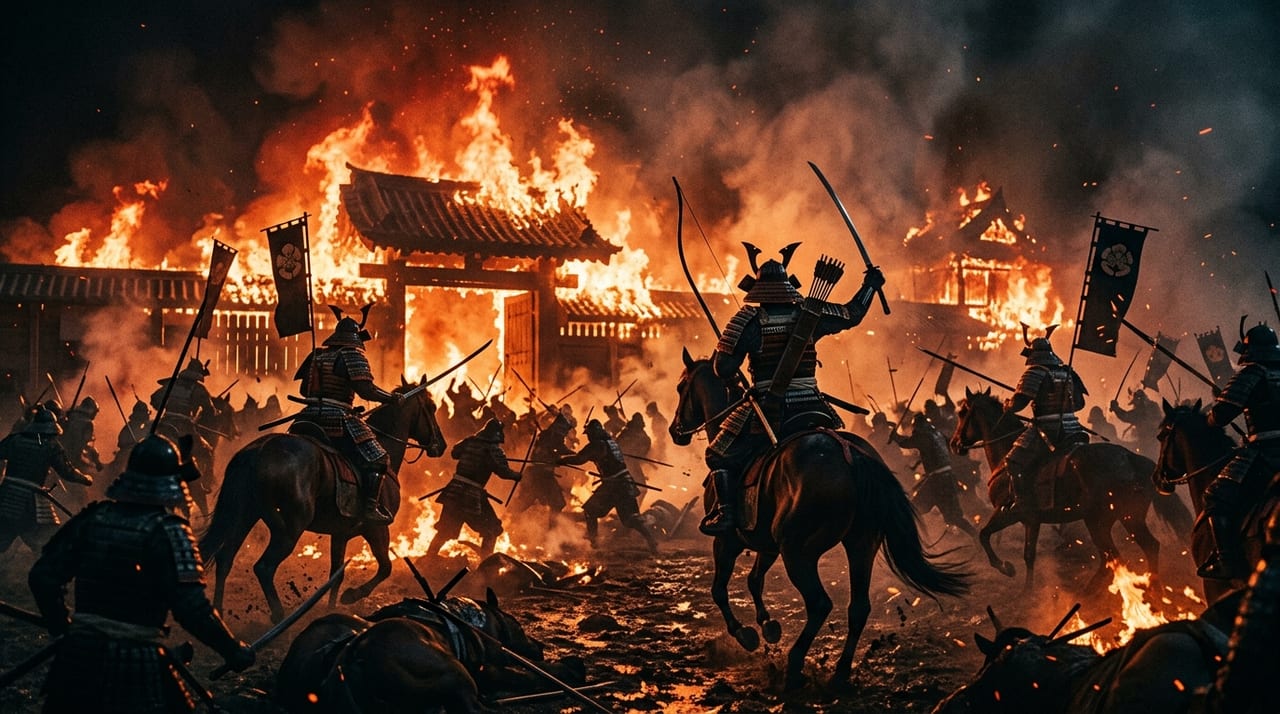
From the 18th to the 20th day of the 1st month of Meireki 3 (March 2–4, 1657, in the Gregorian calendar), Edo suffered three separate outbreaks of fire, later known collectively as the Great Fire of Meireki. Besides much of the city, the main, second, and third compounds of Edo Castle and its keep burned down. Widely repeated estimates put the dead at around 100,000, though sources vary and no exact figure is established.
Dates here are given in the lunisolar calendar unless noted; the 18th day of the 1st month of Meireki 3 corresponds to March 2, 1657. The fire is often ranked alongside the Great Fire of London (1666) and the Great Fire of Rome (64) as one of the world's great urban fires.
The loss of Edo Castle's keep was a turning point in Japanese castle history. The castle had also housed many swords handed down in the shogunal house, and their fate cast a shadow over sword history as well. This entry traces the course of the fire, the loss of the keep, the effect on swords, and the recovery.
The winter of Meireki 3 is said to have been long and dry. Edo was densely packed with samurai residences, temples, and townsmen's districts, and many town houses were wooden with plank roofs. Strong northwesterly winds blew from winter into spring, so once a fire began it could spread easily. Fires were so common that "fires and brawls are the flowers of Edo" became a later saying, yet the Meireki fire was exceptional in scale.
The shogun was the fourth, Tokugawa Ietsuna, who succeeded in 1651 at around age eleven and was seventeen at the time. Government was run with the support of his uncle Hoshina Masayuki and others, and the recovery was among the first large urban policies this administration undertook.
The first fire began in the early afternoon of the 18th near Hongō Maruyama. A widely told account places its origin at Honmyō-ji temple in Hongō, and the legend of the "furisode fire" (a kimono burned as a memorial that was said to have been carried by the wind and set the temple alight) is well known. This story, however, was probably shaped later, and whether Honmyō-ji was really the origin is disputed, so it is not treated here as established fact.
Driven by the strong northwest wind, the fire spread southeast through Yushima, Kanda, and the Nihonbashi area, burning the heart of the townsmen's districts. It reached the Sumida River, where, with few bridges then available, many people who had nowhere to flee are said to have died along the banks.
Around late morning on the 19th a second fire broke out near Denzū-in in Koishikawa, burning samurai districts to the north and east of the castle. That evening a third fire reportedly started near Kōjimachi and spread to the south of the castle, reaching as far as Shiba.
The fire reached Edo Castle from the night of the 19th into the 20th, engulfing the keep, the main residence, and the second and third compounds in turn. It is said to have died down on the morning of the 20th.
The keep that burned was the third Edo Castle keep, completed in 1638 and regarded as the largest of its kind. It is generally described as five stories high, with copper-sheet walls and copper roof tiles (a common account based on later records). It was an emblem of Tokugawa authority and of the castle as the political center.
Afterward the shogunate began preparing to rebuild. The Maeda family of Kaga rebuilt the stone base of the keep, and that base survives today in the East Gardens of the Imperial Palace. However, Hoshina Masayuki is said to have opposed rebuilding. His reasoning was that a keep was an instrument of war from the Oda and Toyotomi era, of little practical use in a peaceful age, and that the cost should go to the recovery of the city and relief of its people. The shogunate accepted this, and the keep was never rebuilt. The decision is often cited as expressing the idea that peacetime rule rests on stable civil government rather than on a castle's grandeur, although views differ on the circumstances, including finances.
Edo Castle and the Edo residences of daimyo held many swords passed down in the shogunal and daimyo families. The names of those burned were later transmitted through various records and sword books. The article on which this entry is based lists, among swords lost, a Tōshirō (a tantō attributed to Awataguchi Yoshimitsu) without signature, Honebami Tōshirō, Namazuo Tōshirō, the Edo Chōmei Masamune, and the Shishi Sadamune.
Several cautions apply. First, the circumstances of each famous sword differ. Honebami Tōshirō and Namazuo Tōshirō are known as Tōshirō blades of the Toyotomi family, and their provenance is told as including damage in the fall of Osaka Castle in 1615 followed by re-tempering. Which fire corresponds to which episode must be checked against each sword's own provenance records, and this entry does not assert it.
Second, a "fire-damaged blade" (yakemi) is one whose steel was heated by a fire so that the hardened edge lost its effect or the surface became rough. Such blades were traditionally considered to have lost their original appearance. Yet many were given a new hardening (saiha, re-tempering) and returned to usable condition. Re-tempered blades may be valued lower for appreciation, while their provenance as famous swords could still be preserved.
Third, there is the matter of "lost meibutsu." The Kyōhō Meibutsuchō, compiled by the Hon'ami family on Tokugawa Yoshimune's order in the Kyōhō era, is said to include swords recorded as destroyed. These records preserve the names and histories of swords that no longer exist, and some are said to be recorded as lost in the Meireki fire.
The loss shows that famous swords were both works of art and property signaling the prestige of shogunal and daimyo houses. That the swords, symbols of the warrior class, were lost together with the keep was probably felt to be symbolic, but few contemporary sources record reactions, so we refrain from asserting this.
Immediately after the fire the shogunate took up relief. Relief huts that distributed food were set up, and rice and money were reportedly provided. The site arranged for burying the dead later became Ekō-in, which still stands in Ryōgoku as a temple that honors the victims.
In rebuilding, the structure of the city itself was reviewed. Samurai, temple, and townsmen's districts were rearranged, and the residences of the Three Tokugawa Houses were moved out from inside the castle area. Fire breaks and wide thoroughfares were placed in various spots, and the Ryōgoku Bridge was built over the Sumida River in 1659 (Manji 2), where bridges had earlier been avoided for defensive reasons. The system of daimyo fire brigades and the later regular fire brigades are also said to have developed in this period.
These measures helped turn Edo into a disaster-conscious city. Because large fires kept recurring afterward, however, assessments of how effective the post-fire measures were differ.
The fire matters to sword history in two ways. One is that it created famous swords that no longer exist. Although iron seems resistant to fire, the heat of a blaze can destroy the hardening of a blade. Swords that survive after fire damage, re-tempering, or repolishing are not rare, and the Meireki fire is told as one node in such provenance.
The other is that it advanced the work of organizing records and provenance of swords. Records such as the meibutsu registers preserved information on lost blades. In effect, the destruction of city and castle raised the value of the records themselves.
Even so, which sword burned at which time, which was re-tempered, and which survives must be checked sword by sword. This entry stays within the scope of its source.
The decision not to rebuild the keep determined the later appearance of Edo Castle, which remained a keepless castle until the end of the shogunate and today preserves only its keep base in the East Gardens. The three days of 1657, when two symbols of the warrior class, castle and sword, were lost together, are still recalled as marking the full passage of the Edo period from an age of war to an age of peace.