New Arrivals — Browse our catalog for the latest authentic Japanese sword arrivals. Browse →
13th–14th day of the 9th month, Keichō 5 (1600)
Ishigakibaru, Hayami District, Bungo Province (present-day Beppu City, Ōita Prefecture)
Forces
Kuroda army (Eastern Army faction)
Ōtomo army (Western Army faction)
About 17 min read
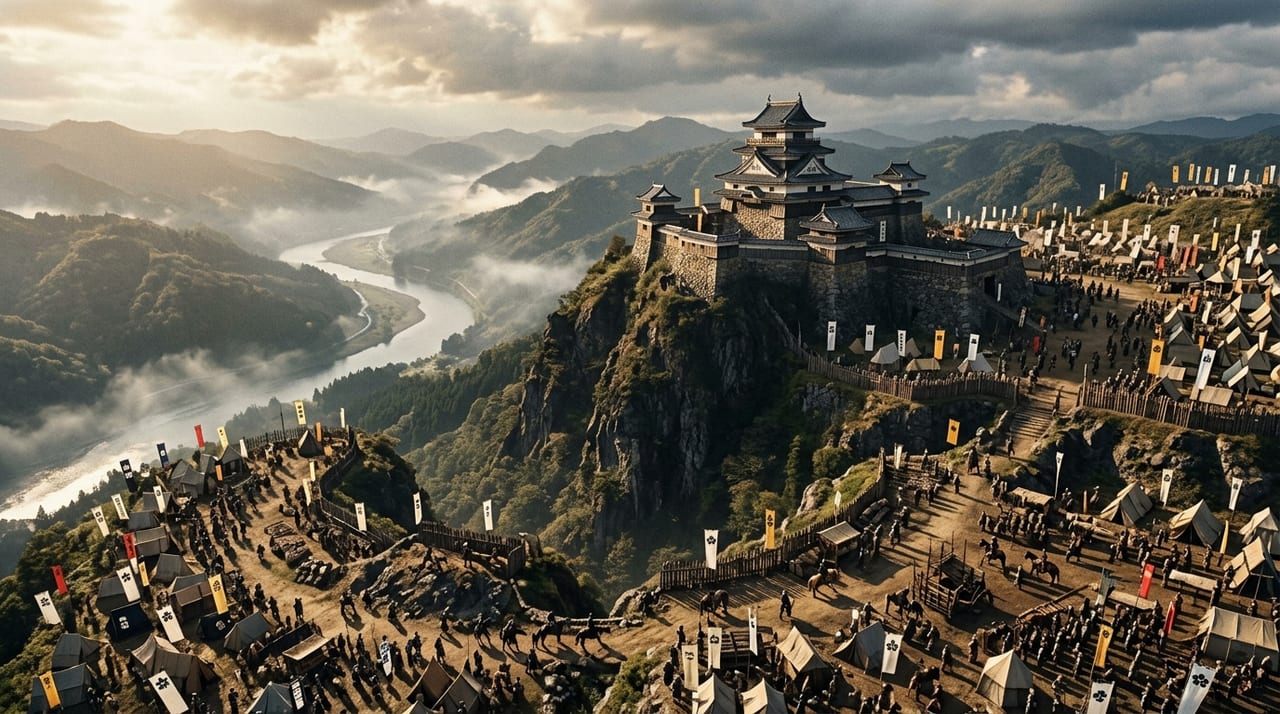
The Battle of Ishigakibaru (Ishigakibaru no Tatakai) was fought from the 13th to the 14th day of the 9th month of Keichō 5 (1600) at Ishigakibaru in Hayami District, Bungo Province (present-day Beppu City, Ōita Prefecture). It is also called 'Kyūshū's Sekigahara' because it was fought in Kyushu from two days before to one day before the main battle of Sekigahara (the 15th day of the 9th month of the same year).
The Ōtomo clan was a warrior house that rose in Ōtomo-gō in Sagami Province in the early Kamakura period. From the Kamakura period on, it was appointed land steward (jitō) and provincial constable (shugo) of Bungo, and through the Nanboku-chō and Muromachi periods it extended its power across Bungo, Buzen, and Chikugo as a leading shugo daimyo. In the Sengoku period, the 21st head, Ōtomo Sōrin (Yoshishige), built a sphere of influence covering six provinces of northern Kyushu at its height, through the economic power of overseas trade and skillful diplomacy and military action. Yoshimune, the eldest son of Sōrin, was born in Eiroku 1 (1558), and around Tenshō 4 (1576) he succeeded to the headship as the 22nd head.
Ōtomo Yoshimune (later Yoshitō) remained a daimyo of Bungo even after Toyotomi Hideyoshi's conquest of Kyushu. However, on the 1st day of the 5th month of Bunroku 2 (1593), he was stripped of his domain for the matter of the withdrawal from Pyongyang during the Bunroku campaign (the first invasion of Korea, 1592–1593). In the first month of Bunroku 2 (1593), when the allied Ming and Joseon forces attacked Konishi Yukinaga's forces at Pyongyang, Yukinaga requested reinforcements from Kuroda Nagamasa, Yoshimune, and Kobayakawa Hidekane. Yoshimune did not respond to this request and withdrew to Hanseong (Seoul), leaving Yukinaga's unit behind. Other daimyo had also withdrawn in similar fashion, yet Hideyoshi condemned Yoshimune alone as a coward, confiscated his domain, and placed it under his direct control. Afterward, Yoshimune was placed in the custody of Mōri Terumoto, and was later transferred to Satake Yoshishige.
When Toyotomi Hideyoshi died on the 18th day of the 8th month of Keichō 3 (1598), tensions sharpened within the regime between Tokugawa Ieyasu, one of the Five Elders, and the Five Magistrates led by Ishida Mitsunari, who opposed him. The Western Army forces led by Ishida Mitsunari approached Yoshimune, who wished to recover his former domain. Yoshimune had been pardoned and was free, and with the support of the Western Army he raised troops to retake Bungo and sided with the Western Army.
Meanwhile, Kuroda Josui (Yoshitaka, commonly called Kuroda Kanbei) of Nakatsu in Buzen did not join his eldest son Kuroda Nagamasa, who had gone to the Aizu campaign and the main battle of Sekigahara. Instead, he remained in Bungo and Buzen as a supporter of the Eastern Army and carried on suppressing Western Army forces in Kyushu. Because Nagamasa led the main force of the Kuroda family, Josui, who was in retirement, served as caretaker of Nakatsu Castle. He released the gold and silver he had at hand and newly took on about 3,600 rōnin. Mobilizing the caretaker troops and even the domain's farmers and merchants, he assembled a total force of about 9,000 men, and on the 9th day of the 9th month he began the invasion of Bungo Province.
On the night of the 8th day of the 9th month of Keichō 5 (1600), Yoshimune crossed the Seto Inland Sea and landed between Tomiku Castle and Aki Castle in Bungo Province. Before dawn, he sailed south off Kitsuki and landed at Hamawaki. On the morning of the following day, the 9th, he set up his headquarters at Tateishi, north of Ishigakibaru, and called on his former Ōtomo vassals to gather. Yoshihiro Muneyuki and Munakata Shigemune, among others, gathered at Yoshimune's camp.
Yoshihiro Muneyuki had earlier served the Tachibana family of Yanagawa. However, Yoshimune's son Yoshinori, who had succeeded to the headship of the Ōtomo house, served the Tokugawa side. Out of gratitude to his former lord's house, Muneyuki asked the Tachibana family for leave to go to Yoshinori, and on the way he met Yoshimune. Taking Yoshinori's position into account, Muneyuki advised Yoshimune to side with the Eastern Army. Yoshimune did not heed this and rose in arms on the side of the Western Army, so it is said that Muneyuki, unavoidably, followed him.
On the night of the 10th day of the 9th month, an Ōtomo force was sent from the Tateishi headquarters to attack Kitsuki Castle. Led by Yoshihiro Muneyuki as commander, with Kibe Gentatsu, Yoshihiro Shichizaemon, and Shibata Muneo, chief of the musketeers, and about 100 foot soldiers, it made a night raid on the castle town. However, Matsui Yasuyuki, senior retainer of the Hosokawa family defending Kitsuki Castle, set an ambush and repelled them. Shibata Muneo was killed in action, and the Ōtomo side was defeated.
On the same day, the 9th, when word reached Kuroda Josui that the Ōtomo force had encamped at Tateishi, he left Nakatsu Castle. He passed through Takamori Castle and Takada Castle at Usa, and on the 10th he crossed Akane Pass to advance toward the Kunisaki Peninsula. He surrounded Tomiku Castle, which was held by the Western Army's Kakimi Kazunao. The Kuroda main force attacked Aki Castle on the 12th day of the 9th month. On the 13th, it defeated the force of Kumagai Naomori, which had sallied out from the castle, and proceeded to relieve Kitsuki Castle.
On the 13th day of the 9th month, the Kuroda vanguard (ichiban-sonae), which set out to relieve Kitsuki Castle, passed through the back road between Mount Jissōji and Mount Kadono. It entered into combat around midday with the Ōtomo force that had encamped at Ishigakibaru. Later, the Matsui force sallying out from Kitsuki Castle joined in. In the early fighting, Yoshihiro Muneyuki of the Ōtomo side feigned a rout and lured the Kuroda force close to the Tateishi headquarters. When the Kuroda vanguard came in pursuit, the forces of Munakata Shigemune, who had been lying in wait, and Muneyuki's counterattack struck. It became a fierce battle in which Kuroda commanders Kuno Jizaemon and Sogabe Goemon were killed in action. Muneyuki skillfully used the tsuri-nobuse (decoy-and-ambush tactic). It is said that he personally wielded a spear with a vermilion-lacquered shaft and killed more than thirty Kuroda warriors, performing heroic work for the Ōtomo side, which was at a disadvantage.
However, the situation gradually tilted toward the Kuroda side, and prominent Ōtomo commanders, the main forces of the Ōtomo side, were killed one after another, including Yoshihiro Muneyuki and Munakata Shigemune. On the eve of the Battle of Ishigakibaru, Muneyuki left a death poem, perhaps anticipating his own death: 'Tomorrow, whose corpse in the grass will the moon light? The moonlight over Ishigakibaru today.' This poem has been passed down in later generations as conveying the feelings of a warrior who scattered in fidelity.
On the 14th day of the 9th month, Kuroda Josui arrived at Jissō-ji and conducted an inspection of the heads and a war council. Ōtomo Yoshimune, who had lost his main senior retainers, realized the defeat and tried to take his own life. He was persuaded by his retainer Tawara Chikakata to give it up. Yoshimune took the form of a lay monk with a shaved head (hōtai), dispatched Tawara Chikakata as an envoy to Mori Tomonobu in the Kuroda army's camp, and formally surrendered to Kuroda Josui. With this, the Battle of Ishigakibaru came to an end.
After surrendering, Yoshimune was moved through Nakatsu to Kuroda Nagamasa in Ōsaka. Although he avoided the death penalty thanks to petitions for clemency by Kuroda Yoshitaka and others, he was placed under confinement at Shishido in Hitachi Province (present-day Kasama City, Ibaraki Prefecture), and he died there in Keichō 10 (1605). With this, the path for the famed Ōtomo clan of Bungo to be revived as a daimyo house was completely closed.
Having subdued Ōtomo Yoshimune, Kuroda Josui resumed his advance from the 16th day of the 9th month. On the 17th he intensified his assault on Aki Castle, which he was surrounding, and brought it to surrender on the 19th. From the 23rd he began full-scale attacks on Tomiku Castle, and on the 2nd day of the 10th month the castle finally surrendered. During this period, Josui's forces kept swelling as they absorbed enemy soldiers who had surrendered in various places. It is said that his strength, initially about 9,000, eventually expanded to about 13,000. Through this series of operations, starting from the victory at Ishigakibaru, Kuroda Josui came to pacify nearly all of Bungo Province.
The Battle of Ishigakibaru is a representative example of a local battle that was linked nationwide with the Battle of Sekigahara. It is known as a battle that demonstrates the practical command ability of the rare strategist Kuroda Kanbei (Josui). Swords handed down in the Kuroda family are now housed in the Fukuoka City Museum and other collections, and they convey the sword culture of the warrior society of late-Sengoku Kyushu to the present.
The Ishigakibaru old battlefield is identified as lying within present-day Beppu City, Ōita Prefecture. Mount Jissōji, the grave of Yoshihiro Muneyuki, and other sites remain there, and monuments and explanatory boards have been installed. They convey the memory of the fierce battle fought in Kyushu at the same time as Sekigahara.