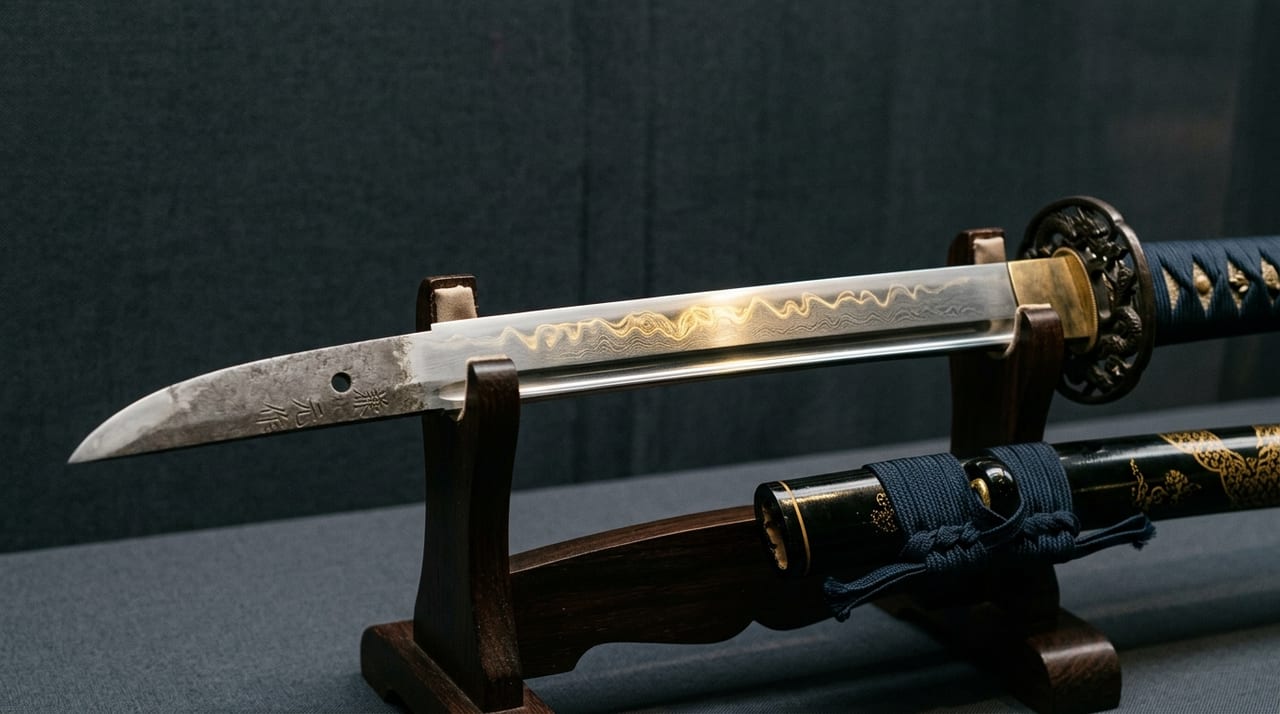
 * Image is for illustrative purposes only.
Inaba-Gō
稲葉江
Also known as: Inaba-Gō: Gō Yoshihiro's Masterpiece and One of the Three Greatest Masters
Description
Overview of the Katana
Inaba-Gō is one of the masterpieces of Gō Yoshihiro, counted among the Tenka Sansaku (Three Great Smiths of the Realm), and is a peerless masterwork designated a National Treasure. The name 'Inaba' derives from Inaba Shigemichi (son of Inaba Ittetsu), who once owned this sword. Gō Yoshihiro was a swordsmith of Etchū Province (present-day Toyama Prefecture), a phantom master who studied the Sōshū tradition and opened a unique realm of his own. There are no extant signed works by Gō Yoshihiro. The only swords credited to Gō are those attributed through Hon'ami family attributions (kiwame) and tradition, yet many of them have been designated National Treasures or Important Cultural Properties.
Gō Yoshihiro's Techniques and Characteristics
Gō Yoshihiro's swords, while inheriting the orthodox lineage of the Sōshū tradition, reached a realm that no one else could follow in their own distinctive sae (brilliance) and nie expression. The jigane is densely packed with fine ko-itame, and within a deep iron tone that gleams like black, kinsuji and sunagashi run in disorder. The hamon is a turbulent pattern of notare mixed with gunome, with abundant nie that makes it bright and clear.
Characteristics of Inaba-Gō
Among these, Inaba-Gō stands out in particular for the texture of its jigane and the power of its hamon. Originally a long tachi, it was shortened (suriage) by Hon'ami Kōtoku in Tenshō 13 (1585), and it is now a katana with a cutting edge length of 70.9 cm. The hamon is ko-notare mixed with gunome, with ashi entering. The nioi is deep, with fine nie abundant, and from monouchi upward the yakiba is especially broad, undulating in a large pattern. The tang is cut with the inscriptions 'Shoji Inaba Kan'emon-no-jō' and 'Tenshō jūsan jūnigatsu hi Gō Hon'ami suriage kore' in gold inlay. Gō Yoshihiro has no extant signed works bearing his own signature, and Inaba-Gō is unsigned. This point is, paradoxically, known as a typical example of a Gō Yoshihiro attribution by the Hon'ami family.
From Inaba Shigemichi to the Tokugawa and the Kashiwabara Museum
Inaba Shigemichi (?–1598), after whom the name Inaba-Gō is taken, was the son of Inaba Ittetsu (Yoshimichi, 1515–1588), known as one of the Nishi-Mino Sanninshū (Three Lords of Western Mino). He was a military commander who served Oda Nobunaga and Toyotomi Hideyoshi. It is also said that his father's common name, 'Ittetsu', gave rise to the expression 'ganko ittetsu' (stubborn to the core). This sword was later sought by Tokugawa Ieyasu, who took it for 500 kan. At the Battle of Sekigahara he gave it to his second son, Yūki Hideyasu. Thereafter it was passed down among Hideyasu's descendants and came to the Tsuyama Matsudaira house. In Shōwa 26 (1951) it was designated a National Treasure. In Heisei 31 (2019), Kashiwabara Corporation of Iwakuni City purchased it and donated it to the Kashiwabara Museum of Art, which holds it today.
Relationship to the Tenka Sansaku
Gō Yoshihiro, as one of the Tenka Sansaku, is positioned together with Masamune and Yoshimitsu as the greatest smiths in the history of Japanese swords. In the Kyōhō Meibutsuchō as well, the works of these three are prized as the 'meibutsu sansaku', and each daimyō eagerly sought to acquire Gō's works.
Legends & Stories
Gō Yoshihiro, the Enigmatic Master Smith
The greatest mystery surrounding Gō Yoshihiro is that not a single signed work (a sword bearing his own signature) has been confirmed. The mid-Muromachi sword treatise Ōjakushō records a sword with the signature 'Gō', and describes him as a disciple of Masamune. Even in modern sword research, it is established as the accepted view that Gō Yoshihiro was a real swordsmith of Etchū and a master who inherited the Sōshū tradition and opened a unique realm of his own.
The Phantom Master Smith and 'Nobody Has Ever Seen a Gō or a Ghost'
In the world of swords there is an old saying: 'Nobody has ever seen a Gō or a ghost.' This is because no signed works by Gō Yoshihiro survive at all. The inscriptions that do survive are all either gold-inlaid inscriptions of Hon'ami family attributions or shu-mei (lacquer inscriptions). Genuine works are rarely encountered. He is said to have existed, yet no one has actually seen one, and so the saying has been used as an analogy for something said to exist but never directly observed. Inaba-Gō is likewise an unsigned famous sword, bearing a gold-inlaid inscription from Hon'ami Kōtoku's attribution. The accumulation of its violently turbulent hamon and golden-shining nie gives the viewer the illusion that the blade is burning from within.
The Unbending Spirit of Inaba Ittetsu
The name Inaba-Gō derives from the fact that it was owned by Inaba Shigemichi, son of Inaba Ittetsu (Yoshimichi). Ittetsu served the Saitō clan as lord of Sone Castle in Mino, and later passed through the eras serving Oda Nobunaga and Toyotomi Hideyoshi. He was one of the Nishi-Mino Sanninshū, and his name 'Ittetsu' is also said to be the origin of 'ganko ittetsu' (stubborn to the core). The image of this sword, handed down from Shigemichi, and the temperament of the Ittetsu family, which possessed an unbreakable spirit, coincide strangely well with the image of Gō Yoshihiro's blades, both intense and dignified. That a stubborn, unbending warlord possessed a masterpiece of Gō Yoshihiro, the very byword for unbreakable blades, shows the marvelous enishi (bond) of Japanese swords, by which a sword and its owner draw each other.
To the Treasure of the Tokugawa
Inaba-Gō is said to have later been taken by Tokugawa Ieyasu for 500 kan, and at the time of the Battle of Sekigahara it was given to his second son, Yūki Hideyasu. It was thereafter passed to the Tsuyama Matsudaira house, which branched from the Echizen Matsudaira house. It is now designated a National Treasure and held by the Kashiwabara Museum of Art (formerly the Iwakuni Art Museum) in Iwakuni City, Yamaguchi Prefecture, where it continues to shine quietly in the western provinces (Saigoku).