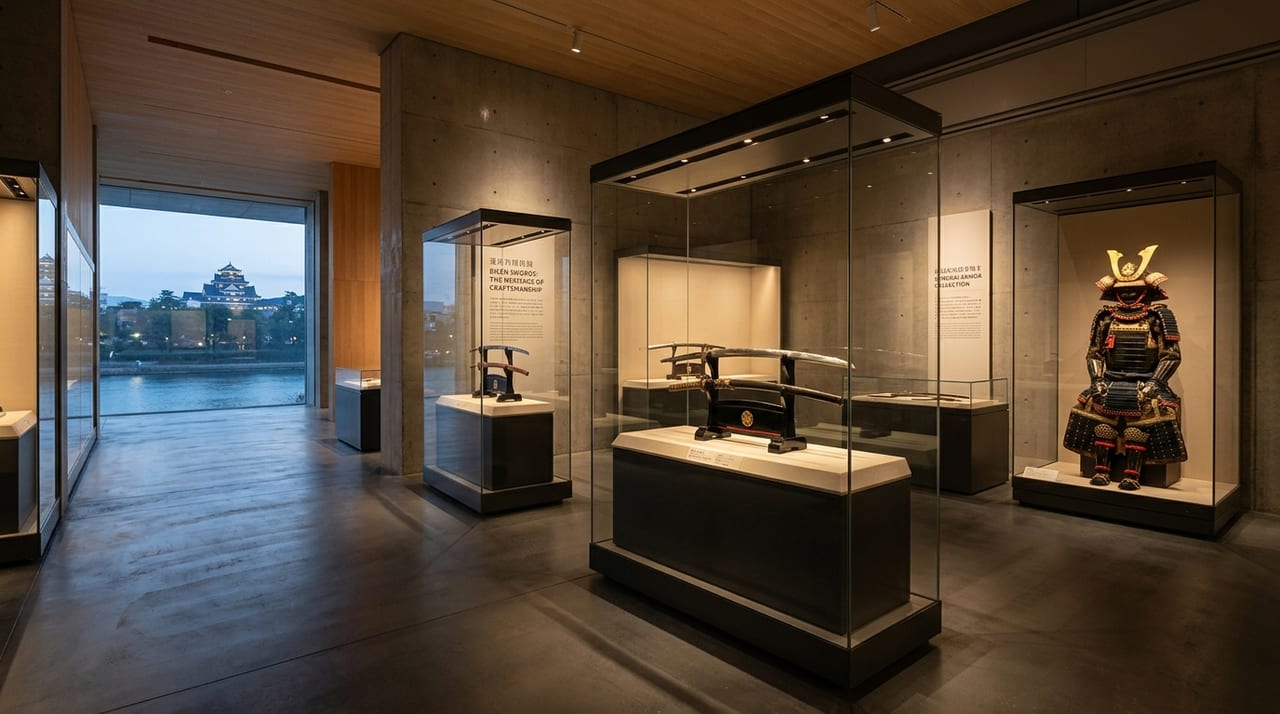
 * Image is for illustrative purposes only.
Okayama Prefectural Museum
岡山県立博物館
Overview
A Hall of Sword Culture Standing in the Land of Bizen
The Okayama Prefectural Museum opened in 1971 (Showa 46) as the core comprehensive museum of Okayama Prefecture. Adjacent to Kōrakuen, one of Japan's Three Great Gardens, it stands on the banks of the Asahigawa river with a view of Okayama Castle (the Black Castle), in a verdant setting. Okayama Prefecture has long been known as Bizen Province, and as the birthplace of the "Bizen tradition," one of the five great sword traditions of Japanese swords, it is one of the most important sites in sword history. From the Kamakura period through the Edo period, Bizen was a center of Japanese sword production, with renowned smithing groups such as the Fukuoka Ichimonji school and Osafune school supplying swords throughout the country, and its renown remains undiminished to this day.
A Treasury of Bizen Blades
The true distinction of the museum's celebrated sword collection lies in its systematic acquisition and exhibition of masterblades of the Bizen tradition. The hallmark of Bizen swords is the tightly-packed small itame steel grain with a clear utsuri (misty reflection), and hamon that displays varied renderings such as choji, gunome, and ko-midare. The museum's presentation allows for comparative appreciation of Bizen swords across periods—from the Ichimonji school and Osafune school of the Kamakura period to Kanemitsu and Nagayoshi of the Nanbokuchō period, through to sue-Bizen of the Muromachi period. With multiple blades designated as Important Cultural Properties, this is the ideal institution for mastering the true essence of the Bizen tradition, which formed the mainstream of Japanese swords.
The Ikeda Family and Their Cultural Artifacts
The Ikeda clan of Okayama domain were lords of a major domain governing Bizen, Mimasaka, and Harima, a cultured daimyo house that developed Okayama Castle and Kōrakuen. The museum houses abundant materials from the clan's period of rule, including swords, armor, and weaponry inherited from the Ikeda family, making it essential for understanding the samurai culture of Bizen. The Ikeda family's sword collection includes both swords granted by the shogunate and commissioned works from renowned swordsmiths, offering a window into the sword culture of a daimyo house.
Integrated Sightseeing with Kōrakuen
Kōrakuen is a daimyo garden created by Ikeda Tsunamasa, lord of Okayama domain, in Genroku 13 (1700), and is counted among Japan's Three Great Gardens alongside Kairakuen in Mito and Kenrokuen in Kanazawa. Visiting the museum, Kōrakuen, and Okayama Castle together allows one to experience Edo period daimyo culture in three dimensions. The Kōrakuen garden, graced with seasonal flowers—cherry blossoms, peaches, and chrysanthemums—is ideal for a stroll after museum viewing. Easily accessible by tram (Okayama Electric Railway) from Okayama Station, making it highly convenient for sightseeing.
Highlights
- Systematic Bizen tradition collection — Ichimonji (Kamakura) through sue-Bizen (Muromachi), covering every era of Bizen swordmaking, one of Japan's most comprehensive Bizen displays
- Multiple Important Cultural Property Bizen blades — illustrating utsuri, choji hamon, and ko-itame jigane with authentic masterworks from the tradition that dominated Japanese swordmaking for centuries
- Ikeda clan swords and armor — including shōgunal gift blades and commissioned works from noted smiths, showing daimyō sword culture in its full Edo-period context
- Adjacent to Kōrakuen (one of Japan's Three Great Gardens) — the Genroku-era garden of Okayama domain lord Ikeda makes for an ideal post-museum stroll
- Combined with Okayama Castle (the Black Castle) — the distinctive crow-black castle and museum together form one of Japan's best single-day samurai culture itineraries
* Opening hours and exhibitions are subject to change. Please check the official website before visiting.