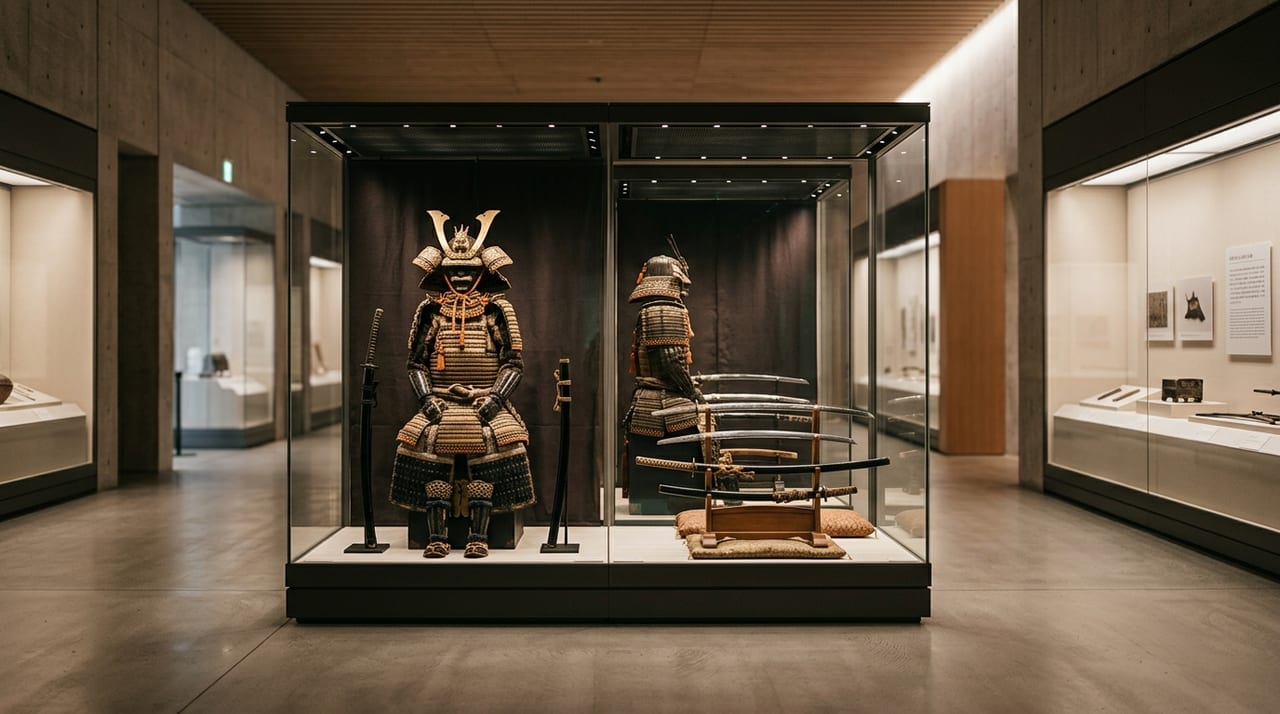
 * Image is for illustrative purposes only.
Kumamoto Museum
熊本博物館
Overview
Kumamoto Museum is a municipal comprehensive museum located at Kokyōmachi, Chuo Ward, Kumamoto City. Since its establishment in 1952 (Showa 27), it has been recognized as one of Kyushu's leading comprehensive museums, widely collecting and exhibiting the natural history, history, folklore, and archaeology of Kumamoto Prefecture. Kumamoto is known as the former province of Higo, and during the Edo period it was the political and military center ruled by two major daimyo: Katō Kiyomasa (controlling 520,000 koku) and the Hosokawa clan (controlling 540,000 koku). Consequently, Kumamoto Museum serves as an important custodian of Higo's samurai culture and sword culture.
From the perspective of Japanese swords and armor, artifacts associated with Higo—including blades, armor, and sword fittings—are particularly noteworthy. Higo metalwork, a distinctive decorative metalcraft tradition, is recognized as among Japan's highest standards in the field of sword fittings (tsuba, menuki, kozuka, kogai). Artifacts related to Katō Kiyomasa, Hosokawa Tadatoshi, and Hosokawa Sansai (Yūsai) are dispersed across facilities throughout Kumamoto. Kumamoto Museum regularly stages special exhibitions on Higo's sword-fitting culture and samurai culture. In the permanent exhibitions, the museum contextualizes warrior culture within Kumamoto's comprehensive history from the Jōmon period to the modern era.
Additionally, Kumamoto is where Miyamoto Musashi (the legendary master of the two-sword style) spent his final years, and Reigandō—the cave where he authored the Book of Five Rings—still exists. From the perspective of materials associated with Miyamoto Musashi and kendo culture, Kumamoto Museum is an essential site for understanding the cultural legacy of Kumamoto as the land of legendary swordmasters. It is approximately a 10-minute walk from Kumamoto Castle's main tower (restored in 2021) and can be visited in combination with the Kumamoto Crafts Hall and Kumamoto Contemporary Art Museum.
Highlights
- Higo metalwork (kinzane)—among the highest achievements in sword fittings such as tsuba, menuki, and kozuka; a distinctive metalcraft tradition nurtured by the Katō and Hosokawa daimyo
- Swords and armor artifacts associated with Katō Kiyomasa, Hosokawa Tadatoshi, and Hosokawa Sansai (Yūsai)—primary historical documents of samurai culture left by a major daimyo domain controlling 540,000 koku
- Kumamoto: where Miyamoto Musashi (master of the two-sword style) spent his final years—understand Japanese swords through the context of the Book of Five Rings and swordmaster culture
- A comprehensive museum displaying Kumamoto's complete history from the Jōmon period through the modern era—an overarching perspective that situates sword culture within the historical context of Higo Province
- A 10-minute walk from Kumamoto Castle's main tower (restored in 2021)—experiencing samurai culture integrated with castle tourism
- One of Kyushu's leading comprehensive museums—housing Higo's natural history, history, and folklore in one place, enabling comprehensive study of the social context of sword culture
* Opening hours and exhibitions are subject to change. Please check the official website before visiting.