 * Image is for illustrative purposes only.
Setonaikai Folk History Museum
瀬戸内海歴史民俗資料館
Overview
Museum Overview
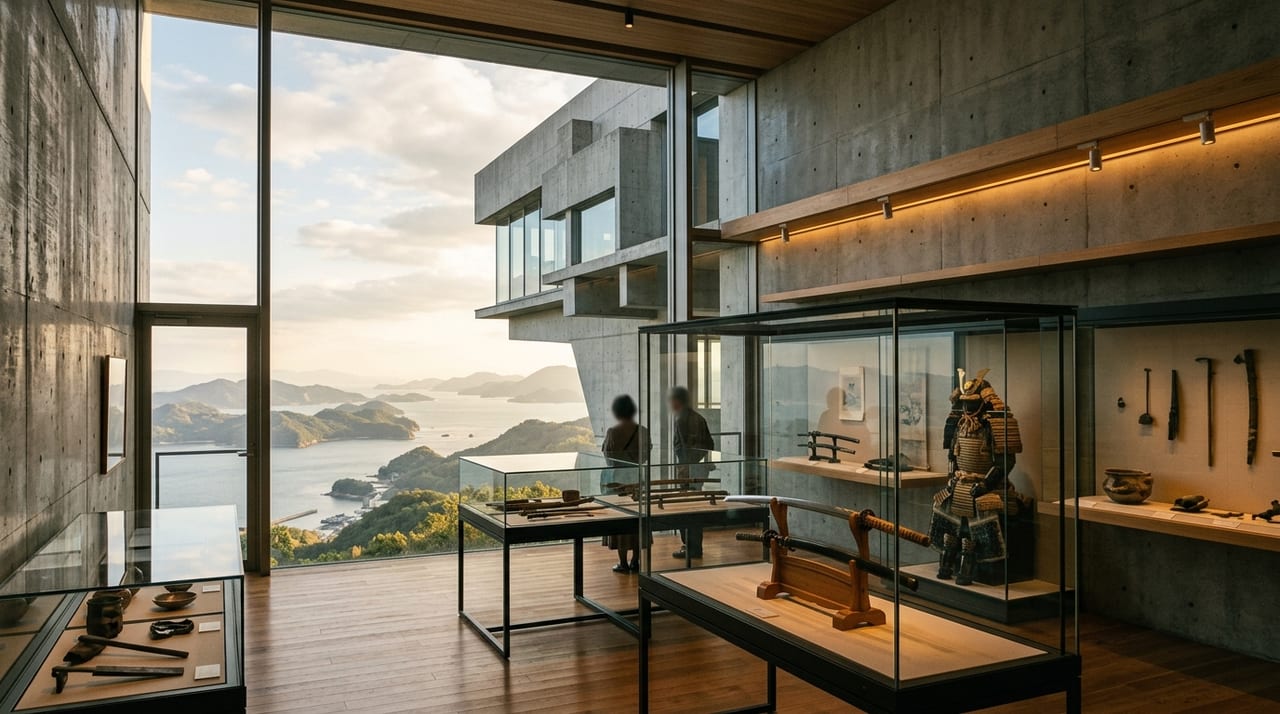
Kagawa Prefectural Museum is a prefectural museum that comprehensively collects, researches, and displays the history, folklore, and culture of the Seto Inland Sea region. Perched on Goshikidai hill at an elevation of approximately 300 meters, it offers panoramic views of the Seto Inland Sea's characteristic island-dotted landscape from its observation platform. Since opening in 1973 (Showa 48), it has been introducing, through abundant original materials, how the Seto Inland Sea as Japan's inner sea has fostered the lives, culture, and commerce of its people.
Folklore Materials
Among sword-related holdings, works by swordsmiths connected to Sanuki Province (Kagawa Prefecture) and weapons and swords associated with the Seto Inland Sea naval forces are noteworthy. From ancient times through the medieval period, the Seto Inland Sea served as a major artery of maritime traffic. The Seto Inland Sea naval forces, exemplified by the Murakami Naval Forces, were powerful armed forces that commanded maritime dominion. The naginata, tachi, and tantō wielded by these naval forces possessed unique forms suited to maritime combat, distinct from land warfare, and are therefore of considerable interest from a weaponological perspective.
Sword Display
Among Sanuki Province swordsmiths from the Kamakura period, names such as "Sanuki-koku-ju Tametsugu" and "Sanuki-koku-ju Fujiwara Masatsune" are transmitted down. However, compared to major production centers such as Bizen and Yamashiro, surviving works are scarce, and the displayed pieces hold significant research value. Although Shikoku in general is not well known as a sword-producing region, Sanuki is situated in close proximity to Bizen (Okayama) across the Seto Inland Sea, and it is thought that there was technical exchange between Sanuki and Bizen smiths.
Seto Inland Sea Culture
The museum's holdings of approximately 6,600 items—including fishing equipment, shipwright tools, and salt-making implements designated as Important Tangible Folk Cultural Properties—comprise a first-rate collection of materials for understanding the maritime culture of the Seto Inland Sea. Models of fishing boats and restored sailing ship models are also displayed, vividly conveying the lives of people who lived with the sea.
Living Culture
The building itself is also highly valued as an architectural work. Designed by architect Yamamoto Tadashi (1923–1998), the main building features bold exposed-concrete forms that harmonize beautifully with the natural landscape of Goshikidai and received the Japan Architectural Institute Award. The interior, incorporating local stone and wood throughout, creates a space fully integrated with the region's natural character. From the rooftop observation platform, views of the Seto Ohashi Bridge and the island-dotted seascape are strikingly beautiful on clear days.
Preservation and Succession
Worth noting is that admission is free. During the Setouchi International Art Festival periods, artworks are scattered throughout the Goshikidai area, allowing visitors to enjoy both contemporary art and historical materials.
Highlights
- Works by swordsmiths associated with Sanuki Province
- Weapons and swords related to Seto Inland Sea naval forces
- Holdings including Important Tangible Folk Cultural Properties
- Acclaimed architecture by Yamamoto Tadashi with Inland Sea views
* Opening hours and exhibitions are subject to change. Please check the official website before visiting.