 * Image is for illustrative purposes only.
Shimane Prefectural Ancient Izumo History Museum
島根県立古代出雲歴史博物館
Overview
Tatara Steelmaking and the Sacred Grounds of the Japanese Sword
The Shimane Prefectural Ancient Izumo History Museum is a prefectural museum that opened in 2007 (Heisei 19) adjacent to Izumo Taisha shrine grounds. It is particularly noted by sword enthusiasts and iron-culture researchers as a facility boasting the nation's highest-level exhibits on tatara steelmaking—the ancient process that produces tamahagane, the raw material for Japanese swords. Izumo Province (present-day eastern Shimane Prefecture) has, since ancient times, been rich in iron-sand resources as symbolized in the 'Land-Pulling Myth of Izumo,' and has held over a thousand years of history as the greatest center for tatara steelmaking—the production of raw materials for Japanese swords.
Tatara Steelmaking Exhibits
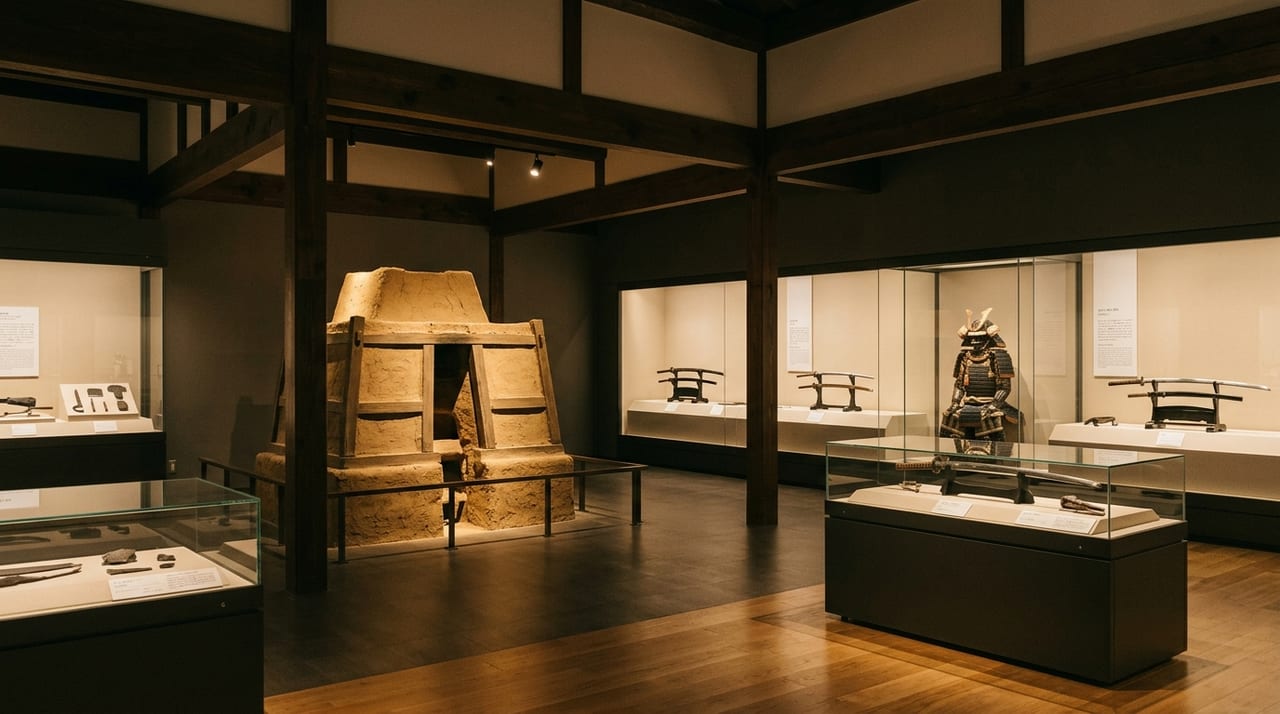
Tatara steelmaking is a distinctly Japanese steelmaking technique in which iron sand and charcoal are continuously burned for three days and three nights in a clay furnace (takadono) to refine tamahagane, the raw material for Japanese swords. Its history traces back to the Kofun Period, and Izumo, Hōki, and Ishimi (present-day Shimane and Tottori Prefectures) have historically borne the majority of Japan's tamahagane production. This museum's tatara steelmaking exhibit systematically explains the entire process—from iron-sand collection to washing (sorting), loading into the takadono, three days and three nights of refinement, iron classification (tamahagane, intermediate grades, slag), and cutting with heavy mallets—through full-scale models, video, and authentic materials. This allows visitors to understand from the ground up what materials Japanese swords originate from and what processes they undergo. Inside the museum is a reconstructed model of an actual tatara furnace, vividly conveying the intense heat within the takadono and the rigorous labor of the craftsmen.
What Is Tamahagane?
Tamahagane is a steel produced through tatara steelmaking and used exclusively for Japanese swords—a unique material unmatched anywhere in the world. Tamahagane derived from iron sand has relatively low carbon content (distributed in the range of 0.6–1.5%), and by combining hard and brittle high-carbon steel (the cutting edge) with soft and resilient low-carbon steel (the core) through differential hardening (folding), Japanese swords achieve the seemingly contradictory properties of never breaking, never bending, and cutting exceptionally well. Today, tamahagane is produced in quantities of only a few tons per year, exclusively at the Nitou Hozonkai Tatara (operated by the Society for the Preservation of Japanese Art Swords) in Okuizumo Town, Nita District, Shimane Prefecture, and is used by contemporary sword smiths in sword-making. Both Okuizumo—which hosts the site of tamahagane production—and this museum, which explains its history and techniques, are irreplaceable resources for understanding the materials of Japanese swords.
The Kōjindani Ruins and Ancient Bronze Swords
The Kōjindani Ruins, excavated in 1984 (Showa 59) in Hii District, Hii Town (now Izumo City), Shimane Prefecture, are known as Japan's largest discovery of bronze artifacts, with 358 bronze swords, 6 bronze bells (dōtaku), and 16 bronze spears buried together in a single cache. This figure of 358 swords exceeded the total number of bronze swords previously discovered throughout all of Japan, shocking the archaeological world upon discovery. The museum displays bronze swords from the Kōjindani Ruins and other Yayoi-period metal artifacts, presenting a comprehensive history of the development of edged-tool culture in Japan—from bronze to iron and finally to the Japanese sword. The fact that such massive quantities of bronze swords were buried in Izumo during the Yayoi period, before iron blades became widespread, indicates that ancient Izumo was a major center for weaponry, suggesting a continuity in edged-tool culture that would eventually lead to the Japanese sword culture enabled by tatara steelmaking.
Izumo Taisha and Ancient Myth
Located at the gate of Izumo Taisha, the museum systematically introduces Izumo myths recorded in the Kojiki and Nihon Shoki—such as the 'Land-Pulling Myth' and the 'Land-Transfer Myth'—through video, models, and materials. The 'Heavenly Sword of Gathered Clouds' (Ame no Murakumo no Tsurugi), which Susanoo no Mikoto drew from the tail of the eight-headed serpent Yamata no Orochi when subduing it, later became the 'Grass-Cutting Sword' (Kusanagi no Tsurugi), one of the Three Imperial Regalia of the imperial house. This mythology is centered on Izumo and represents the most famous sword legend in Japan, demonstrating how deeply Japanese sword culture is intertwined with myth and faith. The museum's exhibits serve as an ideal starting point for understanding this mythological significance of swords.
An Invitation to Tatara Country: Okuizumo
After visiting the museum, we strongly recommend extending your journey to Okuizumo (Nita District). Okuizumo Town, positioned along the way toward Bingo-Ochiai, the terminus of the JR Kizuki Line, continues the tradition of tatara steelmaking today as 'Tatara Country.' Visiting the 'Okuizumo Tatara and Sword Museum' and the 'Sugaya Tatara Yamanouchi' (a nationally designated historical site) allows you to experience the tatara steelmaking environment firsthand.
Highlights
- Complete tatara steelmaking process display—from iron sand collection through three days and three nights of refinement in the takadono to tamahagane extraction, explaining the raw material production process for Japanese swords at the nation's highest level. Full-scale takadono reconstruction model and video are spectacular.
- Tamahagane display and explanation—clearly introduces the carbon content and physical properties of tamahagane, the steel exclusive to Japanese swords, and its relationship to differential hardening. Allows understanding of the essence of Japan's steelmaking technology, unmatched anywhere in the world.
- 358 bronze swords from the Kōjindani Ruins—discovered in 1984, Japan's largest archaeological discovery of bronze artifacts. Overwhelming authentic materials demonstrating the continuity of edged-tool culture from the Yayoi period to the Japanese sword.
- Izumo mythology and the Heavenly Sword of Gathered Clouds—Susanoo's defeat of Yamata no Orochi and the origin of the 'Grass-Cutting Sword,' one of the Three Imperial Regalia. An immersive exhibition showing how Japanese sword culture is integrally bound with myth and faith.
- Gateway to Okuizumo and the Nitou Hozonkai Tatara—ideal as a jumping-off point for visiting the 'Nitou Hozonkai Tatara' (in Okuizumo Town), the only currently operational tatara steelmaking furnace. Combined visits to the Sugaya Tatara Yamanouchi (nationally designated historical site) are recommended.
* Opening hours and exhibitions are subject to change. Please check the official website before visiting.