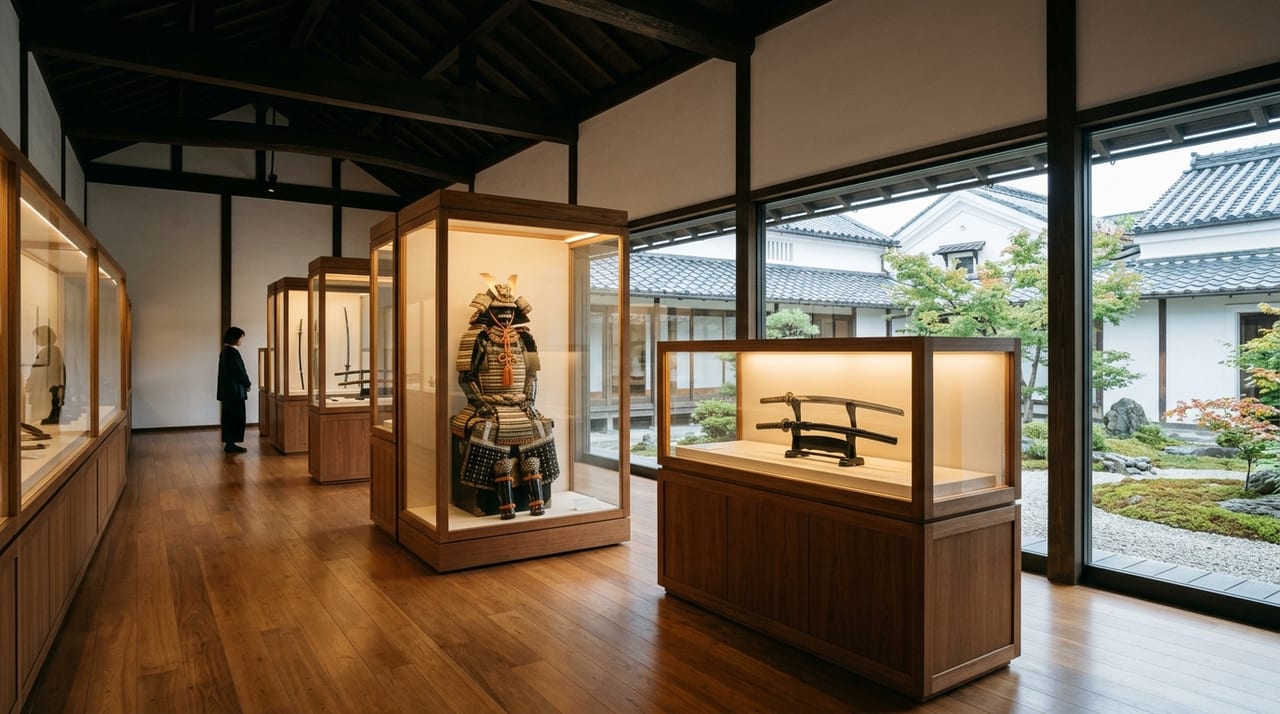
 * Image is for illustrative purposes only.
Yamaguchi Prefectural Hagi Museum – Urakami Memorial Hall
山口県立萩美術館・浦上記念館
- Location
- Hagi, Yamaguchi Prefecture
- Access
- About 7 minutes by taxi from Higashi-Hagi Station on the JR San'in Main Line, or about 20 minutes by the Hagi Maaru Bus (loop bus, western route). About 20 minutes on foot from Tamae Station on the JR San'in Main Line. From Shin-Yamaguchi Station on JR, take the direct Super Hagi express bus (about 60 minutes) and get off at Hagi Meirin Center, then walk about 5 minutes. Alternatively, take the Bōchō Bus (about 90 minutes) and get off at Hagi Bus Center, then walk about 12 minutes. By car, it is about 20 minutes from Edō IC on the Ogōri-Hagi Road, or about 10 minutes from Sanmi IC on the San'in Expressway. The museum is located within the Hagi castle town sightseeing area, so rental bicycles are a convenient way to get around. A dedicated museum parking lot is available (50 standard vehicles, free of charge).
- Opening Hours
- 9:00–17:00 (last admission 16:30) ※Closed Mondays (open if a national holiday or other holiday), closed during New Year holidays, exhibition changeover periods, etc.
- Admission
- Collection exhibition: adults 400 yen, students 250 yen (free for those aged 70 and over and 18 and under). Special exhibitions vary by exhibition
Overview
Museum Overview
The Yamaguchi Prefectural Hagi Museum – Urakami Memorial Hall is a prefectural art museum located in the castle town of Hagi, facing the Sea of Japan. It opened in Heisei 8 (1996). The name "Urakami Memorial Hall" derives from the donation to Yamaguchi Prefecture of a collection of ukiyo-e prints, East Asian ceramics, and other works assembled by Urakami Toshirō (1926–2020), a businessman from Hagi. In Heisei 22 (2010), a Ceramics Hall was added as an extension to promote Hagi ware and other pottery. The museum now specializes in three fields: ukiyo-e, East Asian ceramics, and pottery.
Urakami Collection: Ukiyo-e and East Asian Ceramics
The ukiyo-e collection at the core of the Urakami Collection is one of the finest in Japan. It includes works by leading Edo-period masters such as Kitagawa Utamaro, Katsushika Hokusai, Utagawa Hiroshige, and Tōshūsai Sharaku. Ukiyo-e traveled to Europe in the eighteenth and nineteenth centuries and had a profound influence on the Impressionist painters, becoming the wellspring of "Japonisme." The museum is internationally noteworthy as a facility where visitors can systematically view this art in its original form within Japan. The East Asian ceramics collection also includes outstanding pieces from China, Korea, and Japan, forming a collection that holds an important place in the history of ceramic art.
The Cultural Significance of Hagi
Throughout the Edo period, Hagi flourished as the castle town of the Chōshū Domain (Mōri clan). In the late Tokugawa period, it produced many of the leaders of the Meiji Restoration, including Yoshida Shōin, Takasugi Shinsaku, Itō Hirobumi, and Kido Takayoshi. A museum located on this land goes beyond being a mere facility for displaying artworks. It serves as a place that bears witness to the history and culture of the region that drove Japan's modernization. Visiting together with the Shōka Sonjuku, Hagi Castle Ruins, and the castle town of Hagi (a UNESCO World Heritage Site) allows visitors to experience the historical depth of Hagi to the fullest.
Facilities and Exhibitions
The main building was completed in Heisei 8 (1996) to designs and under the supervision of Tange Kenzō and Urban and Architecture Design Institute. In addition to special exhibitions, collection displays of ukiyo-e, East Asian ceramics, and pottery are held with rotating installations. The museum also includes a special ukiyo-e viewing room and a tea room. As a tourism hub for the Nagato–Hagi area of San'in, it welcomes visitors from Japan and abroad.
Highlights
- Urakami Collection Ukiyo-e — One of Japan's premier collections of woodblock prints, including works by Utamaro, Hokusai, Hiroshige, and Sharaku. Enables systematic appreciation of the finest examples of Edo woodblock art that became the source of Japonisme.
- Oriental Ceramics Collection — Fine ceramics from China, Korea, and Japan. Brings together important works in ceramic art history, selected through the discerning eye of the Urakami family.
- Historic Hagi Castle Town, a World Heritage Site — Museum located in an area with deep connections to Yoshida Shoin and Takasugi Shinsaku. Offers integrated historical tourism with Shoka Sonjuku and Hagi Castle ruins.
* Opening hours and exhibitions are subject to change. Please check the official website before visiting.