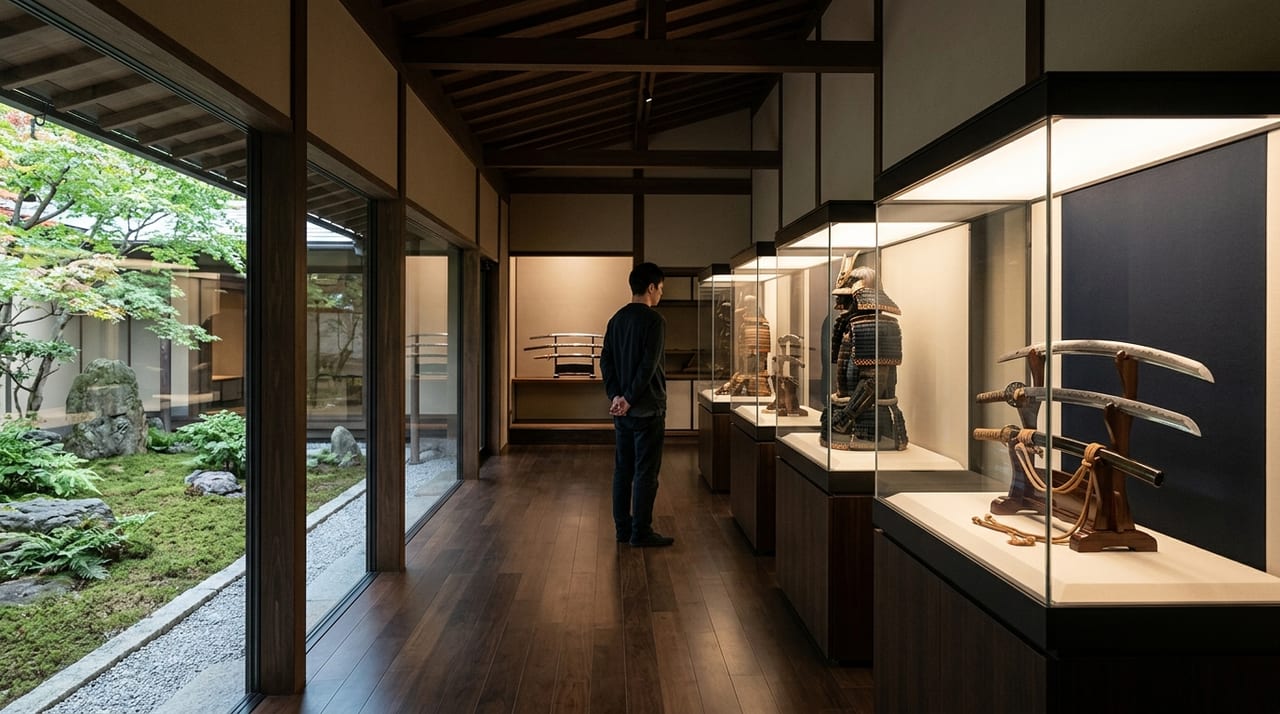
 * Image is for illustrative purposes only.
Kikkawa Historical Museum
吉川史料館
Overview
The Kikkawa Historical Museum is a museum that houses and displays historical materials and art objects handed down through the Kikkawa family, a samurai house that traces its origins to the Kamakura period. Located in the Yokoyama district at the foot of Iwakuni Castle, near the base of the Kintai Bridge, it opened in November 1995 (Heisei 7). It holds about 7,000 historical materials and art objects spanning roughly 800 years of Kikkawa family history.
Building Utilizing the Shōmeikan
Part of the museum's building utilizes structures attached to the Shōmeikan, which was built during the Kansei era as the retirement residence of Kikkawa Tsunetomo, the 7th lord of Iwakuni, and preserves the appearance of the Edo period to this day. The garden uses white sand from Awaji and black granite, and its design is said to express the spirit of Zeami's Fūshikaden.
Motoharu, Son of Mōri Motonari, Adopted into the Kikkawa Family
During the Sengoku period, the Kikkawa family's headship passed to Motoharu, the second son of Mōri Motonari, who succeeded as an adopted heir. After the generations of Motoharu and Hiroie, the family moved to Iwakuni following the Battle of Sekigahara and continued as lords of Iwakuni until the Meiji Restoration.
The National Treasure Tachi "Kitsunegasaki" and Armor of Successive Lords
At the core of the collection is the National Treasure tachi "Kitsunegasaki," attributed to Aoe Tameji. Its name is traditionally said to derive from the fact that in 1200 (Shōji 2), Kikkawa Tomokane used it to kill members of the clan of Kajiwara Kagetoki in Kitsunegasaki, Suruga Province. Other items include the "Kuronuri sujikabuto" helmet, traditionally said to have been used by Kikkawa Motoharu, and the "Namazu-gata" helmet, traditionally said to have been used by Kikkawa Hiroie. The museum holds numerous pieces of armor and swords actually used by its lords, and many have been designated Important Cultural Properties. Centered on swords and armor, the museum displays a broad range of items, including letters, documents, and furnishings of successive Kikkawa heads, and is known as a museum that conveys the real image of one samurai house from the Sengoku through the Edo period.
Highlights
- National Treasure tachi signed Aoe Tameji ("Kitsunegasaki") — a Kikkawa family heirloom traditionally said to have been used by Kikkawa Tomokane when he killed members of the clan of Kajiwara Kagetoki
- The "Kuronuri sujikabuto" helmet, traditionally said to have been used by Kikkawa Motoharu
- The "Namazu-gata" (catfish-shaped) helmet, traditionally said to have been used by Kikkawa Hiroie
- Kikkawa family documents and a Taiheiki handwritten by Kikkawa Motoharu, among other historical documents and books designated as Important Cultural Properties
- The museum building utilizing the Shōmeikan, built during the Kansei era, and its karesansui (dry landscape) garden
* Opening hours and exhibitions are subject to change. Please check the official website before visiting.