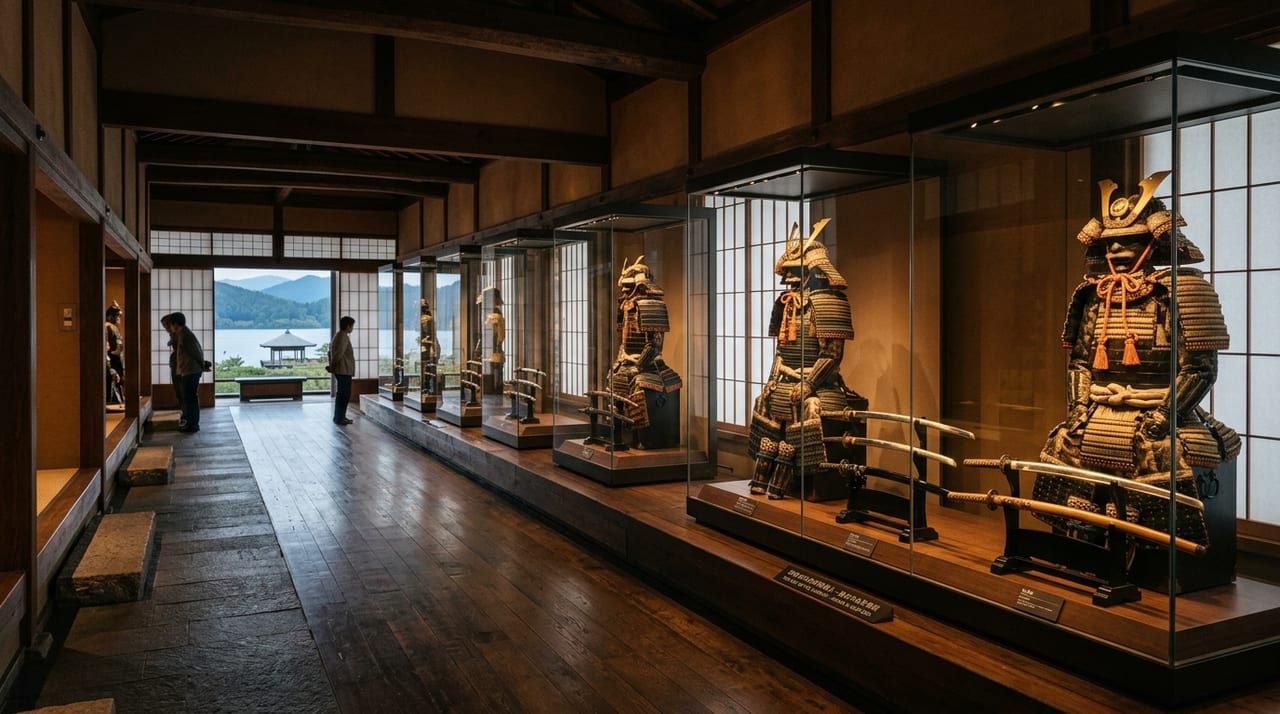
 * Image is for illustrative purposes only.
Shirayama-hime Shrine Treasure Hall
白山比咩神社宝物館
- Location
- Hakusan City, Ishikawa Prefecture
- Access
- From the "Mikawa IC" on the Hokuriku Expressway, it is about 20 minutes by car, or about 35 minutes from the "Hakusan IC." By train, take the IR Ishikawa Railway from Kanazawa Station to Nishi-Kanazawa Station, transfer at the adjacent Shin-Nishi-Kanazawa Station to the Hokuriku Railroad Ishikawa Line, and get off at Tsurugi Station. From Tsurugi Station, it is about 5 minutes by taxi (the Hokutetsu Bus is also available; on foot it takes about 30 minutes).
- Opening Hours
- Treasure Hall: April–October 9:00–16:00, November 9:30–15:30. Closed December–March
- Admission
- Treasure Hall: Adults 300 yen / high-school students and younger free
Overview
Shirayama-hime Shrine is enshrined in Hakusan City, Ishikawa Prefecture, and is known as the head shrine of the more than 3,000 Hakusan shrines nationwide. Mt. Hakusan (elevation 2,702 m) is counted, together with Mt. Fuji and Mt. Tateyama, among Japan's three famous mountains. Since it was opened in the Nara period by the monk Taichō, it has drawn many worshippers as a sacred site of mountain faith. The shrine holds, as a sacred treasure, the National Treasure "Ken (double-edged sword), signed Yoshimitsu," a masterpiece of extremely high value among swords.
The National Treasure "Ken (double-edged sword), signed Yoshimitsu" is the work of the Kamakura-period swordsmith Yoshimitsu of the Awataguchi school of Yamashiro Province, and is a small sword in ryō-shinogi-zukuri (double-edged) form. It was brought as a dowry when an adopted daughter of Tokugawa Iemitsu married Maeda Mitsutaka, lord of the Kaga Domain. After her death, her son Maeda Tsunanori is said to have dedicated it to pray for the repose of his mother. The sword is currently on deposit at the Ishikawa Prefectural Museum of Art while still owned by the shrine, and it is displayed on occasions such as special exhibitions at that museum (it is normally not displayed at the Shirayama-hime Shrine Treasure Hall). Yoshimitsu is known as a master of tantō (daggers).
The Important Cultural Property "Tachi, signed Nagamitsu" is a tachi by Nagamitsu, a master smith of Bizen. It is said that Maeda Toshiaki, lord of Daishōji Domain, dedicated it in Meireki 4 (1658), and it is likewise on deposit at the Ishikawa Prefectural Museum of Art. At the Treasure Hall, Important Cultural Properties such as the wooden komainu guardian figures, the wooden shishi-komainu guardian figures, and the hand box with phoenix design in chinkin (gold-inlaid lacquer) are on display. The Treasure Hall is open from April to October (9:00–16:00) and in November (9:30–15:30), and is closed from December to March.
Highlights
- National Treasure "Ken (double-edged sword), signed Yoshimitsu" — a short double-edged sword by the Kamakura master Awataguchi Yoshimitsu (on deposit at the Ishikawa Prefectural Museum of Art; not normally displayed at the Treasure Hall)
- Important Cultural Properties: wooden komainu guardian figures and wooden shishi-komainu guardian figures — komainu from the Kamakura period and the late Heian period on display at the Treasure Hall
- Important Cultural Property "Tachi, signed Nagamitsu" — a tachi by the Bizen master Nagamitsu, said to have been dedicated in Meireki 4 (1658) by Maeda Toshiaki, lord of Daishōji Domain (on deposit at the Ishikawa Prefectural Museum of Art)
- Head shrine of the Hakusan shrines — head shrine of more than 3,000 shrines nationwide, enshrined at the foot of Mt. Hakusan, one of Japan's three famous mountains, opened in the Nara period
- Closed from December to March — visits recommended during the open period (April–November)
* Opening hours and exhibitions are subject to change. Please check the official website before visiting.