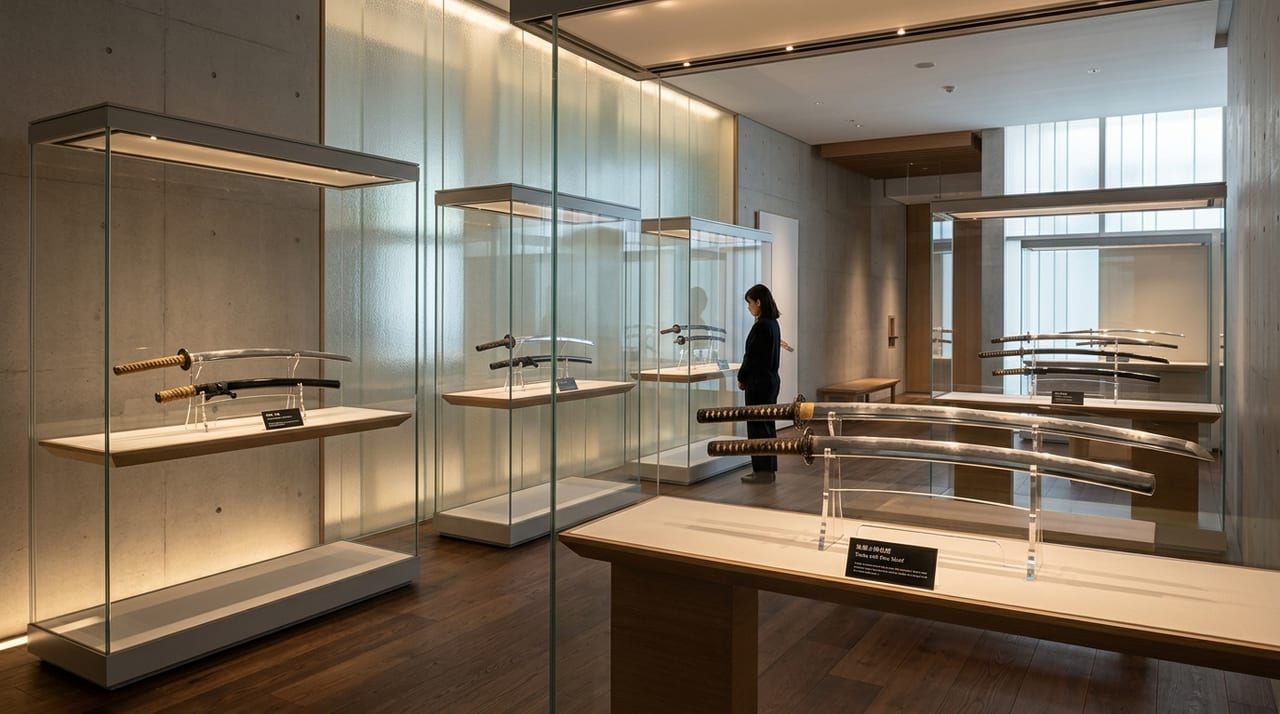
 * Image is for illustrative purposes only.
Shusui Museum of Art
秋水美術館
Overview
Overview of the Museum
The museum opened on June 11, Heisei 28 (2016) in central Toyama City as the Mori Memorial Shusui Museum of Art, to display swords, sword fittings, ceramics, and paintings collected over many years by Mori Masao (1930–2019). Mori was the founder of Lead Chemical, a Toyama pharmaceutical manufacturer, and also served as head of the Toyama Prefecture chapter of the NBTHK (Society for the Preservation of Japanese Art Swords). In 2020 (Reiwa 2), the general incorporated foundation Shusui Museum of Art was established to operate the museum, and it reopened under the name "Shusui Museum of Art." In 2022 (Reiwa 4), it became a public interest incorporated foundation. "Shūsui" is a word meaning a finely honed sword with no clouding.
Swords and Armor
The collection includes about 200 swords and sword fittings. Notable pieces include the Important Cultural Property katana signed Jū Tōeizan Shinobugaoka-hen Nagasone Ko Nyūdō (Kanbun 11 (1671), made by Kotetsu), the unsigned wakizashi attributed to Masamune, and the tachi signed Ichi Sukenari zō, Sanemori zō, Tsugutada, and Yoshiie saku. Also included are the tachi signed Bizen no Kuni Kanehira saku, the wakizashi signed Hasebe Kuninobu, and the tanto signed Muramasa. Among smiths from Etchū (Toyama), the museum also collects and exhibits works by Norishige, who is traditionally considered Masamune's senior disciple, and Gō Yoshihiro, one of the Tenka Sansaku (three greatest smiths). It also holds works of the Uda school from the Muromachi period.
Paintings and Crafts
In addition to swords, the museum holds the Important Cultural Property Satake-bon Thirty-Six Immortal Poets: Minamoto no Shigeyuki. It also has modern Japanese paintings by Yokoyama Taikan ("Uyo (After the Rain)"), Kawai Gyokudō, and Takeuchi Seihō, crafts by Kuroda Tatsuaki and Tokuda Yasokichi III, and Chinese ceramics.
Building
The building is a four-story reinforced concrete structure with a sumi-ink-colored aluminum exterior inspired by armor. It has viewing rooms on the second and third floors. The museum is located in Sengoku-machi in central Toyama City, close to Toyama Castle Park.
Combining with a Visit to Toyama
Toyama's access from Tokyo has improved greatly with the opening of the Hokuriku Shinkansen. Consider visiting as part of a fuller Hokuriku trip that also includes the spectacular views of the Tateyama mountain range, the seafood of Toyama Bay (shiro-ebi (white shrimp), hotaru-ika (firefly squid), and kanburi (winter yellowtail)), and the internationally known Toyama Glass Art Museum (designed by Kuma Kengo).
Highlights
- Six Important Cultural Property swords: the katana by Kotetsu, the wakizashi attributed to Masamune, and the tachi by Ichi Sukenari, Sanemori, Tsugutada, and Yoshiie
- About 200 swords and sword fittings collected by Mori Masao, including works by Norishige, Gō Yoshihiro, and the Uda school from Etchū (Toyama)
- A building inspired by armor: a four-story museum with a sumi-ink-colored aluminum exterior
- Paintings and crafts: the Important Cultural Property Satake-bon Thirty-Six Immortal Poets: Minamoto no Shigeyuki, modern Japanese paintings by Yokoyama Taikan and Kawai Gyokudō, and ceramics by Tokuda Yasokichi III
- A prime location in central Toyama City, close to Toyama Castle Park and ideal for touring cultural facilities together with the Toyama Glass Art Museum (designed by Kuma Kengo)
* Opening hours and exhibitions are subject to change. Please check the official website before visiting.