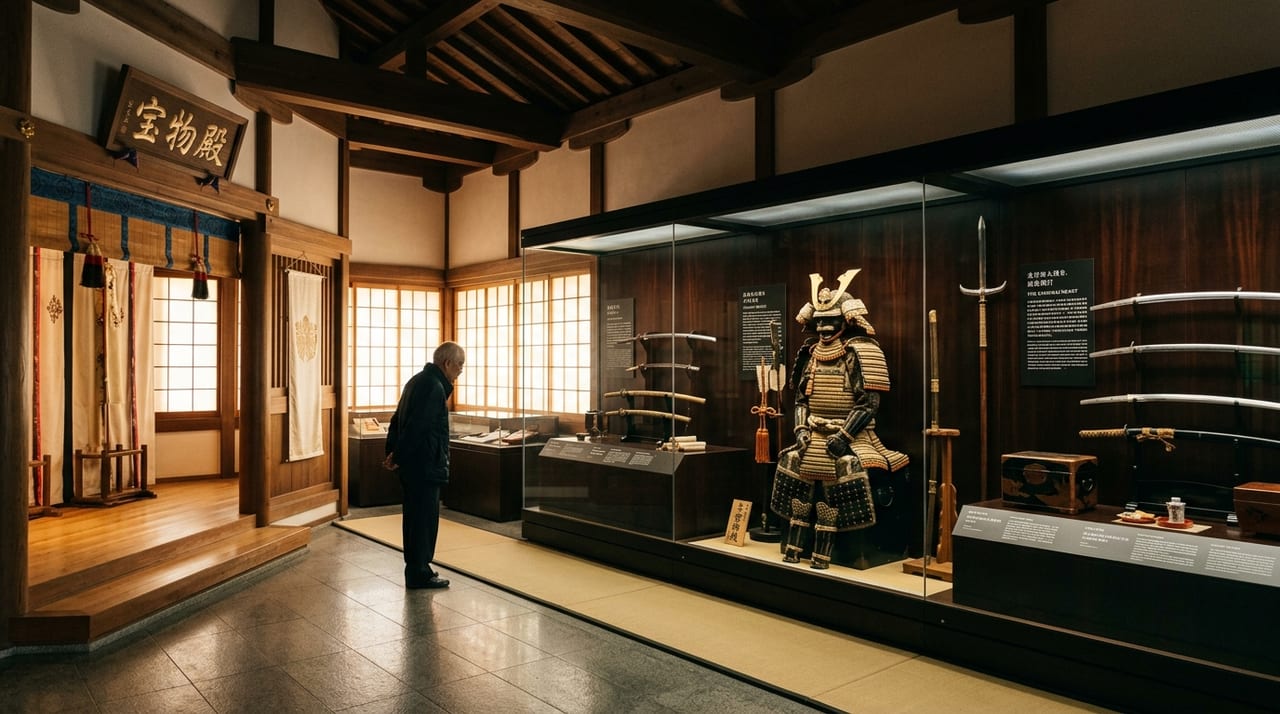
 * Image is for illustrative purposes only.
Suwa Taisha Treasure Hall
諏訪大社宝物殿
Overview
Overview of Suwa Taisha
Suwa Taisha is the head shrine of the approximately 25,000 Suwa shrines across Japan, and is one of the oldest shrines in Japan, situated on the shores of Lake Suwa in Nagano Prefecture. It is a shrine made up of four sanctuaries: the Upper Shrine (Kamisha, comprising Honmiya and Maemiya) and the Lower Shrine (Shimosha, comprising Harumiya and Akimiya). Its principal deities are Takeminakata-no-kami and Yasakatome-no-kami. Takeminakata-no-kami has been worshipped as a god of martial prowess and of hunting, and in the age of the samurai received particularly deep veneration from warlords and warriors. During the Sengoku period, Takeda Shingen revered the shrine deeply and sought to revive its rites at both the Upper and Lower Shrines.
Collection of the Treasure Hall
The Suwa Taisha Treasure Hall (within the precincts of Kamisha Honmiya) stores and displays shrine treasures such as tachi swords and ancient documents, as well as iron bells known as sanagi no suzu, which are said to have been rung by Takeda Shingen in battle, Hachiei bells, and nagi-gama. Note that two tachi transmitted to Suwa Taisha and designated Important Cultural Properties (one unsigned, one signed Tadayoshi) were stolen in 1960 (Shōwa 35).
The Onbashira Festival and Sword Worship
Suwa Taisha is world-renowned for the Onbashira Festival (Onbashira Matsuri), held once every seven years in the Year of the Tiger and the Year of the Monkey. For each of the four shrines, four giant fir trunks are felled from the mountains to serve as pillars. The kiotoshi (tree-felling descent), in which local parishioners (ujiko) risk their lives to haul the logs down a steep slope, is attracting attention at home and abroad as the largest of Japan's unusual festivals. The festival carries a martial spirit that has persisted since ancient times, an offering of “strength and courage,” and through it one glimpses a religious worldview with the same roots as sword worship. The martial character of the Suwa deity is one of the clearest examples of the spiritual background to the practice of dedicating swords to shrines.
Shinshū and the History of Swords
Nagano Prefecture (Shinano Province) has produced swordsmiths such as Minamoto no Kiyomaro, who in the late Edo period was known as “Yotsuya Masamune,” and his elder brother Yamaura Saneo. Set against the natural grandeur of Lake Suwa and the surrounding Kirigamine and Yatsugatake mountain ranges, it is a rare sacred site where one can experience the depth of faith in the god of war.
Highlights
- Treasures linked to Takeda Shingen — including the iron bells (sanagi no suzu) said to have been rung by Shingen in battle — shrine treasures that convey the deep ties between the Kai Takeda clan and Suwa faith
- The Onbashira Festival, held once every seven years — Japan's largest unusual festival, held in the Year of the Tiger and the Year of the Monkey. Its spirit of “offering at the risk of one's life,” symbolized by the descent of giant trees down the slopes, embodies a martial worldview with the same roots as sword worship
- Head shrine of the 25,000 Suwa shrines nationwide — a sacred precinct, one of the oldest shrines in Japan, revered by warriors and samurai across the country. Make a pilgrimage through the sacred precincts of each of the four shrines (Kamisha Honmiya, Kamisha Maemiya, Shimosha Harumiya, and Shimosha Akimiya)
* Opening hours and exhibitions are subject to change. Please check the official website before visiting.