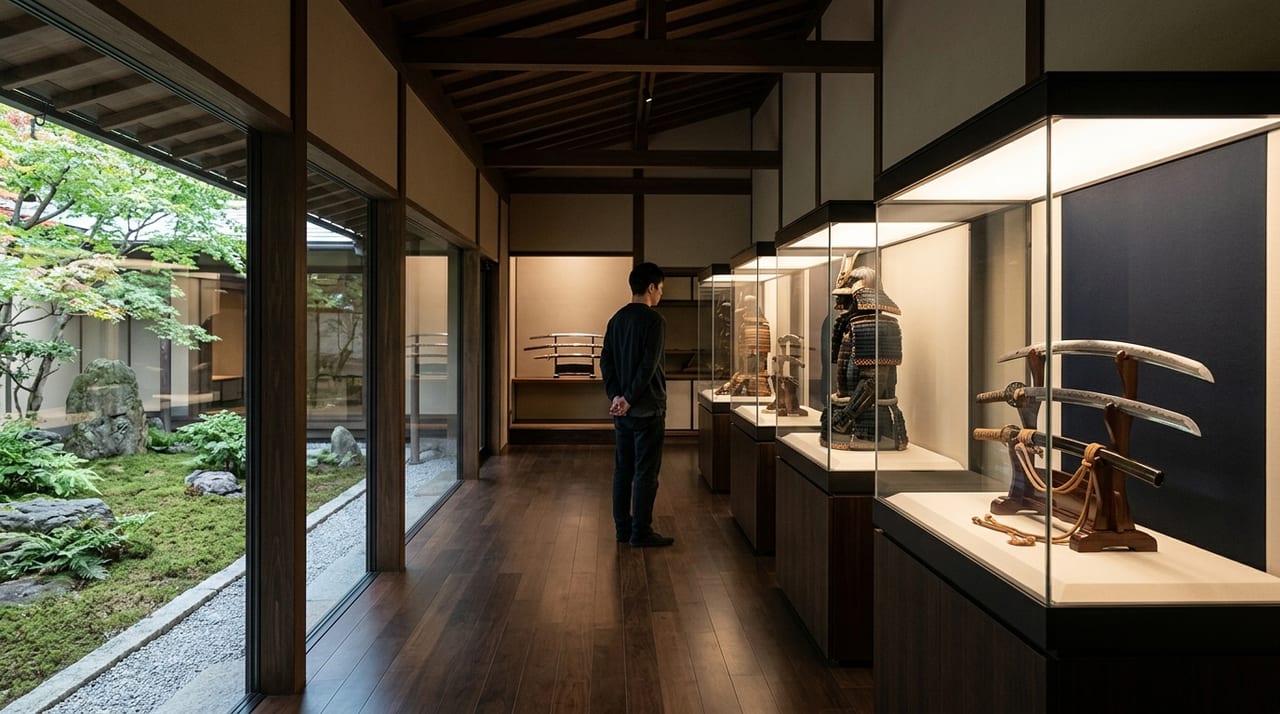
 * Image is for illustrative purposes only.
Sano Art Museum
佐野美術館
Overview
Museum Overview
The museum was founded in 1966 (Shōwa 41) to publicly exhibit the East Asian art collection that businessman Sano Ryūichi (1889-1977) assembled over his lifetime. Sano Ryūichi collected antique art objects, including Japanese swords, Japanese paintings, Chinese ceramics, and Korean Buddhist statues. He donated the collection to a foundation he established to commemorate his 77th birthday.
Sword Collection
Among the swords, the collection includes the National Treasure naginata (signed "Bizen no kuni Osafune jūnin Nagamitsu zō"), in addition to the Important Cultural Property katana, unsigned, attributed to Masamune; the meibutsu Ō-Kanemitsu (katana with gold-inlaid attribution "Bizen no kuni Kanemitsu"); the meibutsu Matsui-gō (katana with red-lacquer attribution "Yoshihiro"); the tantō signed "Kunimitsu" (Shintōgo); and the Akikusa-mon kuro-urushi tachi koshirae (black-lacquered tachi mounting with autumn-grass design), said to have been used by Uesugi Kenshin (the tachi inside is by Bungo no kuni Yukihira). Exhibitions are held about six times a year with a wide range of content, including swords, dolls, paintings, and picture books, and exhibitions themed on swords are also held.
Courses and Art Objects
Since 1996, the museum has offered the "Japanese Sword Beginners' Course," which teaches sword appreciation from the basics. Beyond swords, the museum also holds fine examples of East Asian paintings, ceramics, and bronzeware, so visitors can enjoy art appreciation from many angles.
Garden "Ryūsen-en"
The Japanese garden Ryūsen-en on the museum grounds is the garden of a residence completed in the 1930s as a retirement home for Sano Ryūichi's parents. It is a strolling garden with a shinji-ike, a pond shaped like the character for 'heart', fed by Mt. Fuji spring water. The weeping cherry trees by the shinji-ike are one of Mishima's signature spring sights, and pines, plum trees, azaleas, and maples add color through the seasons. The front gate and the house are registered as national Registered Tangible Cultural Property. A relaxed way to spend your time, combining a garden stroll with art appreciation, is recommended. Mishima is also known as a shrine town (monzen-machi) of Mishima Taisha, and it has many renowned eel restaurants. We hope you enjoy a luxurious cultural experience in this water city with views of Mt. Fuji.
Highlights
- National Treasure and Important Cultural Property swords: the National Treasure naginata (signed "Bizen no kuni Osafune jūnin Nagamitsu zō"), the Important Cultural Property katana, unsigned, attributed to Masamune, the meibutsu Ō-Kanemitsu, the meibutsu Matsui-gō, and the tantō signed "Kunimitsu" (Shintōgo), among others
- Sword exhibitions: among the roughly six exhibitions held each year, the museum holds exhibitions themed on swords (in 2026, the exhibition "Sanobi to Tokubi: Meitō no Iroha")
- Special display of meibutsu swords: precious items in the collection that are normally not on display may be shown in conjunction with special exhibitions, so checking in advance on the official website is recommended
- Viewing together with the garden Ryūsen-en: a strolling garden with a shinji-ike pond, fed by Mt. Fuji spring water. Enjoy scenery through the seasons, including the weeping cherry trees in spring; ideal for a stroll after viewing art
- Japanese Sword Beginners' Course: a course offered since 1996 where you can learn sword appreciation from the basics
* Opening hours and exhibitions are subject to change. Please check the official website before visiting.