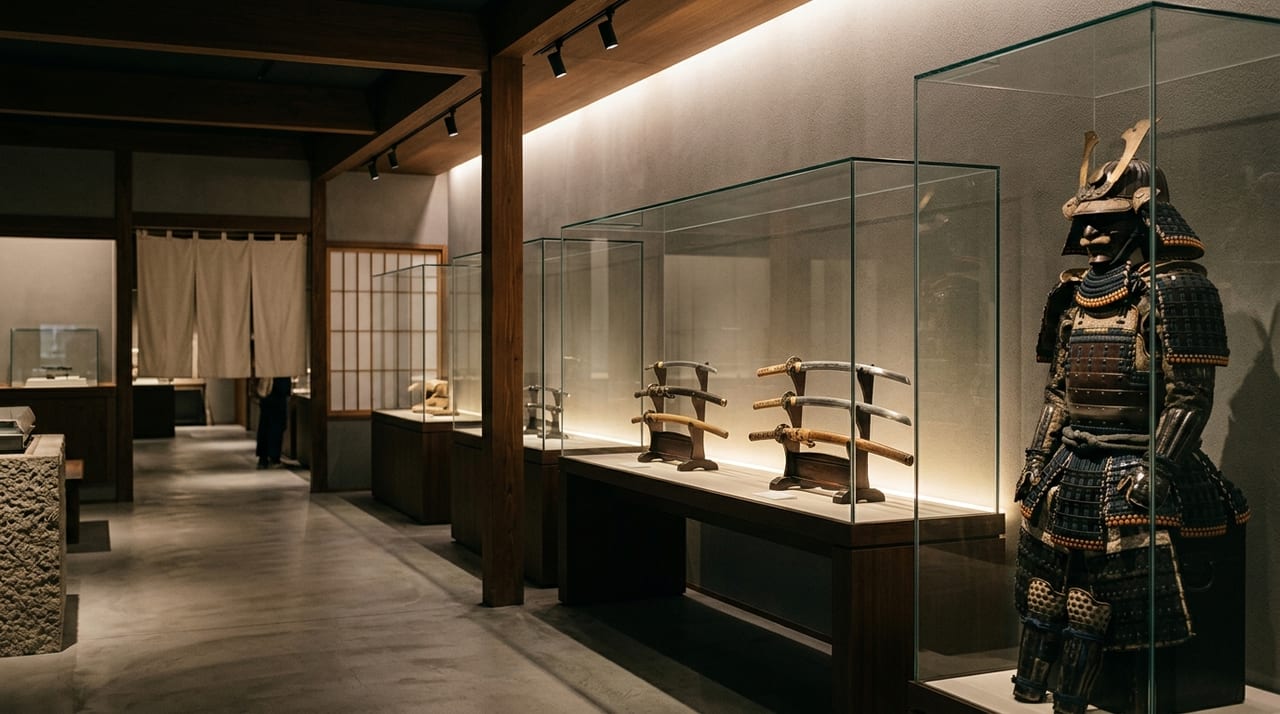
 * Image is for illustrative purposes only.
Kunozan Toshogu Museum
久能山東照宮博物館
Overview
The Kunozan Toshogu Museum is a museum that houses and displays the treasures of Kunōzan Tōshōgū (a National Treasure), where Tokugawa Ieyasu was buried. Kunōzan is situated atop a cliff overlooking Suruga Bay. After Ieyasu died in Genna 2 (1616), he was first enshrined here as a kami, so the site holds particular significance as a sacred place for the Tokugawa family.
The museum's sword collection is of outstanding significance even within the history of Japanese swords. Most notable are the "Tachi by Mitsuyo," said to have been Ieyasu's personal sword, and the National Treasure "Tachi, signed Sanetsune," dedicated by Tokugawa Hidetada. Centered on swords donated by successive shoguns, the museum holds 40 blades in total. Important Cultural Properties include "Tachi, signed Kuniyuki," "Wakizashi, unsigned (attributed to Sōshū Yukimitsu)," and "Wakizashi, unsigned (attributed to Sadamune)," works by master smiths of the Kamakura and Nanboku-chō periods. The armor collection is also extensive, including three sets of armor (gusoku) used by Ieyasu and 63 sets belonging to successive shoguns from Ieyasu to Yoshinobu.
The museum also holds a Western-style clock (Important Cultural Property) presented to Ieyasu by Philip III, King of Spain. It is a rare document conveying the international exchanges Ieyasu engaged in.
Kunōzan is a mountainous site that can be reached either by climbing the 1,159 stone steps (the mnemonic "ichiichi-gokurōsan," a wordplay on a phrase of thanks for hard work) or by ropeway. A sacred space spreads out amid the superb scenery overlooking Suruga Bay. The Tōshōgū shrine buildings are designated National Treasures. By visiting them together with the museum, visitors can deeply learn about Ieyasu's life and his refined engagement with sword culture.
Highlights
- Swords Dedicated by Successive Shoguns — Including the "Tachi by Mitsuyo," said to have been Ieyasu's personal sword, and the National Treasure "Tachi, signed Sanetsune," dedicated by Hidetada; 40 blades in total
- Important Cultural Property "Western Clock (Ieyasu's Clock)" — Presented to Ieyasu by Philip III, King of Spain, in gratitude for maritime rescue assistance. A spring-driven clock and Japan's oldest surviving one. A testament to international exchange
- National Treasure: Kunōzan Tōshōgū Shrine Buildings — Magnificently ornate Gongen-zukuri shrine architecture enshrining Ieyasu
- Armor of Successive Shoguns — Including three sets of armor used by Ieyasu, the collection holds 63 sets of armor belonging to successive shoguns from Ieyasu to Yoshinobu
- Panoramic View of Suruga Bay — A grand panorama of Mount Fuji and the sea, seen from the cliff top
- 1,159 Stone Steps — An approach path beloved through the wordplay "ichiichi-gokurōsan"
* Opening hours and exhibitions are subject to change. Please check the official website before visiting.