 * Image is for illustrative purposes only.
Ueda City Museum (Ueda Castle Ruins Park)
上田市立博物館(上田城跡公園内)
Overview
Overview of the Museum and Ueda Castle
The Ueda City Museum is located within the site of Ueda Castle (Ueda Castle Ruins Park), which Sanada Masayuki built in 1583 (Tenshō 11). It is a museum that comprehensively exhibits the history, culture, and folk traditions of the Ueda region, centered on the Sanada clan. Ueda Castle is renowned as the "Sanada castle" that twice repelled Tokugawa forces, and Sanada Masayuki's outstanding strategy in the First Battle of Ueda (1585) and the Second Battle of Ueda (1600) is passed down to later generations as a remarkable achievement in the history of Japanese castles and military history. The museum's exhibits center on this history of the Sanada clan while covering roughly 400 years of history, including the era of the Ueda domain (the Sengoku and Matsudaira clans).
Materials and Swords Related to the Sanada Clan
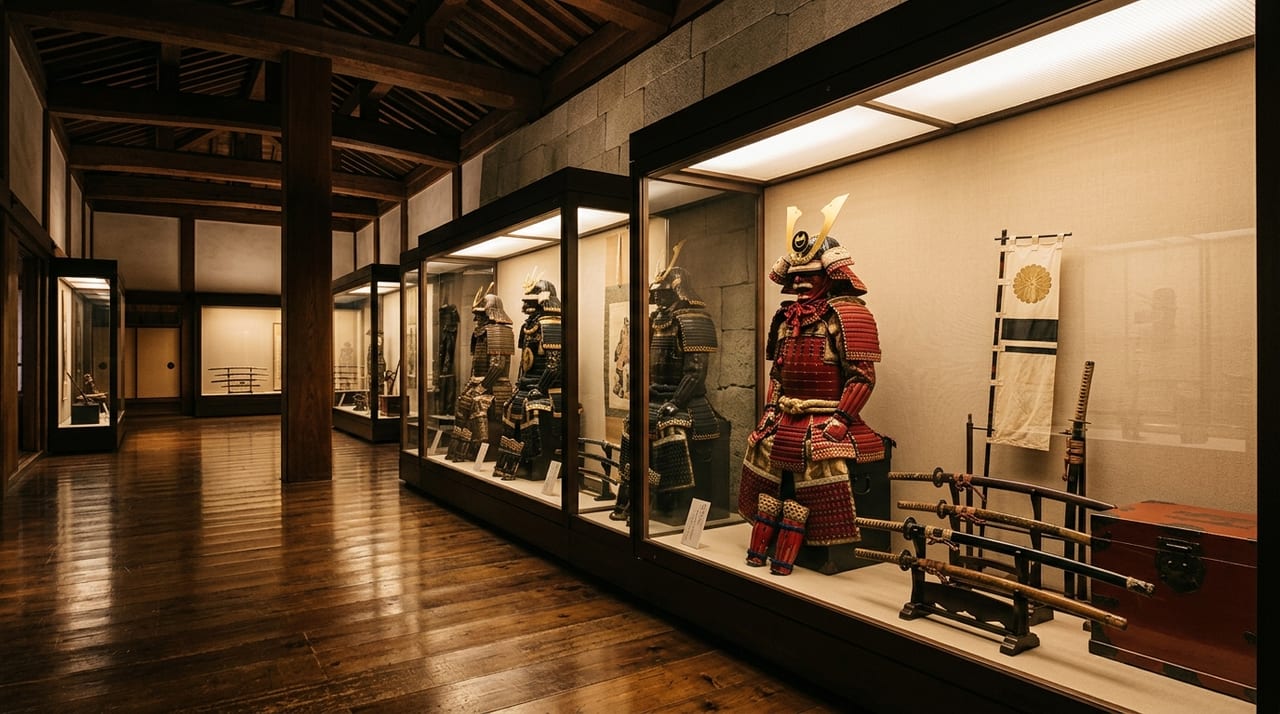
One of the highlights of this museum is its materials related to the Sanada clan, including a suit of armor (gusoku) said to have been worn by Sanada Masayuki and portraits of Sanada Masayuki and Sanada Yukimura (Nobushige). The father and his two sons, Sanada Masayuki, Sanada Yukimura (Nobushige), and Nobuyuki, are among the most legendary warrior families in Japan's Sengoku history and remain immensely popular today. In particular, Sanada Yukimura (Nobushige) fought a fierce battle at the Summer Siege of Osaka (1615) as a Toyotomi commander, pressing toward Tokugawa Ieyasu's main camp, and was hailed as "the finest warrior in Japan." In terms of swords, the collection also includes a tachi by late-Edo-period swordsmith Yamaura Masao (Nagano Prefectural Treasure).
Ueda Castle Ruins and Sightseeing in the Area
Around the museum stand the South Turret and North Turret, both Nagano Prefectural Treasures, and the East Koguchi Turret Gate, which was rebuilt in wood in 1994. In spring, the grounds serve as the venue for the Ueda Castle Senbon-zakura Festival, where some 1,000 cherry trees bloom. The Ueda area also offers plenty of sightseeing spots, including Bessho Onsen (the oldest hot spring in Nagano Prefecture) and the Shioda Plain, also called the "Kamakura of Shinshū" (including important cultural properties such as the three-story pagoda of Zensan-ji). From the Tokyo and Ueno area, Ueda Station on the Hokuriku Shinkansen is about 1 hour and 20 minutes away, making it a day-trip destination from the Tokyo metropolitan area.
Highlights
- Materials related to the Sanada clan — including a suit of armor (gusoku) said to have been worn by Sanada Masayuki, portraits of Masayuki and Yukimura (Nobushige), and old documents of Masayuki and Nobuyuki — materials that convey the history of the Sanada clan, who built Ueda Castle
- Materials related to the First and Second Battles of Ueda — including old documents of the Sanada clan, whose forces twice repelled Tokugawa troops, and nishiki-e woodblock prints depicting the defense of Ueda Castle
- Ueda Castle Ruins, East Koguchi Turret Gate, and Cherry Blossoms — the South and North Turrets, Nagano Prefectural Treasures, and the wood-reconstructed East Koguchi Turret Gate. In spring, some 1,000 cherry trees bloom for the Ueda Castle Senbon-zakura Festival, so visitors can enjoy spectacular views of the castle and cherry blossoms
- Within walking distance of Ueda Station on the Hokuriku Shinkansen — accessible in about 1 hour and 20 minutes from Tokyo and Ueno. Combined with Bessho Onsen and the Shioda Plain (the "Kamakura of Shinshū"), it makes for a fulfilling day trip
* Opening hours and exhibitions are subject to change. Please check the official website before visiting.