The Aesthetics of Sukashi Tsuba — How to Distinguish and Appreciate Ji-sukashi and Mon'yō-sukashi
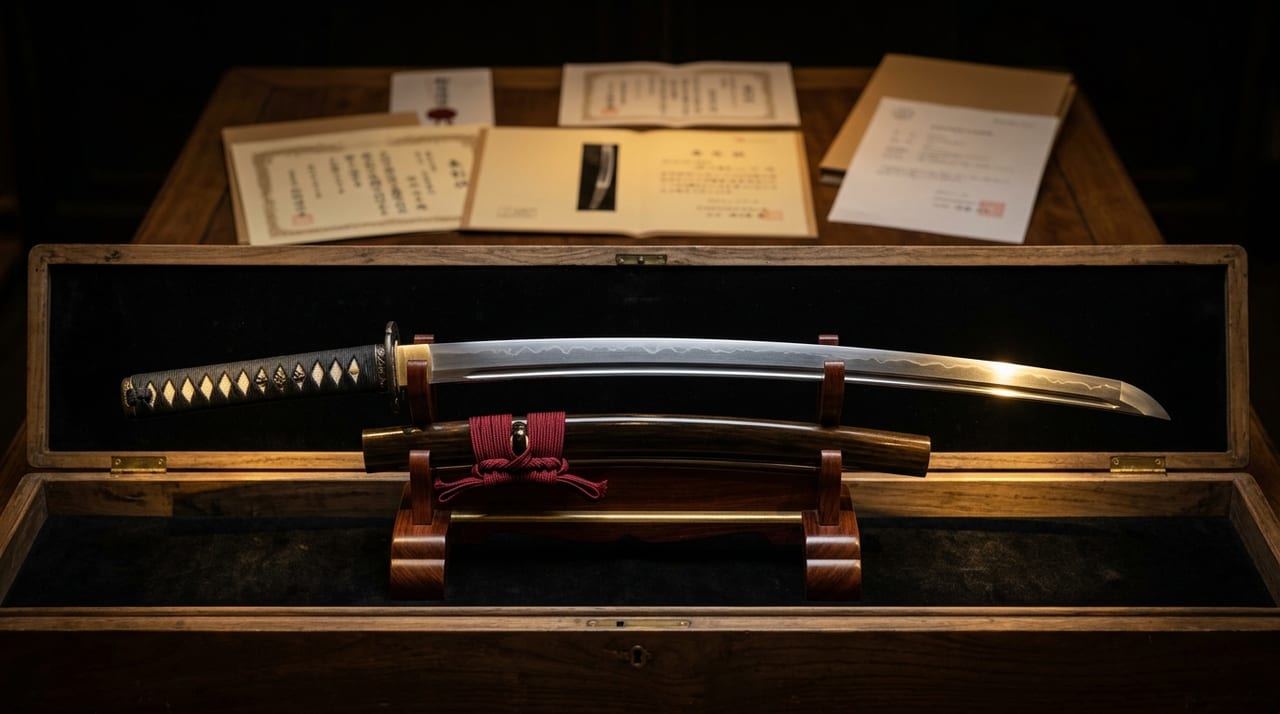 * Image is for illustrative purposes only.
Table of Contents
What Is Sukashi? — A Technique That "Speaks" Through Iron
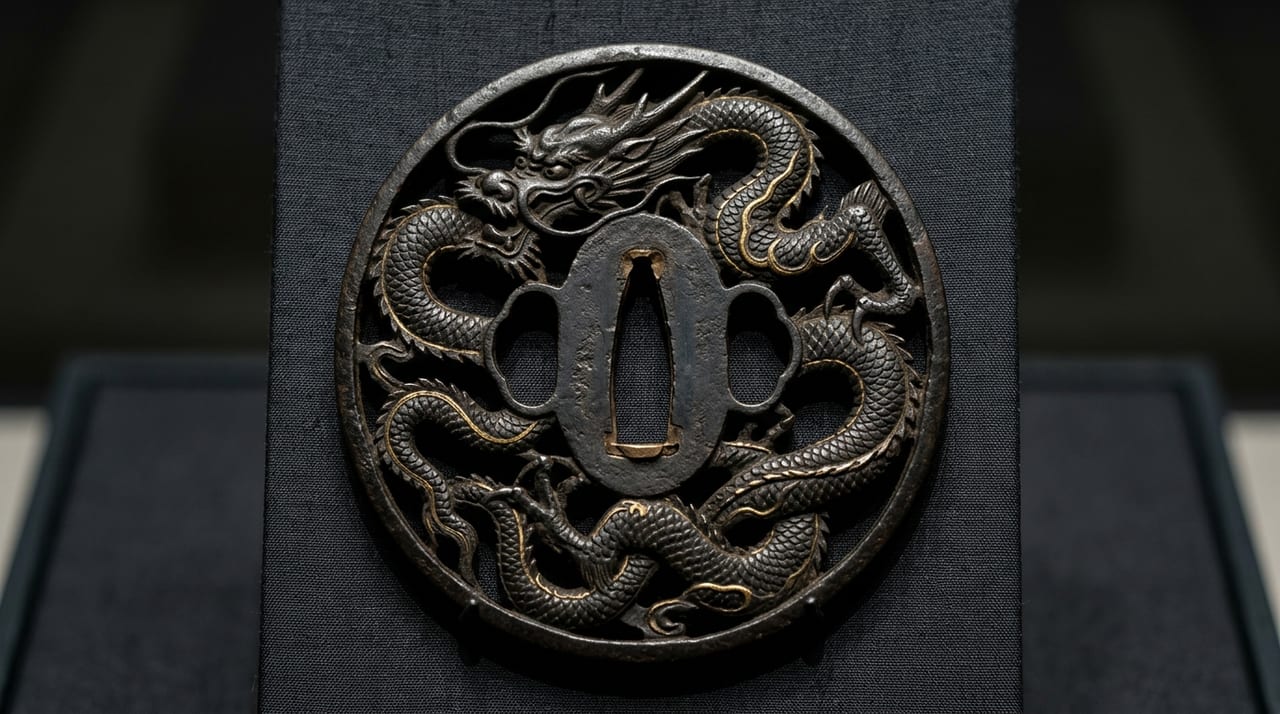
"Sukashi" is the collective term for a technique in which holes are cut into the iron ground of a tsuba (or into a base metal such as brass, shakudō, or yamagane) to express a pattern through the outline of those openings. In modern terms it corresponds to "laser cutting of metal," but in the past it was done entirely by hand by craftsmen — a precise engraving technique using a tagane (chisel). Punching out complex patterns in thin iron plate with only skilled eyes and the feel of the hands, without blueprints or rulers, was a fundamentally different creative act from today's machined work.
There are two main types of sukashi (Kotobank "Tōchō").
- Ji-sukashi: A technique in which the pattern area is left intact while the ground (background) is pierced. Since the motif itself remains as the iron ground, the outline of the subject stands out with the full thickness of the metal.
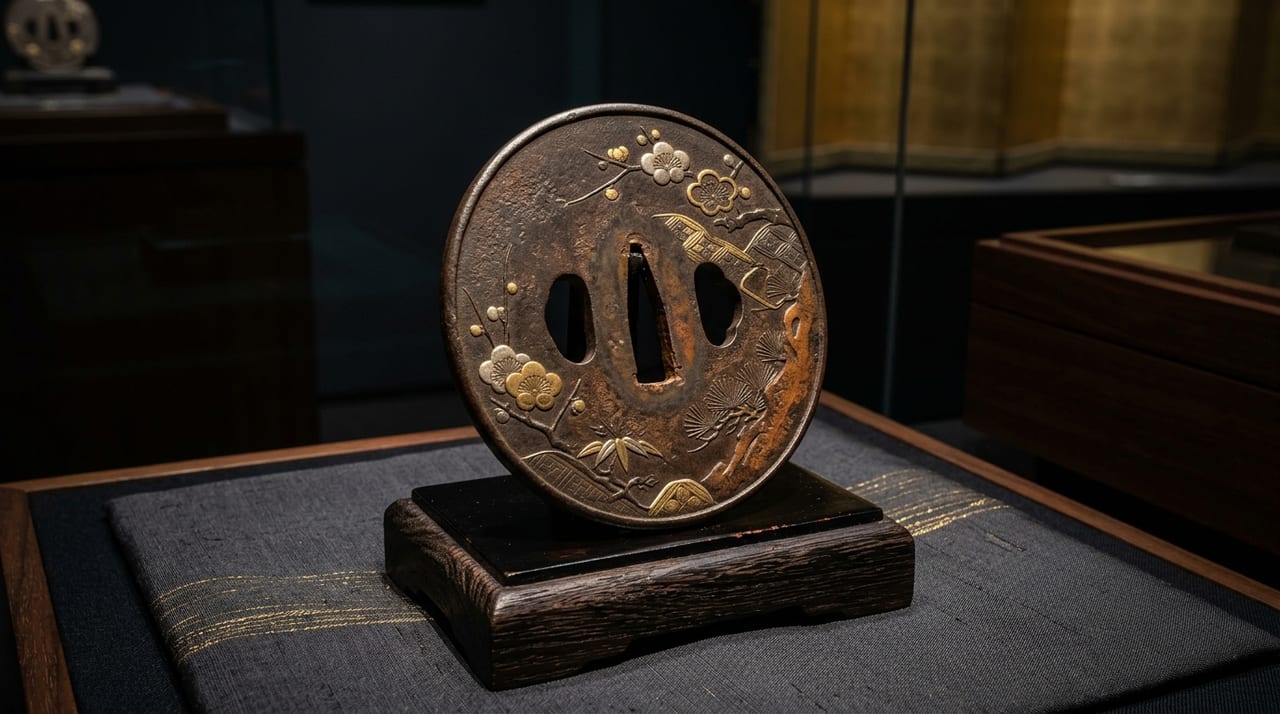
- Mon'yō-sukashi: The reverse of ji-sukashi; the shape of the pattern itself is pierced through the base plate. The pattern area becomes the opening, and the ground remains as the solid material. Kosukashi — in which small shapes such as plum blossoms or cherry blossoms are cut out — is of this type, and sukashi tsuba are said to have developed from round iron-plate tsuba to which kosukashi were added (Kotobank "Tsuba").
Simply understanding the difference between these two types dramatically deepens one's appreciation when standing before a tsuba.
Motif Classification for Sukashi Tsuba — What Do They "Speak" Of?
Knowing the background of the designs on sukashi tsuba adds depth to the experience of appreciating them.
- Geometric patterns: Simple geometric shapes such as circles, triangles, squares, diamonds, and quince (mokko) forms. The oldest type, found most frequently on tsuba from the kotō period. Representative examples include maru-sukashi (round piercing), naga-sukashi (elongated piercing), kōshi-sukashi (lattice piercing), and mokko-sukashi (quince-shaped piercing). Although they may appear simple at first glance, the placement of the openings and the ratio of ground area to openings concentrate the craftsman's aesthetic sensibility.
- Plant patterns: Paulownia, chrysanthemum, cherry blossom, pine, bamboo, plum, and others. In particular, the paulownia (the crest of the Toyotomi clan) and the chrysanthemum (the imperial emblem) were used extensively as symbols of authority. The cherry blossom, associated with the spirit of bushido — the beauty of scattering at the peak of bloom — became popular from the mid-Edo period onward.
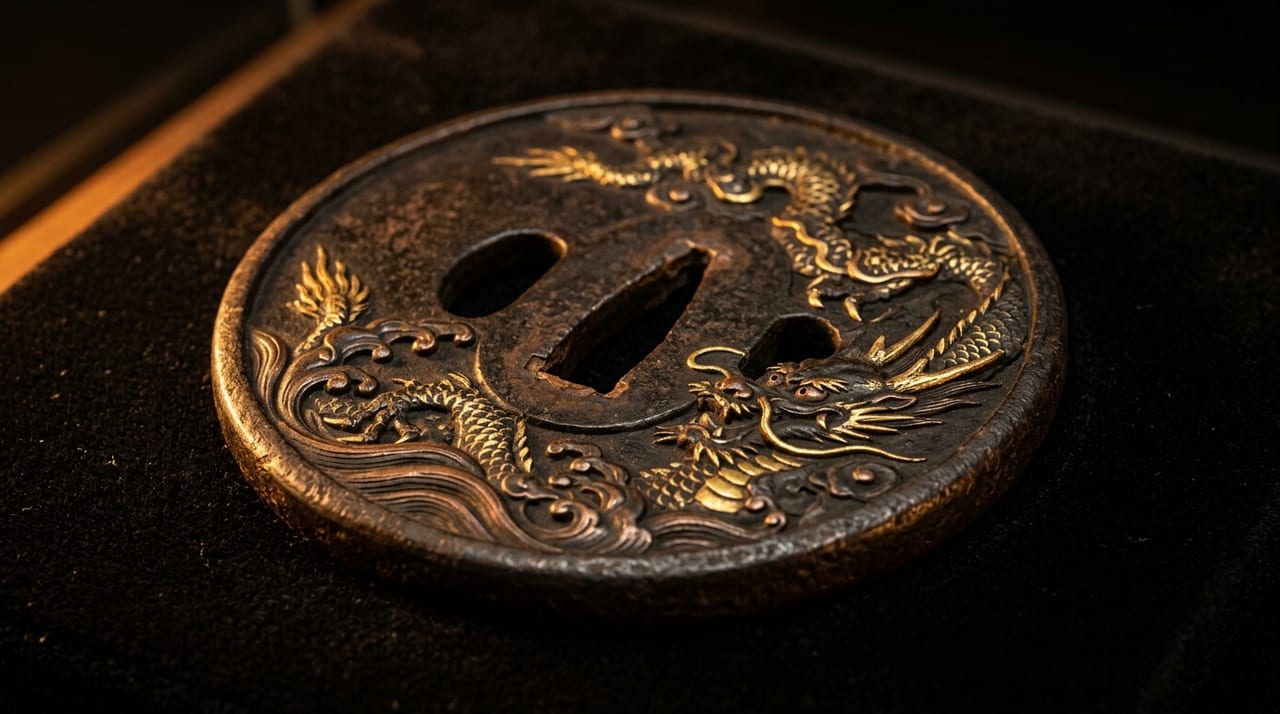
- Animal patterns: Dragons, phoenixes, deer, butterflies, fish, and others. Unryū-sukashi (cloud-and-dragon piercing), combining a dragon with clouds or waves, is particularly common and was depicted according to each school's own interpretation. The butterfly was a motif favored by the Higo kinko craftsmen; many surviving examples convey a lively presence despite their spare outlines.
- Auspicious patterns: Takarazukushi (treasure collection), shippō-tsunagi (linked seven treasures), kikko (tortoiseshell), asa-no-ha (hemp leaf), and other auspicious designs. They increased from the mid-Edo period onward with the rise of townspeople's culture. These reflect the era in which the tsuba came to be regarded more as a work of decorative art than as a piece of practical military equipment.
- Weapon and armor patterns: Motifs taken from military equipment itself, such as swords, bows, arrows, armor, and a commander's baton. A self-referential design unique to warrior society, expressing martial prestige and dignity.
- Landscape patterns: Japanese landscape motifs such as Mount Fuji, the moon, waves, and pine groves. They developed alongside the taste for realistic metalwork in the late Edo period and show a strong influence from the Nara kinko tradition.
Evolution of Styles by Period and School
The styles of sukashi tsuba follow a clear progression through the periods and schools.
- Kotō period (Heian to Muromachi): Simple geometric sukashi predominate. Maru-sukashi, naga-sukashi, and mokko-sukashi are common, reflecting the constraints of materials and a design philosophy that prioritized function. The shapes of the openings are unpretentious, but combined with the kitae-hada (forging grain) of the iron ground they have a distinctive strength.
- Momoyama period: Groups of craftsmen who specialized in making iron sukashi tsuba appeared in Kyoto and Owari, and sukashi tsuba made notable advances through the Kyō-sukashi-tsuba and Owari-sukashi-tsuba styles. At the same period, Umetada Myōju expressed patterns not through sukashi but through hira-zōgan inlay in colored metals (Kotobank "Tsuba"). Exotic designs reflecting the influence of Nanban trade also appeared, and the sukashi technique diversified.
- Early to mid-Edo period: The Shōami school spread to Iyo, Kyoto, Aizu, Shōnai, and other regions. In Higo in Kyushu, Higo kinko craftsmen — Hayashi, Nishigaki, Shimizu, Hirata, and others — flourished as retained craftsmen of the Hosokawa clan and excelled in designs favored by warriors, as well as in zōgan (inlay) and sukashi (Kotobank "Tsuba").
- Late Edo period to Bakumatsu: Among sword fitting metalworkers in general, masters such as Yokoya Sōmin and the Nara Sansaku appeared, and pictorial expression through takabori (high relief) and katakiri-bori (single-bevel carving) spread widely. Among sukashi tsuba, outstanding works are found especially in Akasaka tsuba, Chōshū tsuba, and Echizen Kinai (Kotobank "Tsuba").
Points of Appreciation for Sukashi Tsuba
Keeping the following in mind when appreciating a sukashi tsuba will deepen one's assessment.
- Quality of the cut edges: Whether the edges of the sukashi openings are cleanly cut, and how the traces of the tagane remain on the cross-section. The cross-sections of openings by master craftsmen are remarkably precise — so much so that one might mistake them for machined work. On the other hand, the unpretentious cut edges of the kotō period have a charm distinct from purely functional beauty.
- Kitae-hada of the ground: Observe the quality of the ground (iron surface) surrounding the sukashi — the fineness of the kitae-hada (forging grain), how the age-old rust has settled in, and the balance of thickness. A ground on which a soft rust (a subdued tone close to black rust) has settled evenly is evidence of long, careful storage and enhances appreciative value.
- Completeness of the motif and composition: Whether the design expressed through sukashi is beautiful and well-balanced. The handling of negative space in the composition, the ratio of the motif's size to the area of the ground, the directionality of the viewpoint. In an outstanding sukashi tsuba, the "negative space" of the openings and the "positive space" of the ground function as equals.
- Transmission of light and shadow: When a sukashi tsuba is held up to the light, light shines through the openings and the pattern emerges. This "interplay of light and shadow" is the true essence of sukashi tsuba, revealing an expression entirely different from what is seen when the piece lies flat. To know the true beauty of a sukashi tsuba, it is indispensable to hold it up to the light.
- Compatibility with structural strength: Too much sukashi weakens the tsuba; too little makes it heavy. A design that balances functionality with decoration is the hallmark of a fine sukashi tsuba, and the achievement of a design that shaves the ground to the absolute minimum while maintaining just enough thickness to prevent warping or cracking is a testament to the craftsman's mechanical intuition.
Collections and Research on Sukashi Tsuba
Masterworks of sukashi tsuba are distributed across museums and collections in Japan and abroad. The Tokyo National Museum holds a large number of outstanding sukashi tsuba ranging from the kotō period to the Edo period, with opportunities to view them in special and permanent exhibitions. The Japanese Sword Museum, operated by the NBTHK (Society for the Preservation of Japanese Art Swords), is a specialist institution dedicated to swords and tōsōgu (sword fittings); it conducts systematic collection of and research on metalwork including sukashi tsuba, and also carries out examination and authentication activities.
Among regional institutions, the Kumamoto Museum, which holds many works of Higo kinko, and the Kyoto National Museum, with its extensive materials related to the Umetada school, are also important research centers. These institutions function as the foundations supporting scholarly research, and ongoing study of the styles and techniques of sukashi tsuba is conducted there. Overseas, the British Museum, the Metropolitan Museum of Art, and the Museum of Fine Arts, Boston hold high-quality collections, some of which are also accessible through online databases.
Conclusion — What the Voids in Iron Speak Of
Sukashi tsuba demonstrate the essence of Japanese metalwork — the transformation of iron, a robust material, into a delicate art of light and shadow. The process by which it evolved from simple round holes through the advance of eras and technique to precise sukashi of complex designs is the history of Japanese craftsmanship itself.
When one understands the difference between ji-sukashi and mon'yō-sukashi, brings background knowledge of the motifs, and notices a pattern that can only be seen when the piece is held up to the light, the tsuba transforms from "an accessory of the sword" into "an independent work of art." The aesthetics of sukashi — which fearlessly embraces and actively exploits negative space — is the embodiment of "the beauty of subtraction" that runs through all of Japanese craft and the arts, and it has not faded in the least when seen through modern eyes.