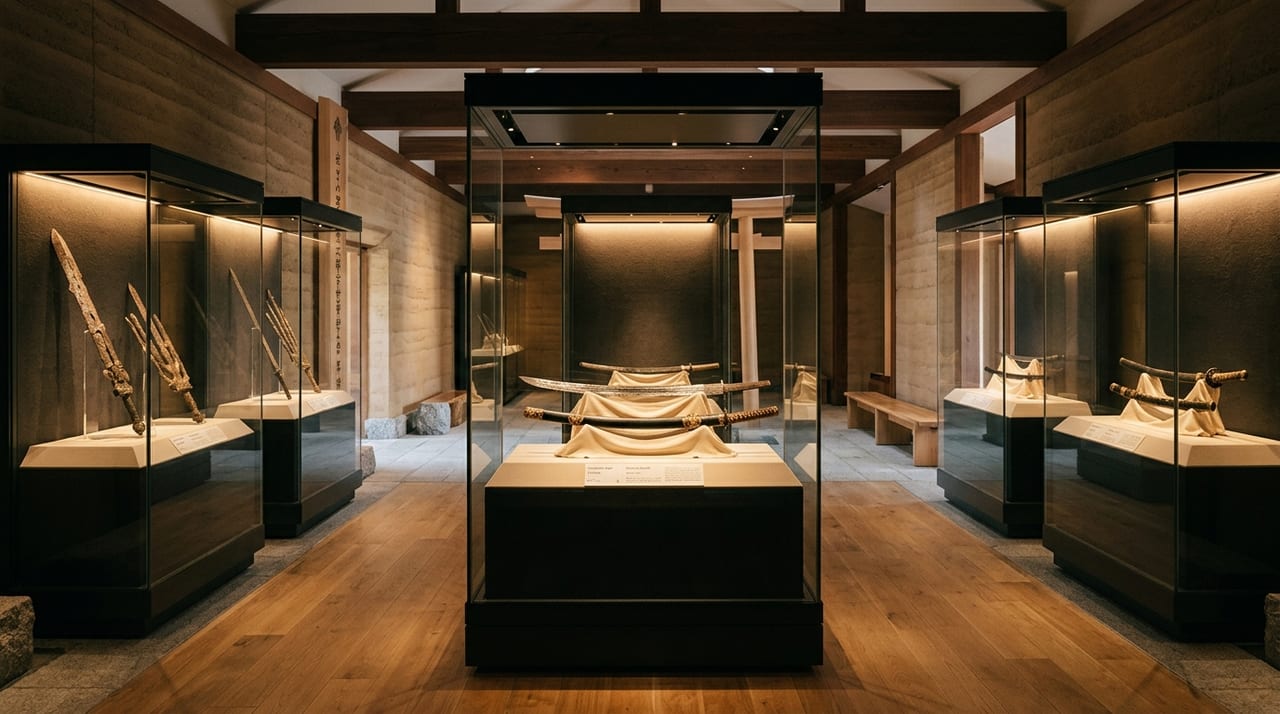
 * Image is for illustrative purposes only.
Isonokami Jingū
石上神宮
- Location
- Tenri City, Nara Prefecture
- Access
- About a 30-minute walk from Tenri Station (JR Sakurai Line and Kintetsu Tenri Line), or within 10 minutes by taxi. About 5 minutes by car from Tenri-Higashi IC on the Meihan National Highway, or about 15 minutes from Tenri IC on the Nishi-Meihan Expressway
- Opening Hours
- Precincts open for free visits (worship at the front of the haiden (worship hall) roughly 5:30–17:30, varies by season). No permanent public display of the treasure hall
- Admission
- Precincts free (no permanent public display of the treasure hall)
Overview
Isonokami Jingū shrine, located in Tenri City, Nara Prefecture, is one of Japan's oldest shrines. It holds the most fundamental significance in Japanese sword culture as a sacred place, with a presence unmatched anywhere else. The swords transmitted at this shrine include the most important heritage that cannot be avoided in discussing the history of the Japanese sword.
The greatest treasure of the shrine is the National Treasure 'Shichishitō' (Seven-Branched Sword). It is an iron sword 74.8 cm in overall length, with a distinctive form in which a total of six branch blades (side branches) are attached to both sides of the blade. Based on interpretation of the gold-inlaid inscription on the blade, it is considered to have been made in 369. It is thought to correspond to the 'Nanatsusaya-no-tachi' (the seven-branched sword named in the Nihon Shoki), which was presented from Baekje in the 52nd year of Empress Jingū's regency according to the Nihon Shoki. This sword is a first-class historical source that tells of ancient diplomacy between Japan and the Korean Peninsula. At the same time, it is a transmitted object of a kind with almost no parallel in the world, conveying the form of ancient metal swords to the present day.
The shrine is also said to enshrine the spiritual embodiments of divine swords (swords said to derive from the gods) that appear in the Kojiki and Nihon Shoki myths, such as Futsunomitama-no-Tsurugi and Ame-no-Habakiri-no-Tsurugi. It is positioned as a sacred place indispensable for exploring the spiritual origins of the Japanese sword. Because the Shichishitō is fragile, it is housed in a climate-controlled storehouse and is seldom taken out. From the kinsokuchi (the shrine's forbidden sacred ground) within the precincts, bead ornaments and ring-pommel (kantō) sword pommels from the Kofun period were excavated, and these have been designated Important Cultural Properties.
Tenri City is the center of Tenrikyō, and it is also close to the Tenri University Sankōkan Museum (an international archaeological and folk collection) and the Tenri Central Library (a treasury of rare books and manuscripts). On the shrine grounds, sacred roosters (shinkei), said to be messengers of the gods, roam freely as free-range chickens. As a sacred ground that conveys the air of ancient belief to the present day, it is an unparalleled place for experiencing the spiritual homeland of the Japanese sword.
Highlights
- National Treasure 'Shichishitō' — an ancient iron sword with six branch blades, said from interpretation of its gold-inlaid inscription to have been made in 369 and thought to have been presented from Baekje; one of the oldest sword heritage objects surviving in Japan
- Spiritual origins of the Japanese sword — a sword-culture sacred site where the divine swords of the Kojiki and Nihon Shoki myths, including Futsunomitama-no-Tsurugi and Ame-no-Habakiri-no-Tsurugi, are said to be enshrined
- Treasures from the kinsokuchi — Kofun-period finds, including ring-pommel (kantō) sword pommels, designated Important Cultural Properties
- One of Japan's oldest shrines — an ancient shrine whose shrine tradition dates its founding to the 7th year of Emperor Sujin's reign, touching on the origins of the sword
- Close to the Tenri University Sankōkan Museum and Tenri Central Library — can be toured together with the museum and library affiliated with Tenri University
* Opening hours and exhibitions are subject to change. Please check the official website before visiting.