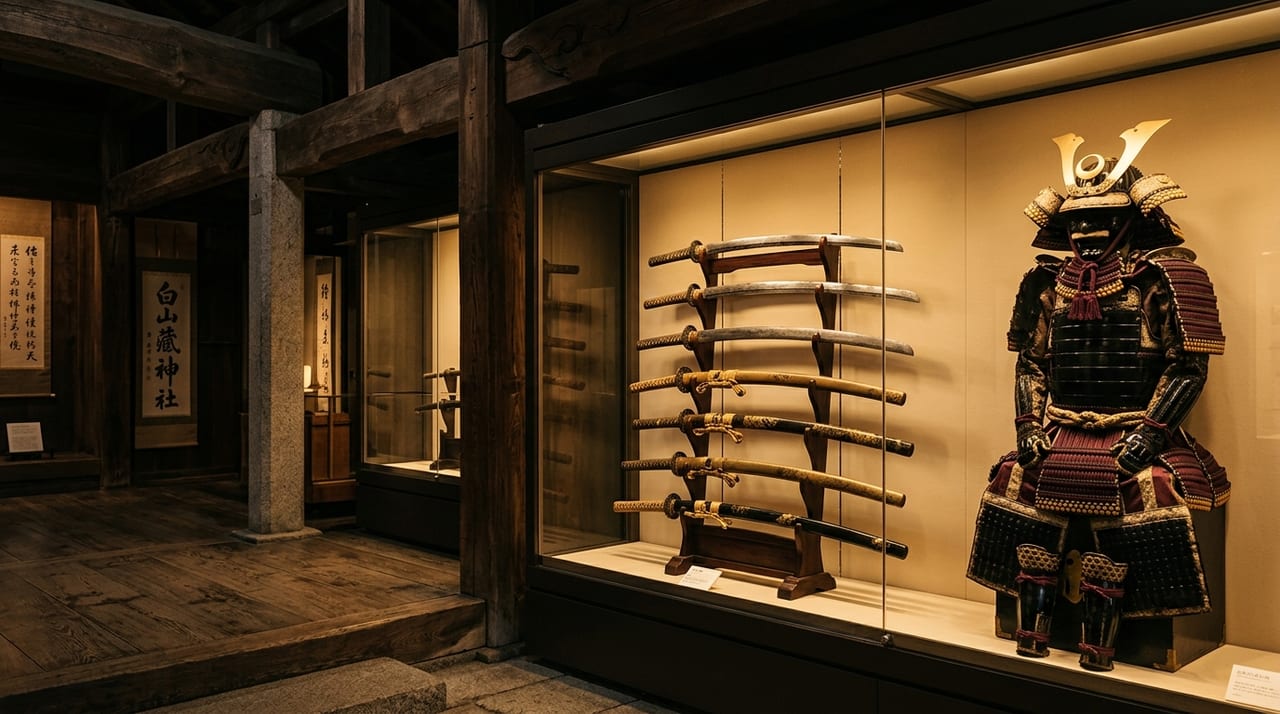
 * Image is for illustrative purposes only.
Kitano Tenmangu Treasure Hall
北野天満宮宝物殿
Overview
Kitano Tenmangu is the head shrine dedicated to Sugawara no Michizane, the deity of learning, and is known as the principal shrine of over 12,000 Tenman and Tenmangu shrines throughout Japan. Located in Hakubaichō, Kamigyo Ward, Kyoto City, the precinct houses important cultural properties including the main hall, worship pavilion, and ceremonial gate tower, alongside numerous attractions such as the plum garden and subsidiary shrines. The Treasure Hall is particularly noted among sword enthusiasts for its extensive collection ranging from cultural artifacts associated with Michizane to centuries of donated blades and swords.
The shrine's greatest appeal from a blade perspective lies in its connection to two legendary swords transmitted since the Heian period: 'Hige-kiri' (Beard-cutter) and 'Hiza-maru' (Knee-rounder). Hige-kiri, also known as 'Oni-kiri' (Demon-cutter), is a tachi treasured as a family heirloom of the Minamoto clan. Its true identity is believed to be the Oni-kiri-maru forged by the swordsmith Yasutsuná of Hōki Province. After being donated to this shrine, this celebrated blade—also called 'Tomokiri-maru'—ranks as one of the most important works in sword legend as a spiritual blade of the Minamoto, passed through successive chiefs: Minamoto no Yoriyoshi, Yoshiie, Yoshitomo, and Yoritomo. It is designated as an Important Cultural Property and is occasionally displayed to the public in special exhibitions.
The shrine also served as the venue for the 'Kitano Ōcha-no-yu' (Grand Tea Gathering at Kitano), hosted by Toyotomi Hideyoshi in his role as Taiko in the 15th year of Tenshō (1587). During this magnificent tea ceremony held within the precinct, Hideyoshi's celebrated swords and treasures are said to have been displayed. As a historical stage where blade culture and tea ceremony culture intersected during the Azuchi-Momoyama period, this shrine occupies a singular place in Japanese cultural heritage.
Located near classic Kyoto destinations (Nijō Castle, Kinkaku-ji, and the Nishijin weaving district), it serves as a hub for cultural sightseeing routes that incorporate other local temples and shrines. On the 25th of each month, the 'Tenjin Market' (Tenjin-san no Ichi) transforms the precinct with antique and vintage goods vendors, where sword fittings and blade-related items occasionally appear.
Highlights
- Important Cultural Property 'Hige-kiri (Tomokiri-maru)' — The Minamoto clan's spiritual blade and a celebrated Heian-period tachi, said to have been donated by Minamoto no Yoritomo; a preeminent work in sword legend
- 'Hiza-maru' as a Minamoto sibling blade — Paired with 'Oni-kiri' and 'Kumo-kiri' (Spider-cutter) associated with Watanabe no Tsuna, comprising a collection of Minamoto spiritual blades
- Venue for the Kitano Ōcha-no-yu (1587) — Toyotomi Hideyoshi's swords and tea vessels assembled in a grand Azuchi-Momoyama celebration
- Repository of donated swords through the centuries — Housing blades presented by samurai houses, court nobility, and the imperial family, representing a thousand years of sword culture
- Tenjin Market on the 25th of each month — Kyoto's premier antique market where sword fittings and mountings occasionally appear
- Cultural pilgrimage combining Kinkaku-ji, Nijō Castle, and the Nishijin district — A blade-themed route through Kamigyo Ward's cultural landmarks
* Opening hours and exhibitions are subject to change. Please check the official website before visiting.