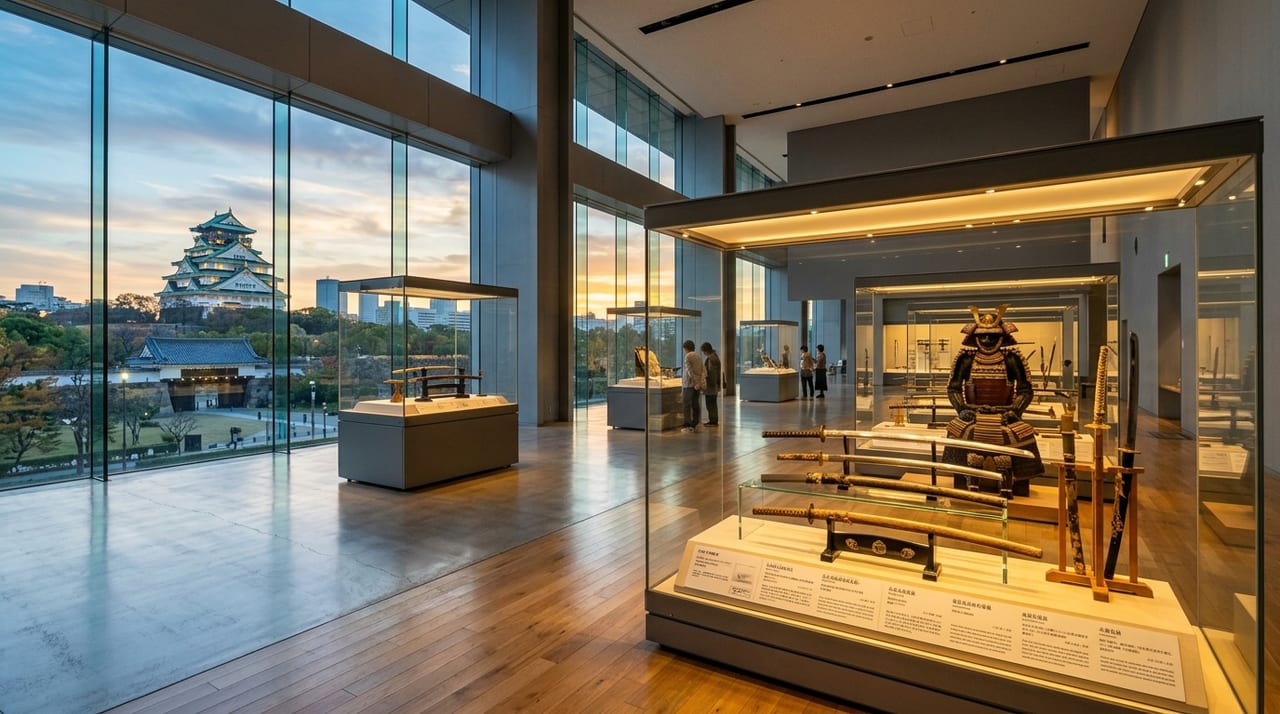
 * Image is for illustrative purposes only.
Osaka Museum of History
大阪歴史博物館
Overview
The Osaka Museum of History is a sprawling 13-story institution spanning Osaka's history from the ancient Naniwa Palace to contemporary popular culture. It opened in 2001 and shares a building with NHK Osaka Broadcasting, positioned with commanding views of Osaka Castle. Built directly above the Naniwa Palace ruins (designated National Historic Site), the 10th-floor exhibition space features an awe-inspiring full-scale reconstruction of the Naniwa Palace's Daigokuden (Great Audience Hall) from the Nara period.
Osaka was a major production center during the Edo period's new sword period, producing some of the finest swordmakers in Japanese sword history. Special exhibitions on this legacy are held regularly. The two masters epitomizing the Osaka-shintou tradition are Inoue Masasada and Tsuda Echizen-no-kami Sukehiro, both renowned craftsmen who practiced their craft in Osaka.
Inoue Masasada (birth name: Masasada; also known as Izumi-no-kami Kunitsugi, 2nd generation) was the son of the first Inoue Kunitsugi and is regarded as a saijousaku (highest-class) new sword craftsman. Considered the twin pinnacle of Osaka-shintou alongside Tsuda Sukehiro, he earned the sobriquet "Osaka Masamune." His blades feature tightly forged ko-itamehada (fine small-plate grain) with an elegant gyo-no-me choujinshi hamon. The seamless synthesis of artistic beauty and functional excellence exemplifies the apex of Osaka-shintou tradition.
Tsuda Echizen-no-kami Sukehiro, a swordsmith from Settsu Province, is renowned for originating the distinctive toranmidare (wave-like undulating pattern) hamon—a dramatic signature that became his defining contribution. This revolutionary hamon reflects both Sukehiro's artistic vision and the vitality of Osaka's merchant culture, earning recognition as an innovative milestone in Japanese sword history.
Special exhibitions feature works by these masters, alongside swords and weapons connected to the Osaka Campaign (1614–1615), and pieces by other Osaka smiths such as Kawachi-no-Kami Kunikatsu and Tatara Nagayuki. Exhibitions also highlight the supporting craftspeople—polishers, scabbard makers, and metalworkers—whose expertise was essential to Osaka's blade-making ecosystem, offering a three-dimensional understanding of sword production.
The permanent galleries descend from the 10th to 7th floor, tracing Osaka's history chronologically: ancient era (Naniwa Palace period) → medieval and early modern (Osaka Hongan-ji, Toyotomi period, 'Japan's kitchen') → modern era (Meiji through prewar 'Great Osaka') → contemporary (postwar popular culture and Dotonbori). Each floor commands splendid views of Osaka Castle's keep; the 10th-floor panorama earns praise as "Osaka's finest view."
Osaka Castle is approximately a 10-minute walk away, and visiting both sites together offers the ideal itinerary for understanding Osaka's layered history. Osaka Castle's keep also displays weapons and swords associated with Toyotomi Hideyoshi.
Highlights
- The Twin Masters of Osaka-Shintou—Inoue Masasada (saijousaku new sword craftsman, 'Osaka Masamune,' renowned for finely forged ko-itamehada with elegant gyo-no-me choujinshi hamon) and Tsuda Echizen-no-kami Sukehiro (originator of the distinctive toranmidare wave-pattern hamon). Featured works exemplify the pinnacle of Osaka blade-making craftsmanship.
- Swords and Weapons of the Osaka Campaign (1614–1615)—Special exhibitions featuring blades and armaments connected to the final confrontation between the Tokugawa and Toyotomi clans. These pieces carry profound historical significance in samurai warfare.
- Osaka Castle Panorama—The 10th-floor observation deck offers commanding views of Osaka Castle's keep, earning recognition as 'Osaka's finest scenery.' Each exhibition floor provides splendid vistas of the castle, creating a luxurious viewing experience.
- Historic Location atop Naniwa Palace Ruins (National Historic Site)—The 10th floor features a magnificent full-scale reconstruction of the Naniwa Palace Daigokuden (Great Audience Hall) from the Nara period. Experience Osaka's history from ancient times to the present on a grand, sweeping scale.
- Osaka's Blade-Making Craft Culture—Beyond the master smiths, exhibitions highlight the supporting craftspeople—polishers (toshinshi), scabbard makers (sayanushi), and metalworkers (shirogane-shi)—whose expertise was vital to the Osaka blade-making tradition. Gain a comprehensive, three-dimensional understanding of the complete sword production ecosystem.
* Opening hours and exhibitions are subject to change. Please check the official website before visiting.