 * Image is for illustrative purposes only.
Osaka Castle Tower Museum
大阪城天守閣
Overview
History of Osaka Castle and the Toyotomi and Tokugawa
Osaka Castle was begun in 1583 (Tenshō 11) by Toyotomi Hideyoshi and completed as the greatest castle architecture project in the history of early modern fortifications, a construction of world-record scale for its era. The castle, featuring a magnificent tower with gilt-tile and lead-tile roofing used abundantly, together with a deep moat and towering stone walls, became known throughout the land as a symbol of Hideyoshi's power and wealth. Following the fall of the Toyotomi house, from 1620 (Genwa 6) the castle was rebuilt as Tokugawa Osaka Castle by Tokugawa Hidetada and Iemitsu upon the remains of the Toyotomi structure, and thereafter throughout the Edo period, Osaka Castle served as the linchpin of Tokugawa shogunate control of western Japan. The present tower is a reinforced concrete reconstruction built in 1931 (Showa 6) with funding from citizens' donations, though its exterior is modeled on the tower from the Keichō era, and it is cherished as a symbol of Osaka.
Sword Collections of the Toyotomi and Tokugawa, and Osaka Blade Smiths
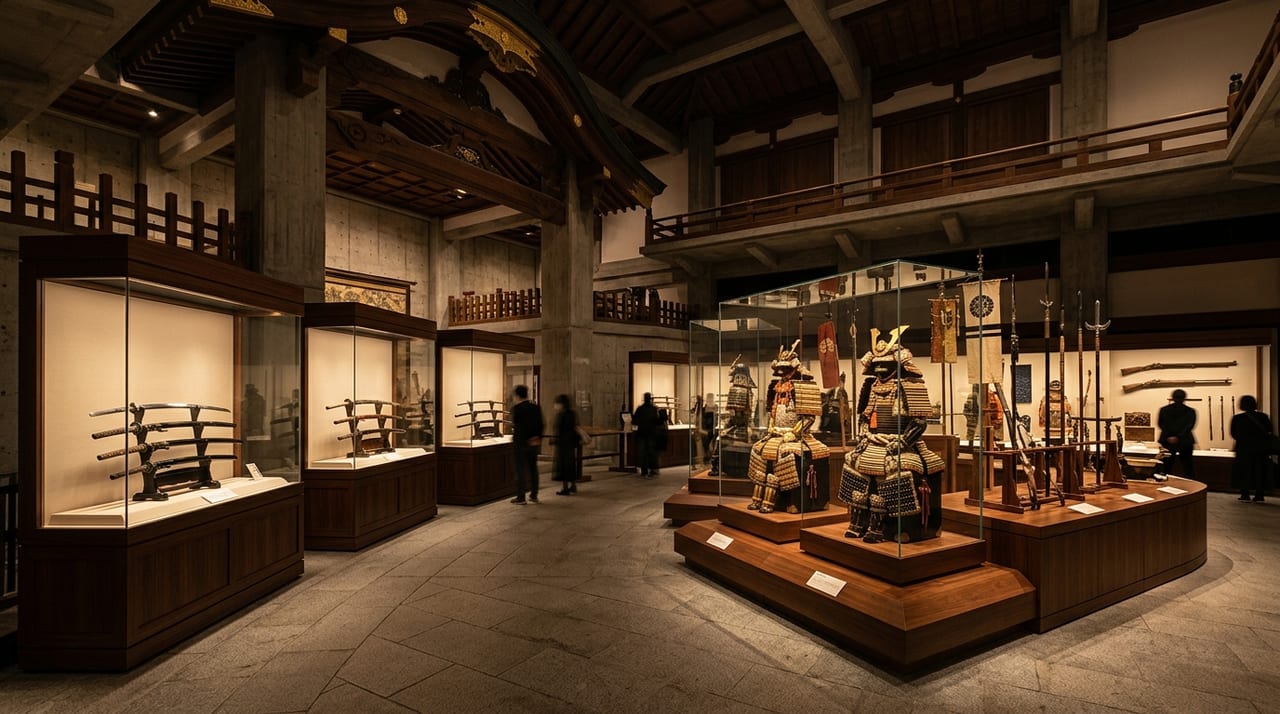
The history museum within the Osaka Castle tower displays original materials of swords, armor, and weapons connected to Toyotomi Hideyoshi and Tokugawa Ieyasu. Hideyoshi was one of the greatest collectors of swords, and it is recorded that from the great quantity of blades confiscated from farmers and monks through the "Sword Hunt Edict" (1588), he personally collected the finest examples. Records also survive of the swords worn by Hideyoshi's mounted retainers and bannermen, and through Osaka Castle's displays one can glimpse the sumptuous and brilliant aspects of sword culture that surrounded the realm's supreme ruler. Additionally, Osaka flourished as the center of commerce during the Edo period and developed as a distinctive sword-making region known as "Osaka Shintō." The works of renowned early Shintō-period masters from Osaka such as Tsuda Echizen no Kami Sukehiro and Inoue Shinkai (Morisada) remain highly valued today, and together with the exhibits at Osaka Castle tower one can systematically study the sword culture of Osaka.
The Osaka Campaigns and Swords
From 1614 (Keichō 19) to 1615 (Genwa 1), the Winter and Summer Osaka Campaigns were the greatest siege of Japanese history, fought between the Toyotomi and Tokugawa houses at Osaka Castle, a battlefield where many daimyo risked their lives. Some of the swords and weapons used in this battle survive in various places today, and Osaka Castle tower also houses materials related to weapons from the Osaka Campaigns. Materials associated with the famous warriors of the "Five Heroes of Osaka"—Sanada Yukimura (Nobutsugu), Gotō Matabei, and Mōri Katsunaga—are also on display, allowing one to learn from actual materials about the armor and sword culture of samurai in what was the greatest civil conflict before the bakumatsu period. The Osaka Campaigns were not merely a political event but possessed the significance of being a grand "final curtain call" for Japanese sword culture.
Osaka Castle Park and Surrounding Facilities
Osaka Castle stands at the center of a vast park (Osaka Castle Park) and is Osaka's largest tourist attraction, visited throughout the seasons by many citizens and tourists. Beyond the main tower, the castle grounds feature many points of interest including the Western Citadel Garden, the Takaoishi stone, and the Sakura Gate rampart stone walls, with Japan's largest stone walls overwhelming visitors. Nearby are the Osaka History Museum (adjacent) and the Naniwa Palace Site Park, forming a historical zone where one can experience Osaka's history from ancient to modern times in a single day. With convenient access via Osaka Metro and JR lines, the castle is visited annually by over 2 million visitors from both within Japan and abroad as a core destination for Osaka tourism.
Osaka Shintō and Osaka's Sword Industry
Osaka in the Edo period was a city that prospered as "Japan's kitchen" in commerce and simultaneously was a major sword-making center where excellent smiths gathered. A group of swords called "Osaka Shintō" are works created by smiths active in Osaka from the early to mid-Edo period, with two masters standing out as particularly renowned: Tsuda Echizen no Kami Sukehiro and Inoue Shinkai (Morisada). Sukehiro was known for his distinctive technique of the "wave-pattern blade" (tōran-ba), a flowing undulation of the edge that continues to be highly valued in modern times. Inoue Shinkai was known for refined chōji-midare blades based on the Bizen tradition and maintained the highest level of appraisal even in the late Edo period. Such Osaka smithcraft culture, supported by the rich economy of the commercial city of Osaka, developed as a major sword industry with commissions coming from throughout the land. Osaka Castle tower also provides explanation of such Osaka Shintō culture and its background.
Special Exhibitions and Educational Activities
Throughout the year, the museum in the tower hosts special exhibitions with periodic featured displays of Toyotomi-period decorative arts, weapons, and swords. In particular, exhibitions themed "Toyotomi Hideyoshi and Osaka" are comprehensive, allowing visitors to trace the life of the realm's supreme ruler through abundant materials. Collaborative exhibitions with other museums in Osaka (Osaka History Museum, Osaka City Art Museum, Nakanoshima Art Museum, etc.) are also held, creating an environment where one can explore Osaka's history and culture from multiple perspectives. Multilingual explanations for foreign tourists are also abundant, and the facility is operated befitting Osaka's status as an international tourist destination. Osaka Castle is one of Japan's most visited historical sites, serving an important role in broadening appreciation of sword culture. The exhibitions at Osaka Castle, which stood at the center of the lavish and brilliant culture of the Momoyama period, represent one of the finest spaces for demonstrating how the Japanese sword at its zenith was a symbol of power, beauty, and faith. It is a must-visit facility not only for sword enthusiasts but for all visitors with interest in Japanese history, art, and culture.
Highlights
- Toyotomi Hideyoshi's arms and swords — the spectacular Momoyama warrior culture of Japan's great unifier, whose castle and sword-collecting ambitions were unmatched
- Osaka Campaigns (Osaka no Jin) weapons — armor and swords from the last great castle siege of Japanese history, connecting to Sanada Yukimura and the 'Five Men of Osaka'
- Osaka Shintō school swords — Sukehiro, Shinkai, and the remarkable Edo-period blade masters who worked in Osaka and produced some of the finest Shintō swords
- Complex Toyotomi-Tokugawa castle history — the layers of political and architectural history embedded in one of Japan's most visited historical sites
- Most visited historical monument in Japan — over 2 million annual visitors, with excellent multilingual resources and nearby Osaka History Museum
* Opening hours and exhibitions are subject to change. Please check the official website before visiting.