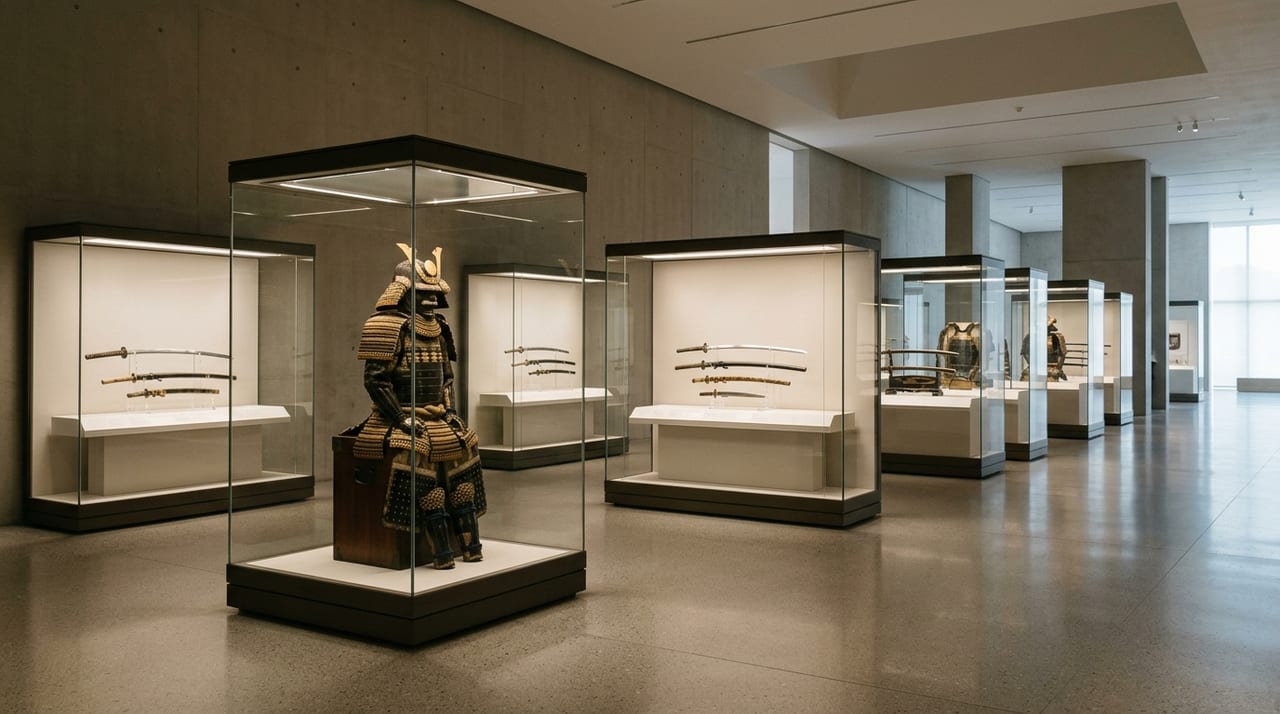
 * Image is for illustrative purposes only.
Daikaku-ji Reihokan (Treasure Hall)
大覚寺霊宝館
Overview
Daikaku-ji is the head temple of the Daikaku-ji branch of Shingon Buddhism, located in the Saga district of Ukyō-ku, Kyoto. Originating as the detached palace "Saga-in" of Emperor Saga, it was established as a temple in 876 CE by Imperial Prince Kōjaku (Emperor Saga's grandson) and has since been one of Japan's most distinguished monzeki temples — those with imperial family abbots — maintaining an exceptionally deep connection with the imperial household throughout its history. The temple's Reihokan (Treasure Hall) holds many cultural properties associated with Emperor Saga and Emperor Go-Saga; in the nihonto world, Daikaku-ji occupies a singular position as the custodial temple of "Usumidori (Hizamaru)" — one of the most celebrated swords in Genji (Minamoto clan) lore.
Primary Sword Holding: Tachi "Usumidori (Hizamaru)"
The most important sword in the Daikaku-ji collection is the Important Cultural Property "Tachi, signed □Tada (Meibutsu: Usumidori / Hizamaru)." It is attributed to the Ko-Bizen school and estimated to date from the 13th century (Kamakura period).
Legend and Provenance — According to tradition, Minamoto no Mitsunaka commissioned the forging of two divine swords — "Hige-kiri" (Beard-cutter) and "Hiza-maru" (Knee-cutter). When Minamoto no Yoshitsune came to possess the latter, he renamed it "Usumidori" (Pale Green). The blade passed through Minamoto clan hands as a clan treasure before coming to rest at Daikaku-ji. Its companion sword "Hige-kiri" (also known as "Onikiri-maru") is the Important Cultural Property "Higekiri" held at Kitano Tenmangū.
Viewing Opportunities — Usumidori (Hizamaru) is not on permanent display. It is shown during Daikaku-ji's autumn Meihō-ten (Named Treasures Exhibition) held at the Reihokan, and has been exhibited at the Tokyo National Museum and Kyoto National Museum at major special exhibitions (including the "Daikaku-ji Ten" of 2024–2025). Confirm display schedules at the official website before visiting.
The Reihokan Collection
Beyond Usumidori, the Reihokan holds numerous National Treasures and Important Cultural Properties, including imperial calligraphy by Emperor Saga and Emperor Go-Uda, and celebrated esoteric Buddhist paintings such as the "Godai Myōō-zu" (Five Vidyārāja paintings, National Treasure) — one of the most important temple collections in the history of Japanese art.
Saga-Arashiyama Tourism Context
Daikaku-ji is a major attraction on the Saga-Arashiyama sightseeing circuit, often visited alongside Tenryū-ji, the Arashiyama bamboo grove, and Togetsukyo Bridge. The adjacent Ōsawa Pond — one of Japan's oldest man-made ponds, created by Emperor Saga — is a renowned moon-viewing site and a cherry blossom and autumn foliage destination.
Access
Take Kyoto City Bus Route 91 or 28 to "Daikaku-ji" stop, then approx. 2 min on foot. Approx. 20 min walk from JR Saga-Arashiyama Station. Visiting hours 9:00–17:00 (last entry 16:30). Admission: adults ¥800, middle/high/elementary school students ¥400.
Highlights
- Important Cultural Property 'Usumidori (Hizamaru)' — the Minamoto clan spirit-sword said to have belonged to Minamoto no Yoshitsune; shown in seasonal exhibitions (not permanent display)
- Companion to Kitano Tenmangū's 'Higekiri' — the two Genji 'brother swords' have been displayed together at joint exhibitions; a unique pairing in nihonto history
- Former imperial palace — monzeki temple of imperial abbots with origins in Emperor Saga's detached palace; Reihokan holds many National Treasures and Important Cultural Properties
- Heart of Saga-Arashiyama tourism — central to the circuit with Tenryū-ji, bamboo grove, and Togetsukyo Bridge
- Ōsawa Pond moon-viewing and seasonal scenery — one of Japan's oldest man-made ponds, spectacular in cherry blossom and autumn foliage seasons
* Opening hours and exhibitions are subject to change. Please check the official website before visiting.