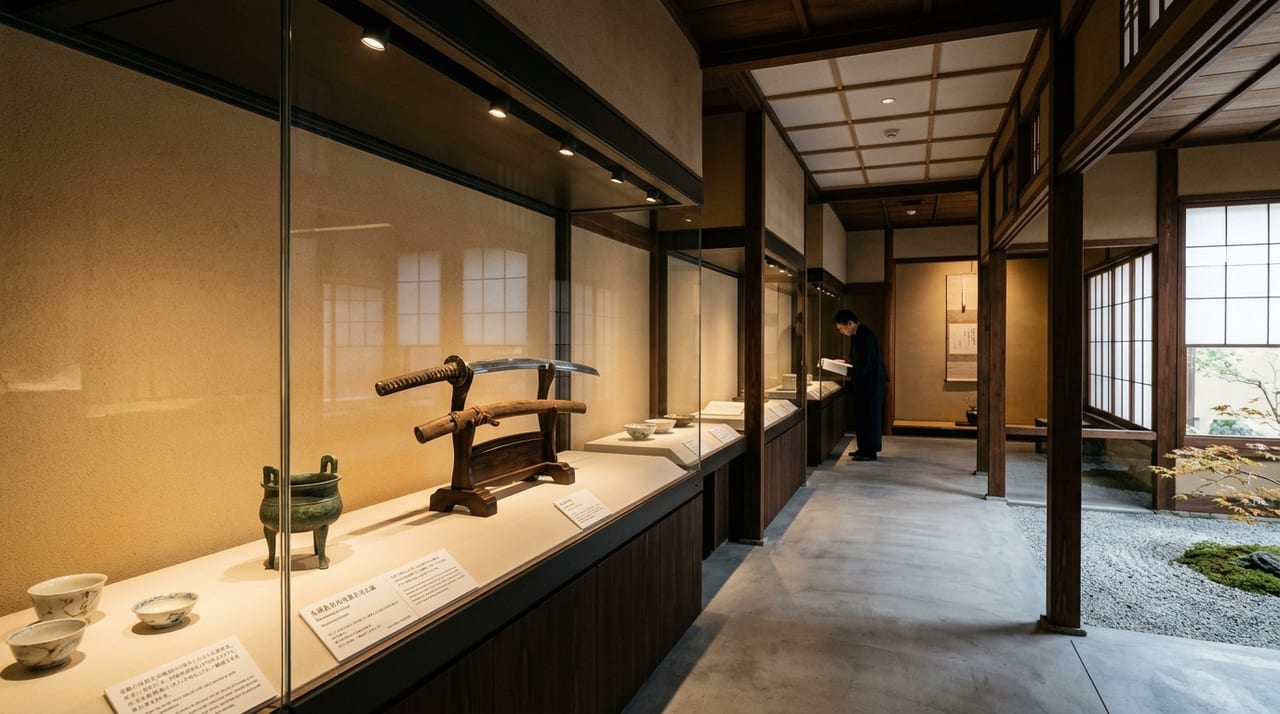
 * Image is for illustrative purposes only.
Kurokawa Institute of Ancient Cultures
黒川古文化研究所
Overview
Overview of the Research Institute
An academic institution dedicated to researching, preserving, and presenting publicly the East Asian ancient art collection assembled by the Kurokawa family over two generations. Established in 1950 (Showa 25) as a foundation, it is not merely a display facility but a research institute whose primary mission is the scholarly research of East Asian art. The collection encompasses diverse holdings including Chinese and Japanese bronzes, ceramics, calligraphy, paintings, and archaeological artifacts, with the Chinese ancient bronze collection particularly highly regarded internationally.
The Institute and Swords
The treasures of the sword collection are the National Treasure short sword inscribed "Raikusatsu" and the National Treasure short sword with red inscription "Sadamune" (the famous sword "Fushimi Sadamune"). Raikusatsu was a master craftsman representing the Yamashiro Raiku school of the Kamakura period, and the "short sword with red inscription Sadamune" is a fine work traditionally attributed to Sadamune, who perfected the Sōshū tradition, bearing the famous-sword name "Fushimi Sadamune." Both are masterpieces of short swords representative of the Yamashiro and Sōshū traditions, transmitting the finest achievements of Kamakura-period sword art to the present day.
Academic Research
As an institution dedicated to scholarly research of East Asian art, the Kurokawa Foundation for Ancient Cultures continues the investigation and research of its collection and publication of catalogues and research journals. The fine swords, including the short sword by Raikusatsu and the famous sword "Fushimi Sadamune," are carefully preserved and transmitted as objects of such scholarly investigation and preservation.
Sword Craftsperson Training
A distinctive feature of the institute is that it is open to the public only twice yearly, in spring and autumn. The collection is open to the general public only during the spring exhibition (approximately April–May) and autumn exhibition (approximately October–November); it is closed to the public at other times. This limited public access actually enhances the rarity and special character of appreciation, with art enthusiasts visiting from across the nation during exhibition periods. Since exhibition schedules vary year to year, please verify the official website before visiting.
International Exchange
The institute is situated in Kurakuen, a quiet upscale residential neighborhood of Nishinomiya City, and the surrounding environment itself becomes part of the appreciation experience. The elegant building and well-maintained gardens create a serene space befitting artworks. Although the path from Hankyū Kurakuen-guchi Station involves numerous slopes, the scenery is beautiful during cherry blossom and autumn leaf seasons, and a leisurely visit offers its own charm.
Cultural Activities
Nearby attractions include the Ōtani Memorial Art Museum, the Hakushika Sake Museum (representing Nishinomiya's sake brewery culture), and Hanshin Kōshien Stadium, making a visit in combination with cultural walks through the Nishinomiya and Ashiya areas all the more appealing.
Highlights
- National Treasure tachi signed 'Norimune' (masterpiece of Bizen Norimune)
- Research collection of East Asian antiquities
- Limited public exhibitions held twice yearly (spring and autumn)
- Viewing experience in the tranquil Kurakuen setting
* Opening hours and exhibitions are subject to change. Please check the official website before visiting.