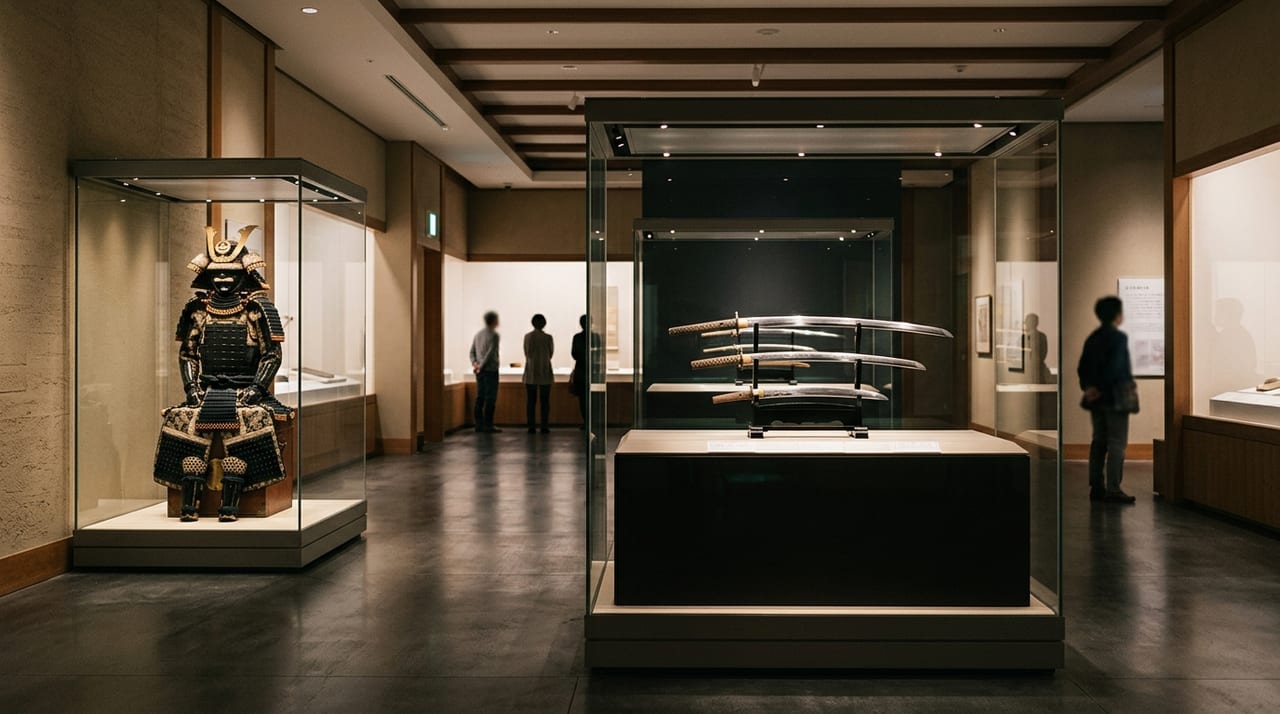
 * Image is for illustrative purposes only.
Ishikiri Tsurugiya Shrine
石切劔箭神社
Overview
Ishikiri Tsurugiya Shrine, located in Higashiosaka City, Osaka Prefecture, enshrines Nigihayahi no Mikoto and his son Umashimade no Mikoto as its principal deities. Tradition dates its founding to 659 BCE (the second year of Emperor Jinmu's reign). Known affectionately as "Ishikiri-san," the shrine is famous for its prayers for the healing of tumors and intractable diseases; the sight of devotees walking their prayer circuits (ohyakudo-mairi) throughout the day continues to this day, creating an atmosphere of living popular faith unique in the Osaka region. The shrine's treasure house holds the Important Art Object "Tachi: Ishikirumaru (signed Arinari)" — a designation recognized in 1939 — making it one of the most important sword-related shrines in the Kinki region.
Primary Sword Holding: Tachi "Ishikiri-maru (signed Arinari)"
The shrine's most celebrated treasure is the "Tachi, signed Arinari" — designated an Important Art Object (Jūyō Bijutsuhin) on February 22, 1939. Dating from the Heian period, the blade's maker "Arinari" is said to have been a student or son of Sanjō Munechika (the master swordsmith who forged the National Treasure Mikazuki Munechika).
Physical Characteristics — The blade is notably long at 76 cm, with a deep "Kyō-zori" curvature (2.6 cm). Its fine, dense jigane (surface steel) and elegant suguha (straight) hamon are characteristic of the Sanjō school — "a sword that combines power and elegance." The name "Ishikiri-maru" (Stone-Cutting Circle) derives from its legendary spiritual power to cut through stone.
Viewing — Ishikiri-maru is displayed in the treasure house on specific dates only. The treasure house opens during the Spring Festival (April 15–16), Summer Festival (August 3–4), Autumn Festival (October 21–22), and on the second Sunday of each month from September through December. Admission is free; hours are 9:00–16:00. The display features three swords side by side — the original Ishikiri-maru, a restoration replica, and a shadow replica — allowing direct comparison of jigane and hamon.
Touken Ranbu Connection
The popular game Touken Ranbu (Sword and Blossoms) features "Ishikiri-maru" as a sword character, reflecting its nature as a shrine's sacred sword guardian. Since the game's release, the shrine has experienced a marked increase in visits from sword enthusiasts, and the game's community has shown support for the shrine's restoration project for the blade.
Approach and Highlights
The 350-meter shopping street connecting Shin-Ishikiri Station to the main shrine building retains the atmosphere of a traditional Osaka neighborhood, lined with pharmacies, restaurants, and souvenir shops. The constant presence of ohyakudo-mairi practitioners throughout the day makes the precinct a living religious space unlike any other in the Kinki region.
Access
Approx. 7 min walk from Shin-Ishikiri Station (Kintetsu Keihanna Line). Approx. 15 min walk from Ishikiri Station (Kintetsu Nara Line). Precinct open at all times, free of charge. Votive counter open 8:00–16:30.
Highlights
- Important Art Object 'Ishikiri-maru (Arinari)' — Heian-period tachi by Munechika's student; displayed alongside restoration and shadow replicas for direct comparison
- Treasure house open on specific dates — free admission at Spring/Summer/Autumn festivals (Apr 15–16, Aug 3–4, Oct 21–22) and second Sundays Sept–Dec, 9:00–16:00
- Pilgrimage site for Touken Ranbu 'Ishikiri-maru' — the source shrine of the game's character, drawing sword fans to one of Osaka's most distinctive sacred spaces
- Lineage of Sanjō Munechika — Arinari, maker of Ishikiri-maru, was a disciple of Munechika (forger of National Treasure Mikazuki Munechika); a rare example of the Sanjō school in Osaka
- Living popular faith: ohyakudo-mairi and the approach street — daily prayer circuits and a 350m traditional shopping street make this unlike any other nihonto pilgrimage site
* Opening hours and exhibitions are subject to change. Please check the official website before visiting.