 * Image is for illustrative purposes only.
Sen-oku Hakukokan (Sumitomo Collection)
泉屋博古館(住友コレクション)
Overview
Overview of the Izutsu Museum and the Sumitomo Collection
The Izutsu Museum is a museum situated in the quiet confines of Shishigatani (鹿ヶ谷), Sakyo Ward, Kyoto, where it displays the finest examples of Oriental art collected by the Sumitomo family, which has led Japan's economy and culture from the Edo period into the modern era. "Izutsu" (泉屋) is the trade name of the Sumitomo family, and "Hakukokan" (博古館) is a Chinese term referring to a facility for collecting ancient vessels and artifacts. Founded in 1960 (Showa 35), its collection of approximately 3,400 pieces—encompassing ancient Chinese bronzes, Japanese calligraphy and painting, ceramics, tea ceremony utensils, and sword fittings—is highly regarded academically as one of Japan's preeminent private collections.
Sword Fittings Collection
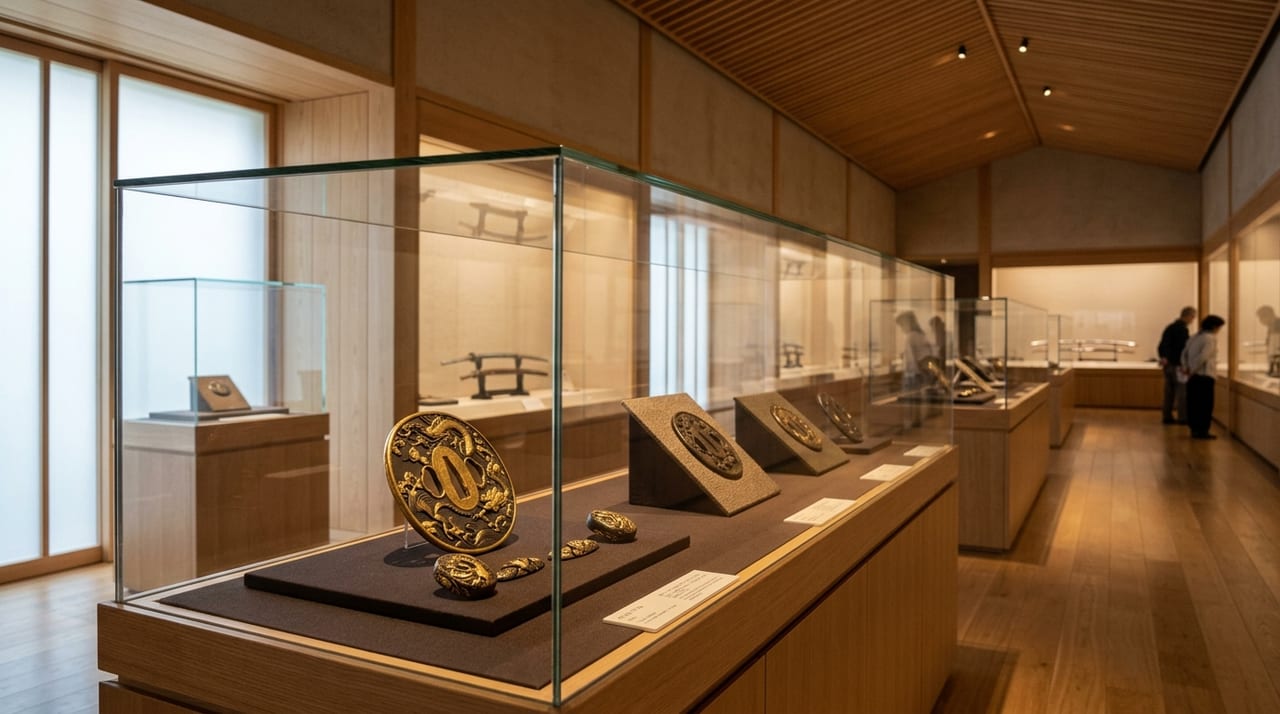
The heart of the Izutsu Museum's sword and armor-related collection consists of the refined sword fittings (kodogu) gathered by successive Sumitomo family heads. During the Edo period, among the upper merchant houses and daimyo families, the beauty of a sword's "koshirae"—that is, its outer fittings—was valued as a reflection of the warrior class's education and aesthetic sensibility, and the Sumitomo family was no exception. Sword-fitting accessories such as tsuba (guard), fuchi-kashira (pommel and ferrule), menuki (hilt ornaments), kozuka (small blade), and kogai (hairpin-shaped tool) were works of art crafted from metal materials including gold, silver, red copper, and shibuichi (copper-silver alloy), upon which were worked precise chasing, inlay, and nunome-zogan (textile-pattern inlay). They can be appreciated as pure metalwork art independent of the blades themselves.
Ancient Chinese Bronzes and Weapon Culture
The reason the Izutsu Museum is recognized as a globally special institution lies in its collection of ancient Chinese bronzes. Approximately 600 bronze vessels spanning the Shang, Western Zhou, Spring and Autumn, Warring States, and Han dynasties are internationally acclaimed as Japan's largest collection of ancient Chinese bronzes, and the collection includes masterpieces designated as Important Cultural Properties and Important Art Objects. The collection also includes weapon-form bronzes from ancient China such as ge (halberd-axe), mao (spear), jian (sword), and ji (halberd-lance), and serves as invaluable material for studying the influence continental weapon culture exerted on Japanese blade culture. Ancient Chinese bronze-casting technique can be said to be one of the distant sources of Japanese sword-smithing technique.
Display Environment and Surrounding Tourism
The museum is situated in a quiet location within walking distance of the Philosopher's Path and is in proximity to renowned temples and shrines in the Higashiyama and Okazaki areas of Kyoto, including Nanzen-ji, Eikando, and Ginkaku-ji. Special exhibitions held seasonally present diverse aspects of the Sumitomo Collection, and displays featuring sword fittings and metalwork are especially well received by sword enthusiasts. Additionally, the Izutsu Museum Tokyo Branch is located in Roppongi, Tokyo, where a portion of the Sumitomo Collection is displayed. A day spent immersed in the world of decorative and applied arts crystallized through the aesthetic sensibility of the Sumitomo zaibatsu, in the serene Japanese atmosphere of the Kyoto main museum, is one of the finest opportunities to appreciate the depth of Japanese culture.
Highlights
- Sumitomo collection of Edo-period sword fittings: tsuba, fuchi-kashira, menuki
- Japan's largest Chinese ancient bronze collection (~180 pieces, Shang to Han)
- Ancient Chinese bronze weapons illuminating continental blade culture origins
- Important Cultural Property and Important Art Object designated pieces
* Opening hours and exhibitions are subject to change. Please check the official website before visiting.