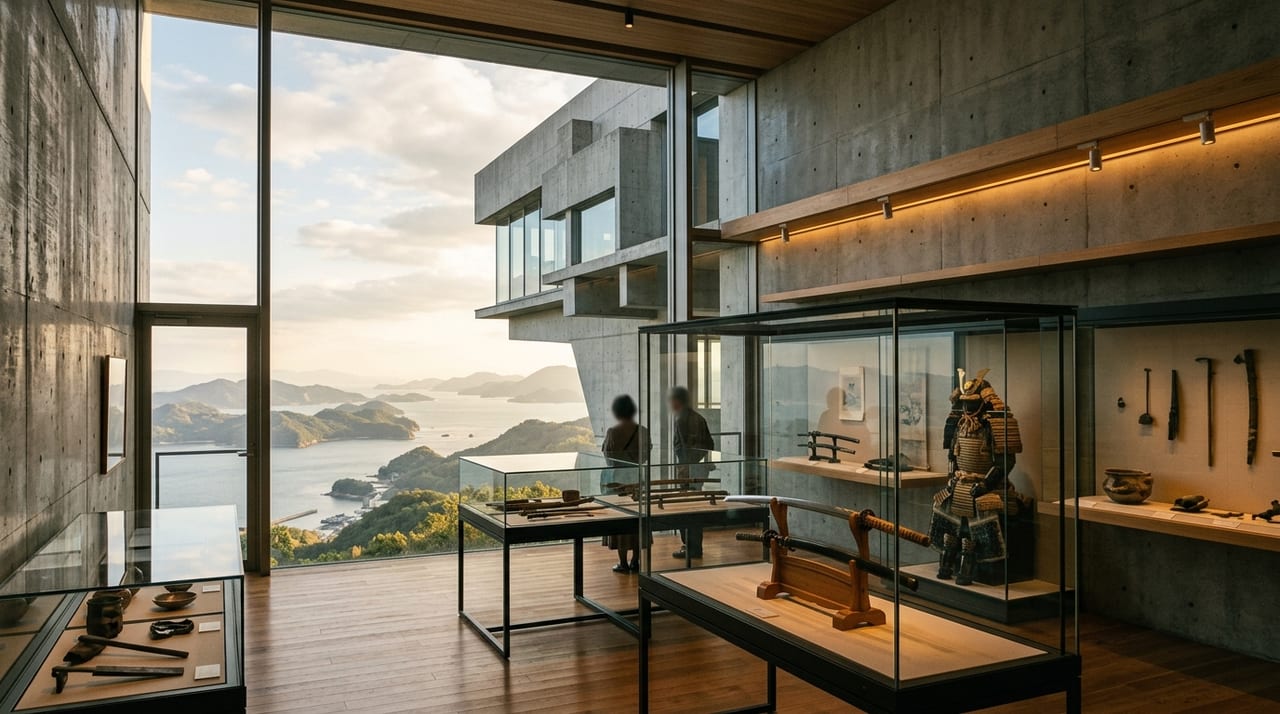
 * Image is for illustrative purposes only.
Kurama Temple Treasures Hall
鞍馬寺霊宝殿
Overview
Kurama Temple is a mountain temple located on the slopes of Mount Kurama in Sakyō Ward, Kyoto City. According to tradition, it was founded in 770 when Ganjō, a principal disciple of Ganjin, enshrined a statue of Bishamonten at this site. The Treasures Hall (Reihoǔden), an annex to the main temple's Golden Hall, is a three-story exhibition facility that systematically displays Buddhist statues, paintings, and decorative arts transmitted through Kurama Temple.
From a sword enthusiast's perspective, the most significant piece is the Important Cultural Property "Black Lacquered Sword" (Kuro-urushi-ken)—76.6 cm in total length, unsigned, dating to the Nara to early Heian period. According to tradition, it was donated by Sakanoue no Tamuramaro, a military commander who used Mount Kurama as his base and devoted himself to subduing the Emishi of northeastern Japan. The blade displays the straightforward form characteristic of ancient forging techniques, with its original black lacquered fittings preserved. While no documented historical record confirms Tamuramaro's donation—and later attributions may contain embellishments—its dating to the Nara to early Heian period is well-established. It is designated as an Important Cultural Property as a rare artifact attesting to the veneration of Heian-period warriors.
The first floor of the Treasures Hall features displays of nature and animals; the second floor houses the Temple Treasures Exhibition Room and the Yosano Memorial Room; the third floor enshrines Buddhist statues, including the National Treasure triad of Bishamonten and his two attendants. Entry to the Kurama Temple precinct requires a mountain admission fee. To reach the main temple and Treasures Hall, take the cable car (¥200 one way, 2 minutes) from the Niō Gate followed by a 10-minute walk, or hike approximately 30 minutes via the mountain trail. The Treasures Hall is closed on Tuesdays (or the following weekday if Tuesday falls on a holiday) and from December 12 through the end of February. For winter visits, verify the Treasures Hall's opening status on the official website in advance.
Highlights
- Important Cultural Property 'Black Lacquered Sword' — a rare ancient blade from the Nara to early Heian period with tradition attributing its donation to Sakanoue no Tamuramaro
- Sacred mountain and warrior faith — traces of devotion by the Heian warrior Tamuramaro, who used Mount Kurama as his military base
- Three-story Treasures Hall — comprehensive display of Buddhist art related to Bishamonten, sculptural works, and natural history exhibits
- Closed December through February — confirmation of opening hours on the official website is essential before winter visits
- 5 minutes on foot from Kurama Station on the Eizan Electric Railway — access to the main temple by cable car or mountain trail
* Opening hours and exhibitions are subject to change. Please check the official website before visiting.