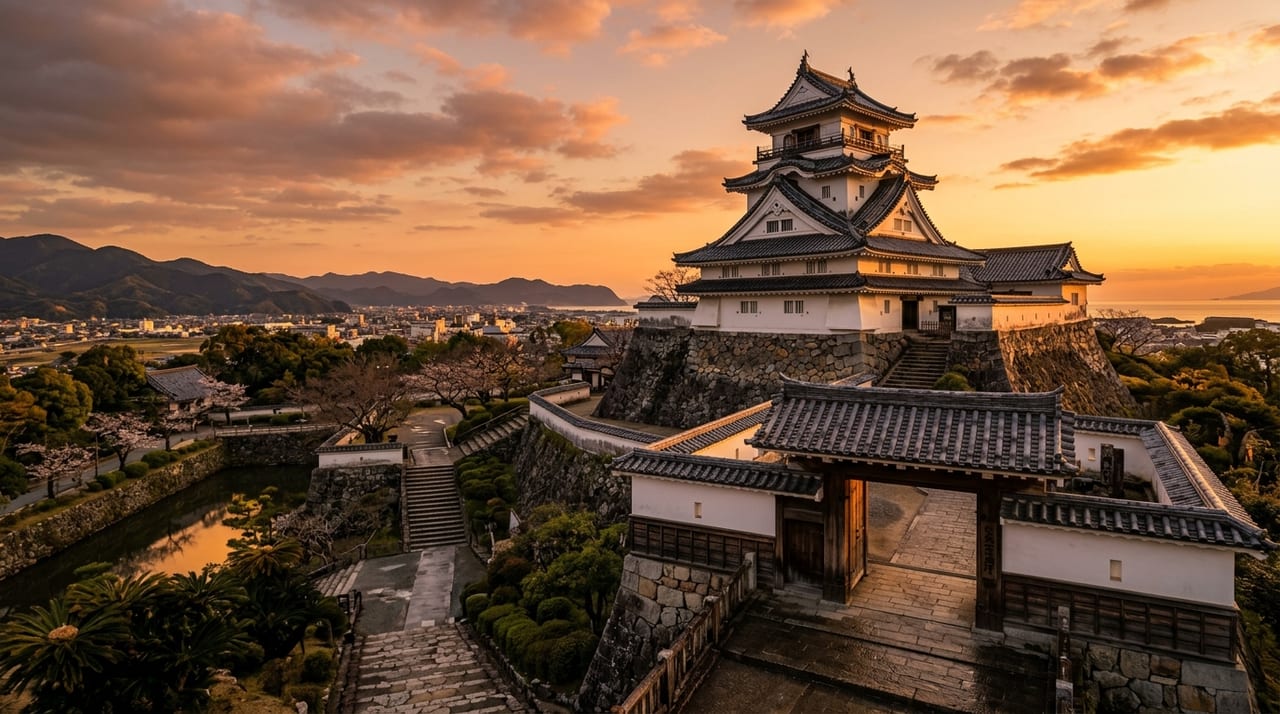
 * Image is for illustrative purposes only.
Kōchi Castle
高知城
Kōchi Castle is a historic castle in the Shikoku region (Built in 1601 (Keichō 6)). Its lord was Yamauchi Kazutoyo / Yamauchi clan.
Overview
About the Castle
Kōchi Castle is a renowned castle of the Nankai region. Yamauchi Kazutoyo began construction in Keichō 6 (1601), after receiving Tosa Province, 240,000 koku, for his merit in the Battle of Sekigahara, and it was completed in Keichō 16 (1611). It is the only castle in Japan where both the main keep (tenshu) and the Honmaru palace (Kaitokukan) survive, which makes it extremely valuable in the history of castle architecture. Yamauchi Kazutoyo was a seasoned warrior who served Oda Nobunaga and Toyotomi Hideyoshi. The anecdote of his wife Chiyo offering the money to buy a famous horse is widely known as the epitome of naijo no kō (inner support). In the Battle of Sekigahara he sided with the Eastern Army and, in a decisive move, handed Kakegawa Castle over to Ieyasu. In the postwar distribution of rewards he received all of Tosa Province.
Architecture and Structure
After the great fire of Kyōhō 12 (1727) destroyed the main keep and most of the castle interior, the present main keep was rebuilt in Kan'en 2 (1749). It preserves the graceful form of the bōrō-gata (watchtower-type) keep. The top floor of the main keep has an open wraparound gallery with railings on all four sides, from which one can view the Kōchi Plain, the Pacific Ocean, and the mountain ranges of the Shikoku mountains. The beautiful composition that allows the Ōtemon gate and the main keep to be captured in a single photograph is one of the most famous angles in Japanese castle photography. In the late Edo period, Tosa produced many patriots (shishi) and politicians, including Sakamoto Ryōma, Nakaoka Shintarō, Takechi Hanpeita, and Itagaki Taisuke. It was the epicenter of the Restoration (ishin no shingen), and Kōchi Castle is located at the center of that historical stage.
Development of the Castle Town
The Yamauchi family, though tozama daimyō, maintained a major domain of 240,000 koku until the end of the Edo period. Under a distinctive status system of upper samurai (jōshi) and country samurai (gōshi), they upheld a domain character that prized the martial arts. This strict status system was the background to the formation of the Tosa Loyalist Party in the late Edo period, and it was a driving force in advancing Japan's modernization. The Nichiyō-ichi (Sunday market) in the castle town is a street market with a tradition of about 300 years, where one can experience Kōchi's food culture and the vitality of ordinary people. Kōchi Castle stands in the bright southern sunlight and embodies the free and open spirit of Tosa. The Tosa temperaments of igossō (stubborn person) and hachikin (spirited, strong-willed woman) were the source of the action of the patriots of the late Edo period.
The Spirit of Bushidō
Kōchi is also widely known for the Yosakoi festival, and every August the castle town is wrapped in the passion of its dancers. The free and open spirit of Tosa and its martial spirit also connect to the energy of the festival. The stone walls of Kōchi Castle have drainage facilities called ishidoi (stone drains), which show ingenuity that responds to the heavy rainfall characteristic of the southern region.
Connection to Swords
Tosa Province was home to its own swordsmith groups, and Tosa blades, rugged yet practical and sturdy in character, were beloved by warriors. Although the Yamauchi family were tozama daimyō, they governed a major domain of 240,000 koku and upheld a domain character that placed importance on martial arts under a strict status system of jōshi (upper samurai) and gōshi (country samurai). For domain retainers, the sword was part of everyday life. In the late Edo period, the Tosa Domain produced many men of purpose, including Sakamoto Ryōma, Nakaoka Shintarō, and Takechi Hanpeita, and the swords they wore have drawn great attention historically. Among them, the blade said to have been favored by Sakamoto Ryōma, "Mutsu no Kami Yoshiyuki," is a famous sword representative of Tosa. Mutsu no Kami Yoshiyuki was a swordsmith of the Tosa Domain, and his work is said to have been present with Ryōma at the scene of the Ōmiya Incident. The tradition that Ryōma fought back with this sword at the time of his assassination is one of the most dramatic sword episodes in late Edo period history. Takechi Hanpeita led the Tosa Kinnō-tō as its leader and led the sonnō jōi movement, and his sword, too, draws attention as a historical relic embodying the spirit of men of purpose. The Kōchi Castle Museum of History (adjacent to Kōchi Castle) holds about 67,000 items handed down from the Yamauchi family, through which one can deeply understand the culture of martial and political affairs in Tosa via swords, armor, and historical documents. The sword culture of Tosa reflects the very temperament of the Tosa people, forged by the rough Pacific waves, and that spirit continues to flow through present-day Kōchi. It is well known that Ryōma is said to have declared, "Protect the country not with swords but with international law." This did not deny the value of the sword; it was a philosophy that sought to elevate the spirit of the samurai that the sword symbolizes into a new age. Tosa is also known for its bold food culture, typified by katsuo no tataki, and the "spirit of freedom" nurtured by its open climate facing the Pacific also bore fruit in Itagaki Taisuke's Freedom and People's Rights Movement.
Highlights
- Surviving tower and main palace (only castle in Japan with both)
- Beautiful composition of main gate and tower
- Kōchi Castle Museum of History (Yamauchi clan swords)
- Statue of Itagaki Taisuke
- Sunday Market (street market on Ōtesuji)
- Sakamoto Ryōma Memorial Hall (Katsurahama)
* Opening hours and admission fees are subject to change. Please check the official website before visiting.